30 Minimalist Bathroom Ideas for a Calm, Clutter-Free Retreat

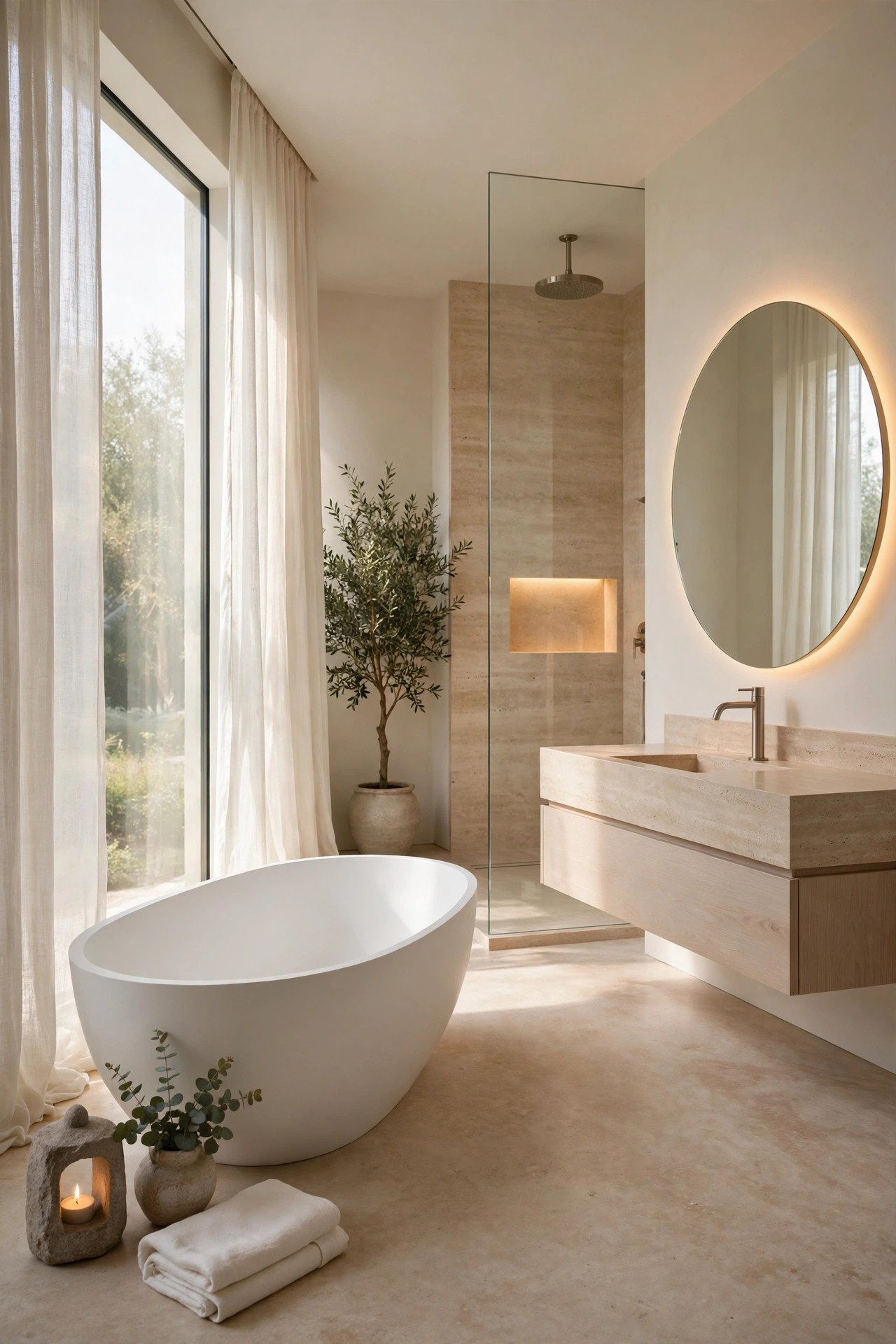
Minimalism in the bathroom is not about empty rooms or cold sterility; it is about clarity, intention, and the quiet luxury of having exactly what you need and nothing you do not. A minimalist bathroom calms the mind from the moment you step inside, with clean lines, uncluttered surfaces, and a restrained palette that turns daily routines into small rituals. Because bathrooms are often the smallest rooms in the home, they benefit enormously from this approach: fewer visual interruptions make tight spaces feel open, airy, and surprisingly generous. The style also happens to be practical, since smooth surfaces and hidden storage make cleaning faster and everyday use more effortless.
This collection of thirty ideas shows you how to achieve minimalist calm at every scale and budget. You will find guidance on floating vanities, frameless showers, concealed storage, and seamless materials, along with concrete suggestions for finishes, fixtures, and lighting that keep the look warm rather than stark. Each idea pairs design inspiration with actionable detail, so you can plan a full remodel or simply edit what you already have into something more serene. Minimalism is a discipline of thoughtful choices, and these thirty ideas will help you make every one of them beautifully.
1. Floating Minimalist Vanity
A floating vanity is the cornerstone of minimalist bathroom design, lifting the cabinet off the floor to create an unbroken sweep of tile beneath it. The visible floor space tricks the eye into reading the room as larger, while the clean horizontal line of the cabinet establishes the calm geometry minimalism depends on. It is a single move that transforms the whole room.
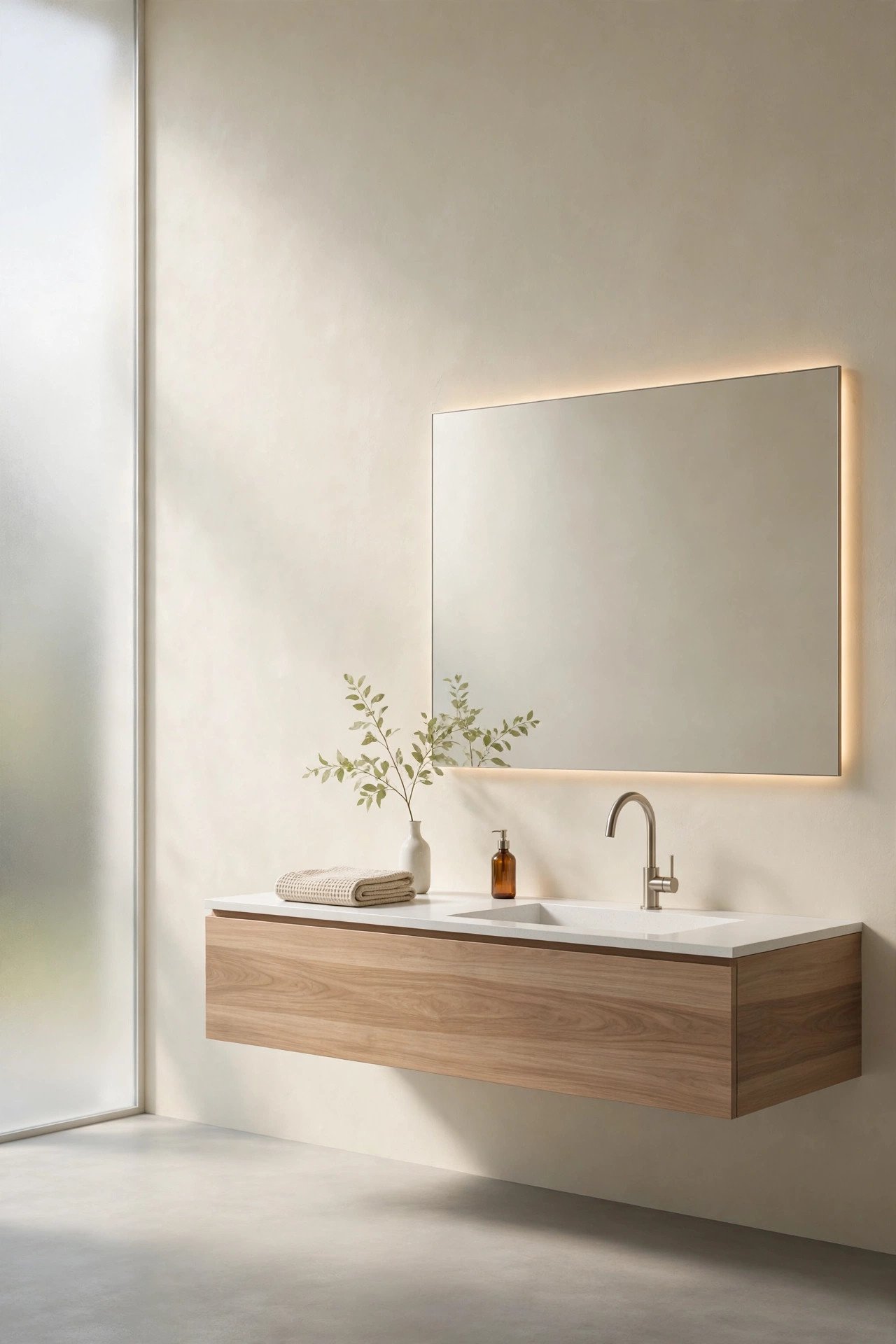
Choose a simple slab-front vanity in matte white, pale oak, or soft gray lacquer, and keep the depth modest so the cabinet feels light rather than bulky. Wall-mounted installation hides plumbing inside the wall or a slim trap cover, eliminating the visual noise of exposed pipes. Soft-close drawers keep the daily experience as quiet as the look.
Pair the floating vanity with a vessel-free integrated sink or a slim undermount basin so the countertop stays one continuous plane. A single wall-mounted faucet in chrome or matte black reinforces the streamlined composition. Resist open shelving here; closed drawers with organizers hide every toiletry and keep surfaces pristine.
Add a slim LED strip beneath the cabinet for a gentle floating glow that doubles as nighttime lighting. The effect is subtle by day and magical by night. A floating vanity proves that minimalism is not about having less storage, but about designing storage so well that you never see it.
2. Monochrome White Palette
An all-white minimalist bathroom feels like a deep breath: crisp, luminous, and endlessly calming. White reflects every bit of available light, making even windowless bathrooms feel bright and open. The monochrome approach removes color decisions entirely, letting form, texture, and light carry the design. It is minimalism in its purest expression.
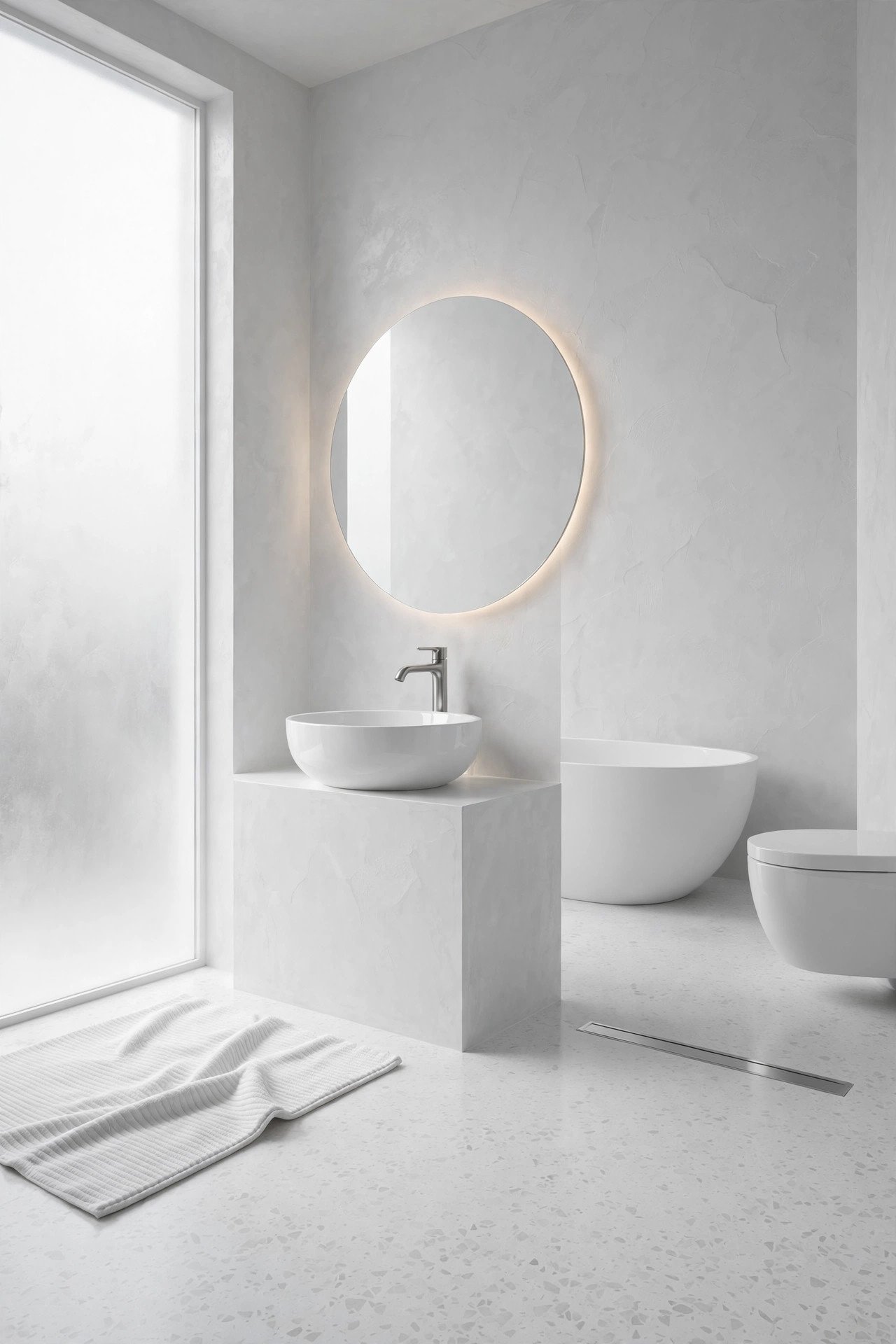
The secret to keeping all-white from feeling flat is layering subtle texture. Combine matte wall tile with a honed stone floor, a ribbed glass shower panel, and soft white textiles. Each surface catches light differently, creating depth without introducing a single competing color. Warm whites with a hint of cream feel softer than stark blue-whites.
Keep fixtures equally quiet: a wall-hung white toilet, a simple rectangular mirror, and slim chrome or brushed nickel fittings disappear into the palette. One natural accent, like a light oak stool or a single green stem in a clear vase, prevents sterility while respecting the monochrome discipline. Restraint is the whole point.
Maintenance rewards the palette choice, since white surfaces show exactly what needs cleaning and nothing hides. Choose grout in bright white or light gray and seal it well. A monochrome white bathroom is timeless, resale-friendly, and the perfect blank canvas for a minimalist life.


3. Hidden Storage Solutions
Minimalism lives or dies on storage, because clutter is the enemy of calm. Hidden storage keeps every bottle, brush, and towel out of sight while keeping them within easy reach. Recessed medicine cabinets, deep vanity drawers with dividers, and niches carved into shower walls all serve the same goal: a bathroom that looks empty but works hard.
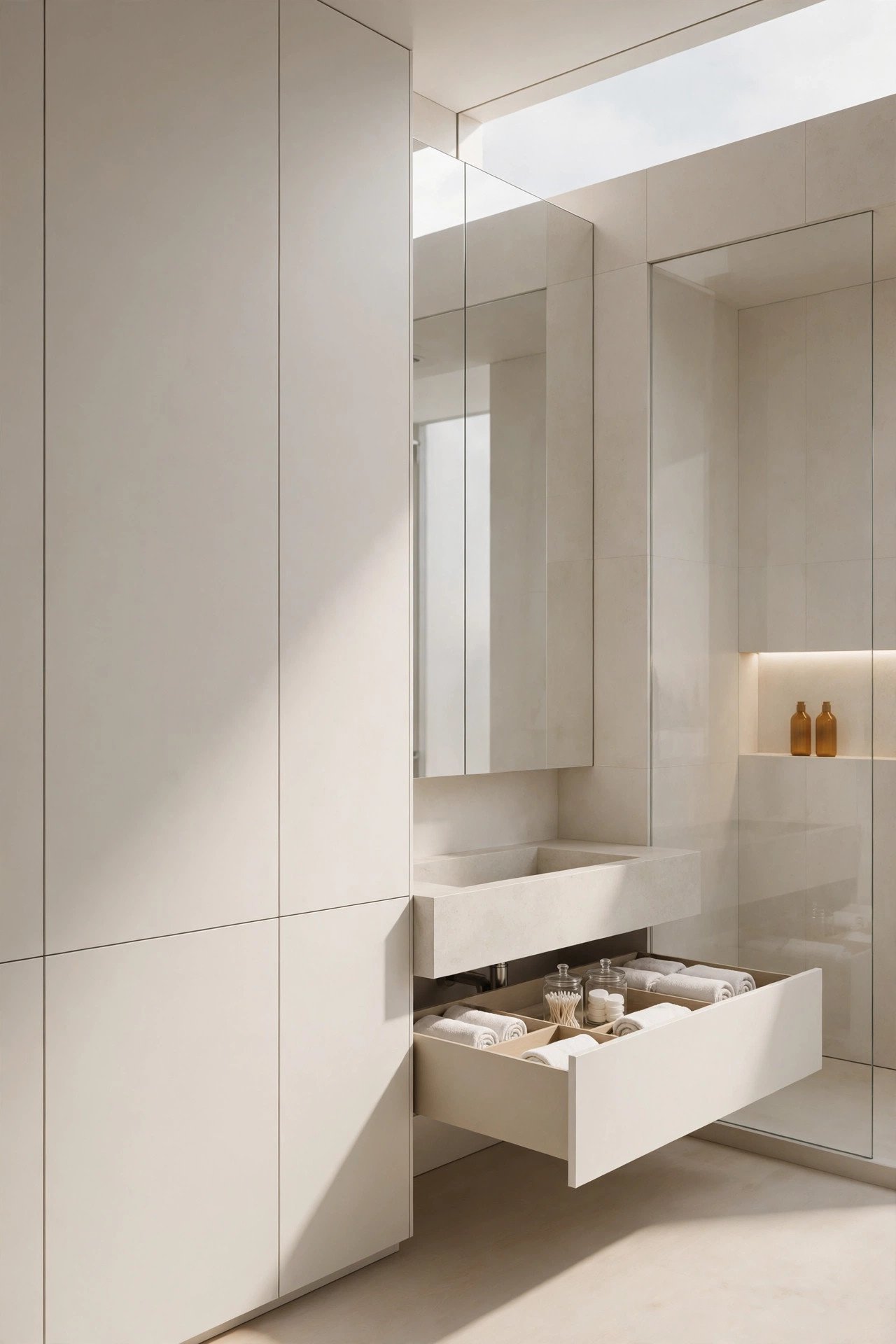
Plan storage around your real routines. Tall, narrow pull-out cabinets beside the vanity swallow cleaning supplies and spare toilet paper. A mirrored cabinet recessed between studs offers generous depth without protruding into the room. Inside drawers, use simple organizers so small items stay sorted and the drawer closes cleanly every time.
Think vertically and invisibly: a full-height cabinet with push-to-open doors can hide laundry, linens, and bulk supplies behind a seamless front. Toe-kick drawers under a floating vanity capture dead space. The best minimalist storage is storage you forget exists until the moment you need it.
Edit ruthlessly before you organize. Minimalist storage works only when every item inside earns its place, so discard expired products and duplicates first. Then assign each remaining item a home and return it there daily. Hidden storage plus disciplined editing equals the serene, empty-counter look minimalism promises.
4. Frameless Glass Shower
A frameless glass shower dissolves visual barriers, letting the eye travel uninterrupted across the bathroom and making the whole room feel twice as large. Without bulky frames or frosted doors chopping up sightlines, the tile work becomes a continuous canvas. It is the single most transformative upgrade for a minimalist bathroom.
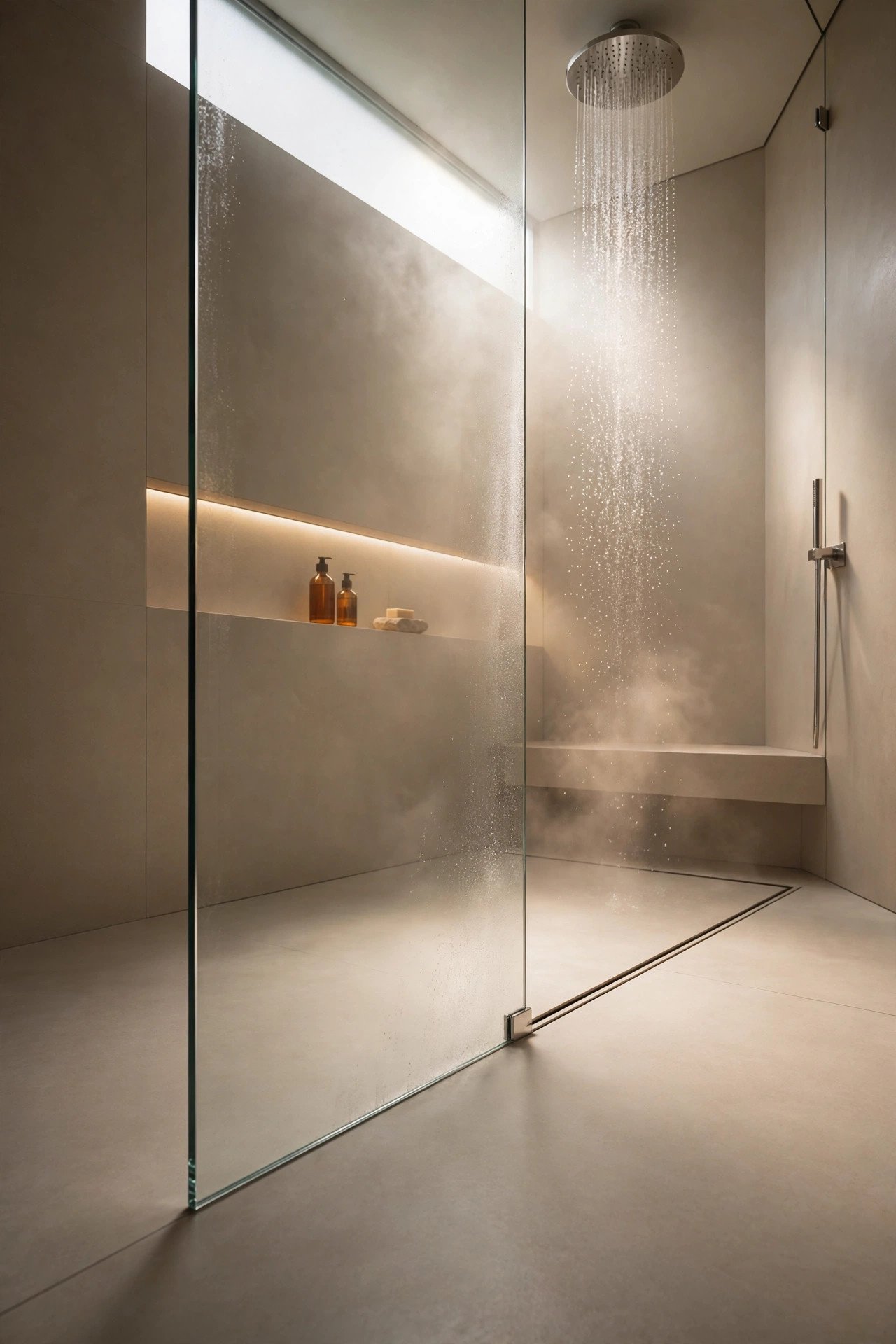
Specify thick tempered glass, typically ten to twelve millimeters, with minimal hardware in a quiet finish like polished chrome or matte black. A single fixed panel with an open entry is the cleanest configuration, eliminating doors, tracks, and seals that collect grime. Keep the glass as large as the space allows for maximum openness.
Inside the shower, continue the same tile from the bathroom walls and floor so the enclosure reads as part of the room rather than a separate box. A recessed niche and a linear drain keep the interior equally streamlined. A rainfall showerhead mounted flush to the ceiling completes the architectural feel.
Maintain the clarity with a daily squeegee habit and a water-repellent glass treatment applied every few months. Spotless glass is essential, since smudges are the only visual noise in an otherwise pristine composition. A frameless shower is minimalism made visible: nothing between you and beautiful space.
5. Wall Hung Toilet
A wall-hung toilet is a minimalist essential, floating above the floor with its tank and plumbing concealed inside the wall. The result is a sculptural, almost weightless fixture that makes cleaning the floor effortless and the room feel noticeably larger. Few changes deliver so much calm for so little visual effort.
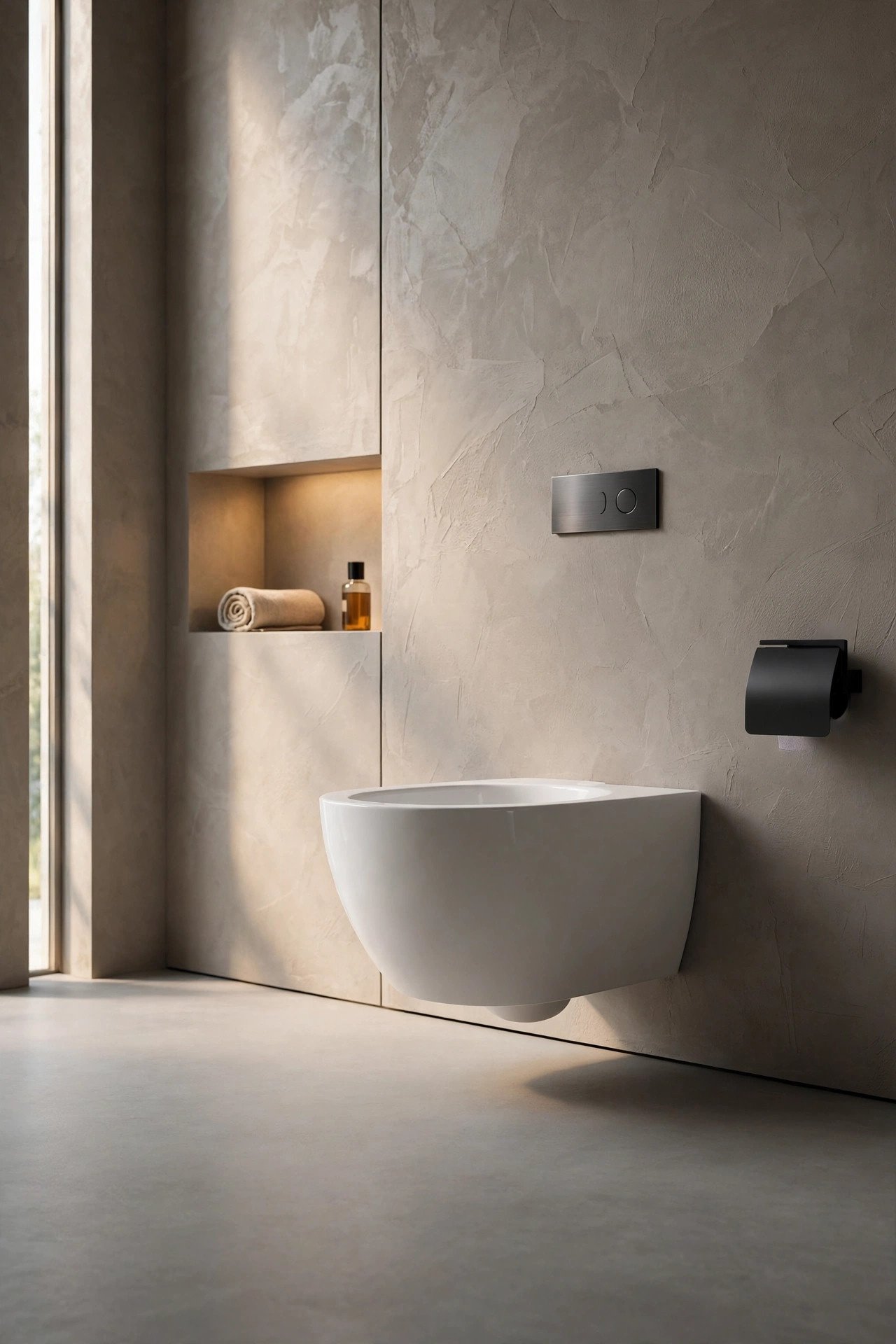
The concealed cistern sits within a sturdy in-wall carrier frame, which your contractor installs during rough-in. Choose a rimless bowl design for a cleaner silhouette and easier cleaning. A soft-close seat in matching white completes the quiet composition, and a slim flush plate in chrome or matte black is the only visible control.
Because the floor beneath stays completely clear, mopping takes seconds and dust has nowhere to gather. The floating form also reveals more floor tile, reinforcing the spacious feeling that minimalism seeks. Adjust the mounting height slightly during installation for personalized comfort.
Wall-hung toilets suit any minimalist palette, from all-white to warm concrete tones. Pair with a simple wall-mounted flush plate and keep the surrounding wall free of decoration. This is functional minimalism at its best: advanced engineering hidden away so that all you experience is serene simplicity.
6. Warm Wood Accents
Minimalism does not have to feel cold, and warm wood is the fastest way to add soul to a restrained bathroom. A single oak vanity, a teak bath mat, or a walnut-framed mirror introduces organic warmth that softens white tile and concrete without adding visual clutter. Wood brings nature indoors in the quietest possible way.
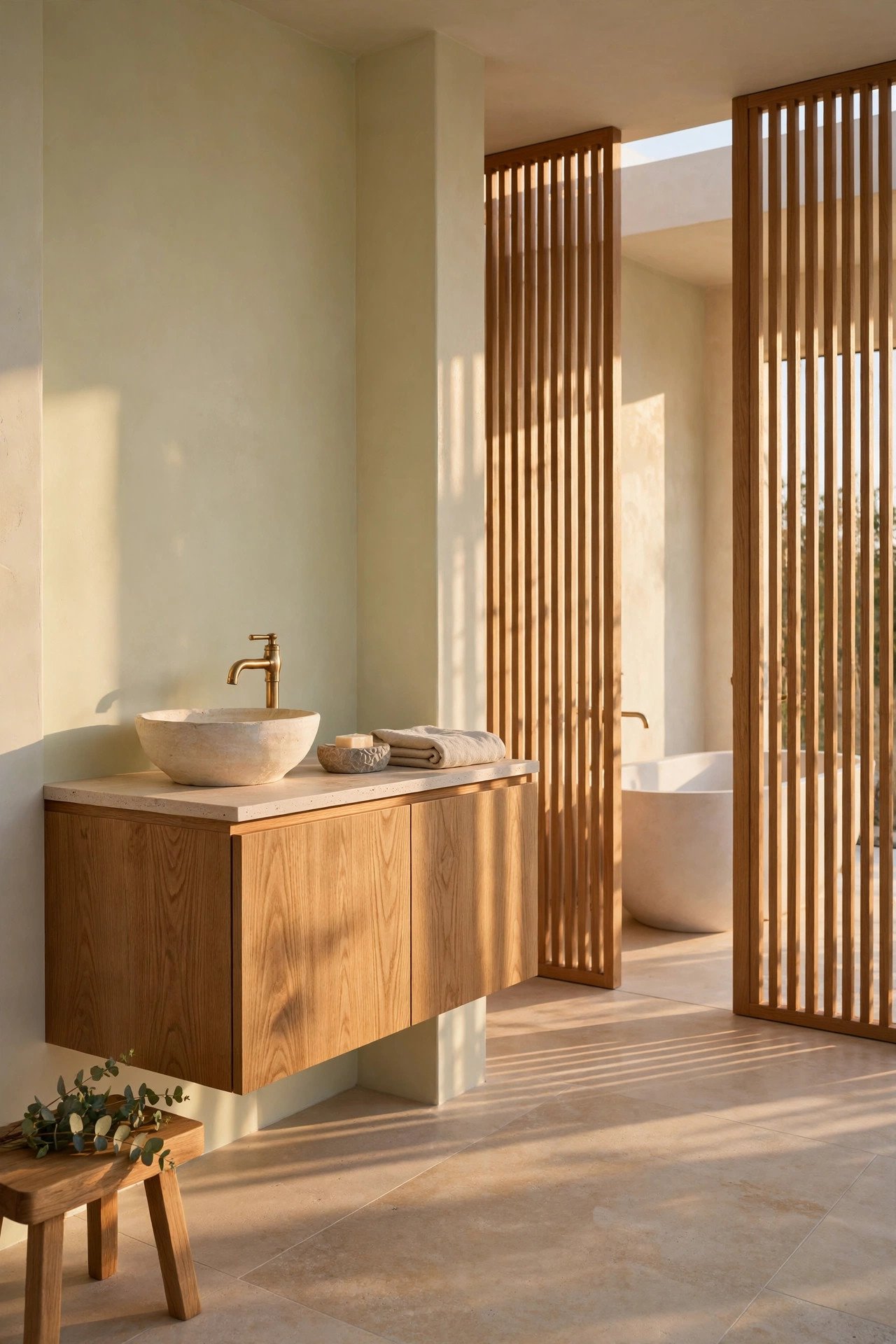
Choose one wood tone and repeat it sparingly for cohesion: light oak or ash keeps the palette airy, while teak and walnut add richer contrast. Limit wood to two or three elements, such as the vanity, a stool, and a small tray, so it reads as an intentional accent rather than a competing material story.
In wet areas, select moisture-tolerant species or properly sealed finishes. Teak naturally resists humidity, making it ideal for shower benches and bath mats. Elsewhere, a marine-grade sealant protects oak vanities from splashes. Properly finished wood ages gracefully, developing a patina that deepens the minimalist warmth over time.
Balance wood with cool, smooth companions: white walls, a stone basin, and chrome fixtures let the wood grain shine as the textural hero. Keep accessories minimal so the natural material gets the spotlight. Warm wood proves that minimalist bathrooms can feel cozy, human, and deeply inviting.
7. Concrete Microcement Walls
Microcement walls give a minimalist bathroom a seamless, plaster-like skin with no grout lines to interrupt the eye. The hand-troweled surface has gentle tonal movement that adds depth while remaining firmly neutral. It is the material equivalent of a deep exhale: calm, continuous, and quietly artisanal.
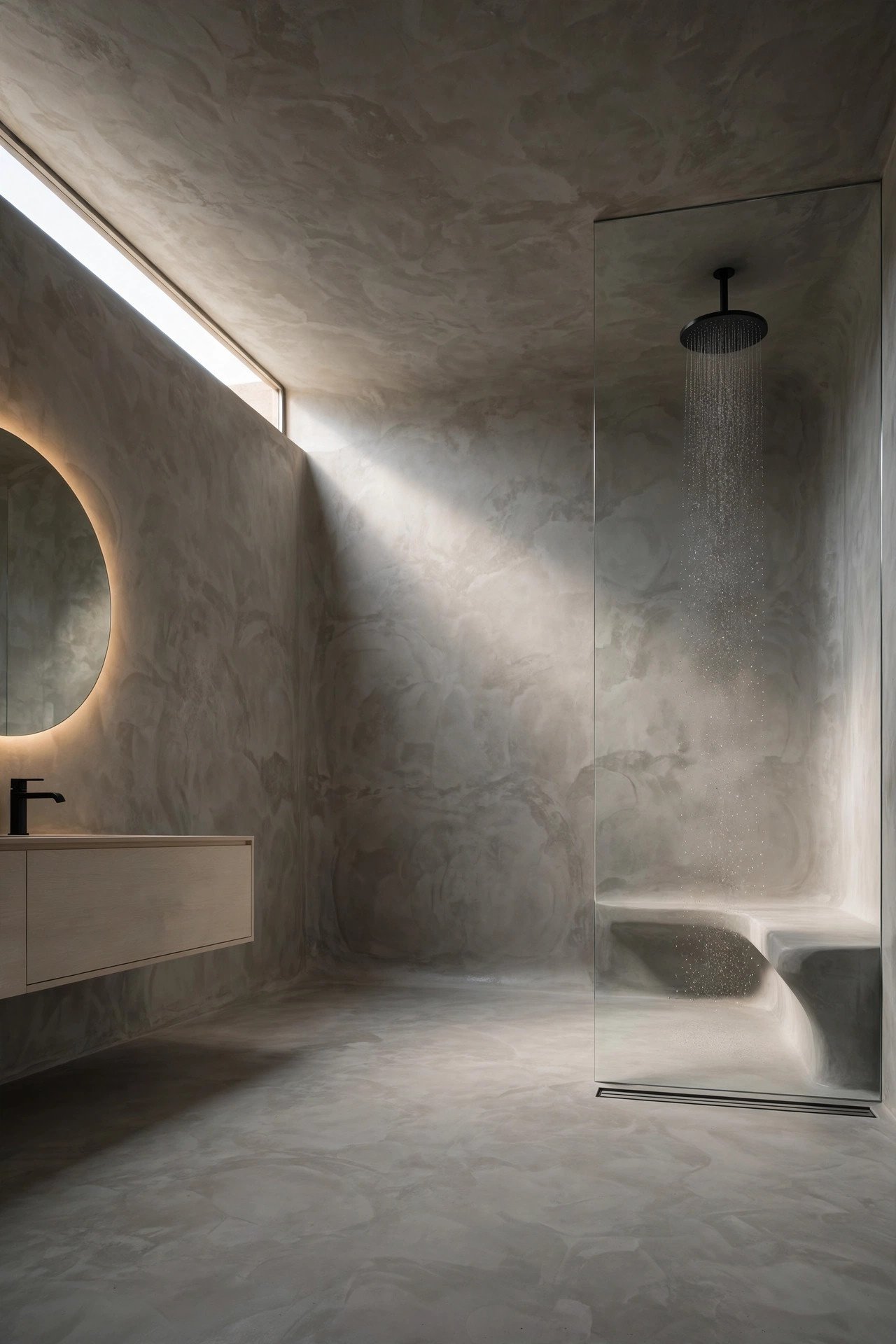
Applied in thin layers over existing tile or plasterboard, microcement suits both renovations and new builds. Choose soft gray, warm greige, or pale concrete tones that sit comfortably in a minimalist palette. A matte sealer keeps the finish velvety and waterproof, suitable even for shower enclosures when installed correctly.
Pair microcement with simple, sculptural fixtures that respect the beautiful surface: a wall-hung toilet, a floating vanity, and frameless glass keep the focus on the walls. Matte black or brushed steel fittings add crisp definition against the soft plaster texture without introducing visual noise.
The absence of grout lines makes small bathrooms feel significantly larger and makes cleaning remarkably simple. Work with an experienced applicator, since the artisanal finish depends on skilled hands. Microcement turns walls into a single calm canvas, which is exactly what minimalism asks of every surface.
8. Backlit Round Mirror
A round mirror softens the hard geometry of a minimalist bathroom, introducing a gentle curve that feels calm and welcoming. When backlit, it casts a halo of warm light onto the wall behind, turning a functional object into ambient art. The circle becomes a quiet focal point that needs no frame and no decoration.
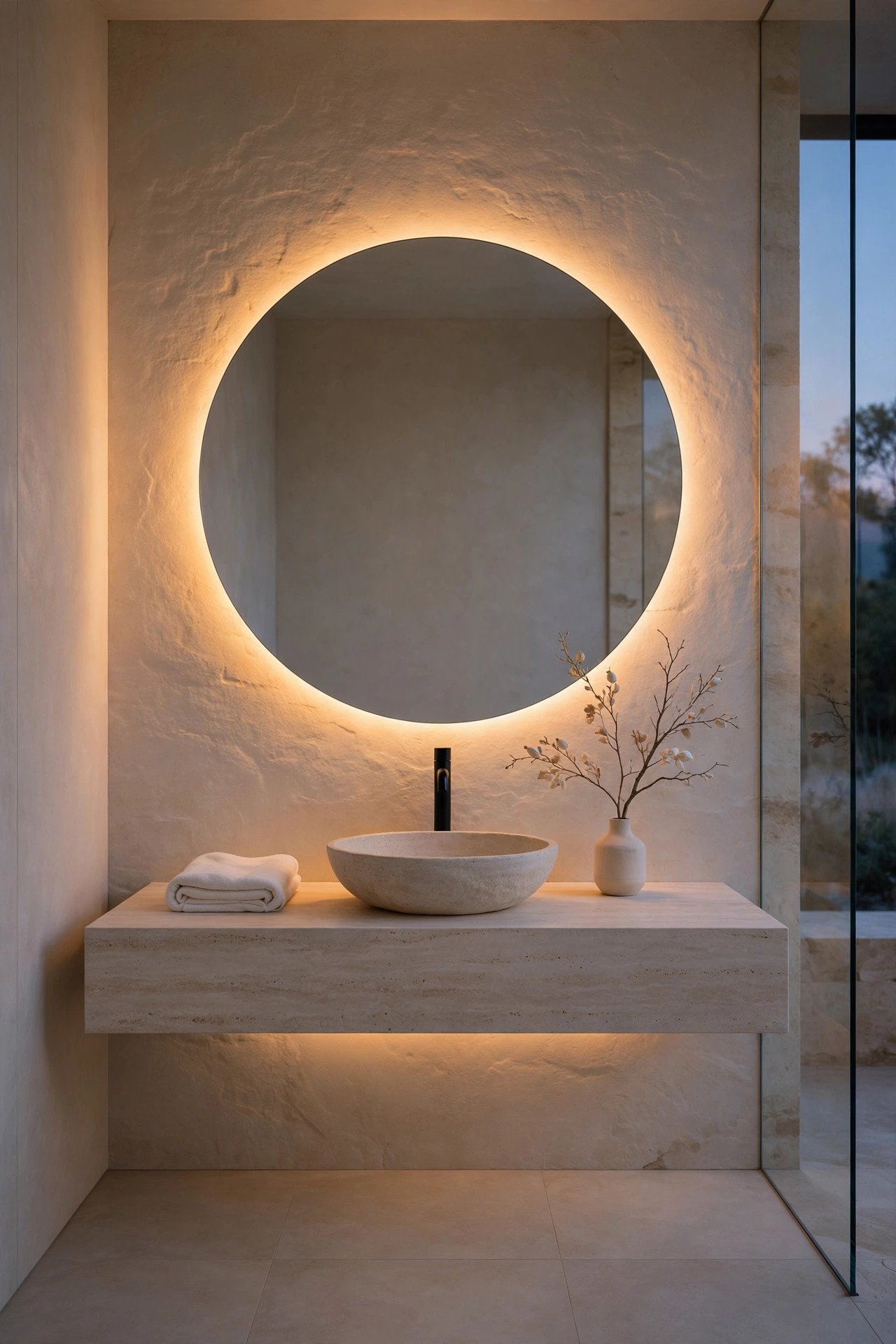
Choose a frameless round mirror with integrated LED lighting at 2700 to 3000 Kelvin for the most flattering glow. The frosted light border should be even and dimmable, serving as both task lighting and evening ambience. Size it generously, as a large round mirror amplifies light and doubles the sense of space.
Mount it centered above a floating vanity with a single wall-mounted faucet below, keeping the composition symmetrical and serene. The round shape contrasts beautifully with rectangular tile and cabinetry, adding just enough softness to prevent the room from feeling severe. No frame means no visual interruption.
Look for bathroom-rated models with anti-fog technology and touch controls for a seamless experience. The backlit round mirror is minimalism perfected: one object doing the work of lighting, reflection, and sculpture, while appearing to do almost nothing at all.
9. Matte Black Fixtures
Matte black fixtures draw crisp, graphic lines through a minimalist bathroom, defining edges the way ink defines a drawing. Faucets, shower trims, towel bars, and flush plates in this finish add quiet drama without color or pattern. Against white or concrete surfaces, black reads as pure architectural punctuation.
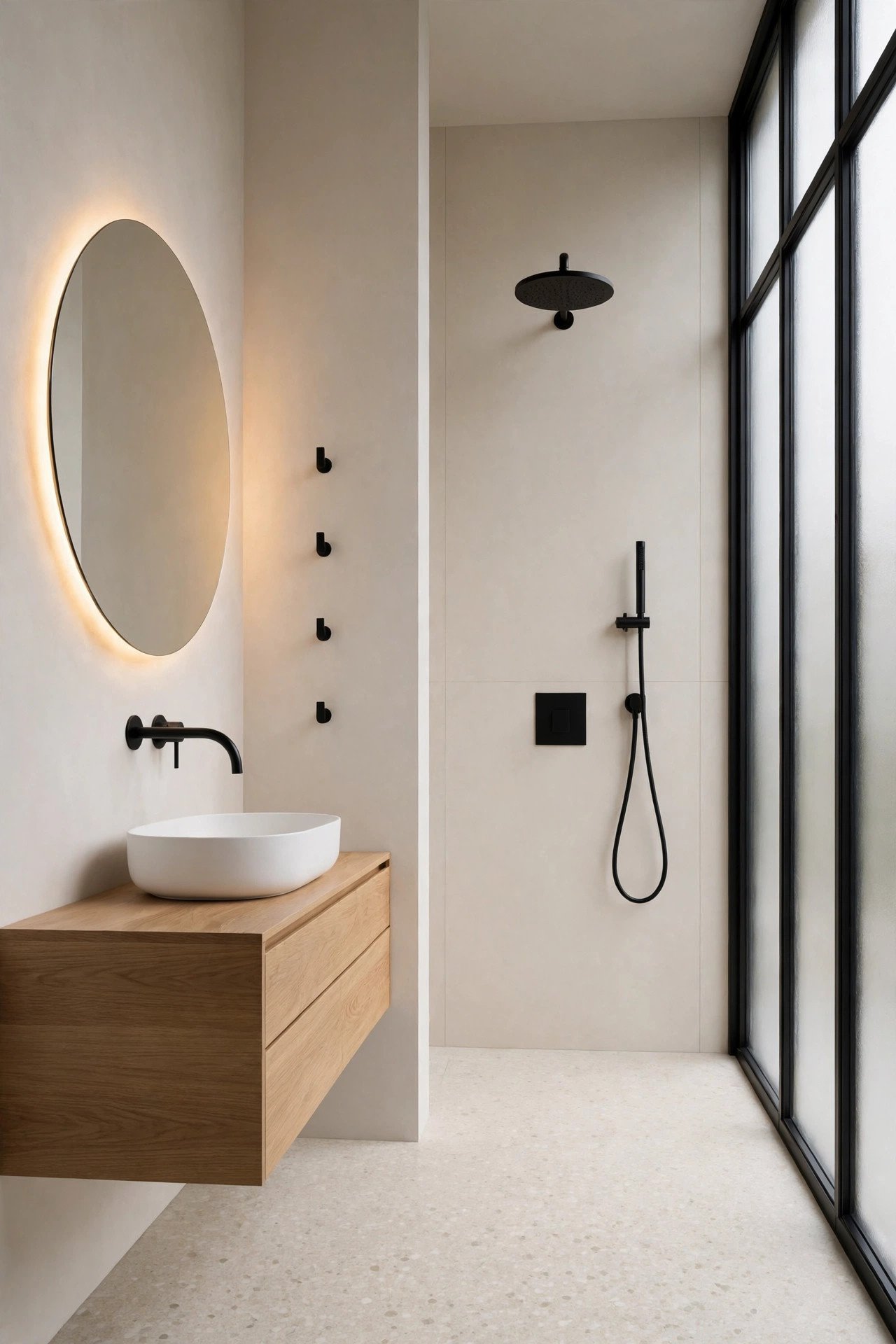
Use black consistently but sparingly: match the faucet, shower controls, and hardware so the finish forms a coherent thread through the room. A black-framed shower panel or a slim black mirror edge can echo the fixtures. Too many black elements will dominate, so let pale surfaces remain the majority.
Matte black pairs beautifully with every minimalist material, from white porcelain to warm oak to gray microcement. It adds definition that keeps light palettes from feeling washed out. The soft, non-reflective surface feels modern and tactile, a welcome contrast to glossy tile.
Choose powder-coated or PVD finishes for durability, and clean with a soft cloth and mild soap to avoid scratching. Water spots show less on matte than on polished chrome. Matte black fixtures prove that minimalism can have an edge, with contrast doing the decorative work that ornament never could.
10. Open Space Layout
The most powerful minimalist move is spatial: removing visual barriers so the bathroom reads as one continuous open volume. A wet-room layout with no shower enclosure, a freestanding tub in the open, and clear floor throughout creates a sense of generosity that no decoration can match. Space itself becomes the luxury.
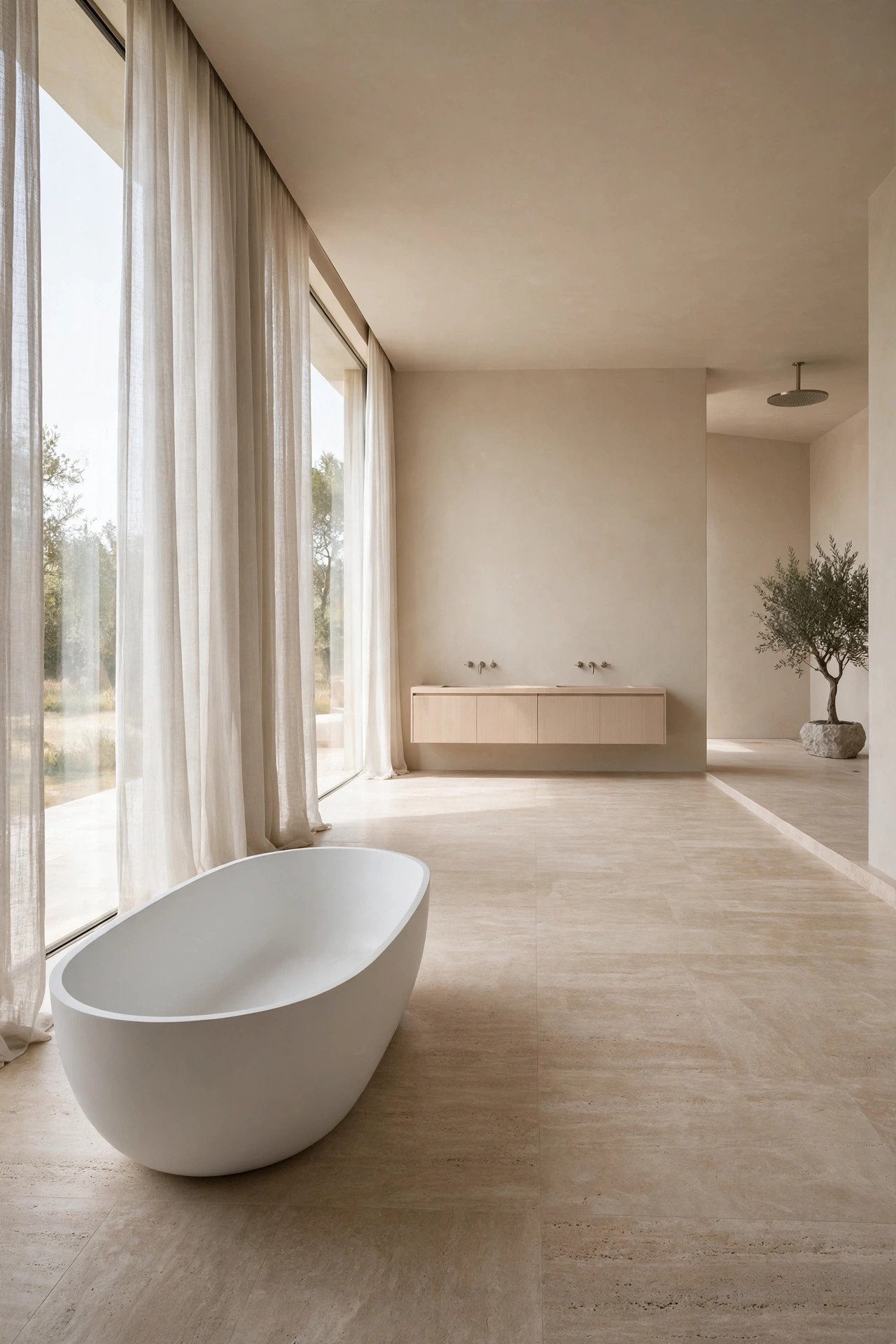
Achieve openness by consolidating plumbing on one wall, floating the vanity and toilet, and using a single flooring material wall to wall. A curbless shower with a linear drain lets tile flow uninterrupted. Every removed threshold and partition adds to the feeling of calm, unbroken space.
Keep sightlines clean from the doorway: the first thing you see should be a composed, uncluttered view, perhaps a sculptural tub or a beautiful stone wall. Hide storage in recessed niches and full-height cabinets so open areas stay truly open. Resist filling empty corners; negative space is a design element.
Open layouts demand excellent waterproofing and a well-planned slope to the drain, so work with an experienced contractor. The reward is a bathroom that feels like a private spa suite. In minimalism, the space you leave empty matters as much as the objects you choose.
11. Recessed Shower Niches
A recessed shower niche keeps bottles and soap off the floor and out of sight, carved directly into the wall so storage becomes architecture. Unlike corner caddies or hanging racks, a niche adds zero visual clutter while keeping essentials exactly where you need them. It is storage that disappears into the design.
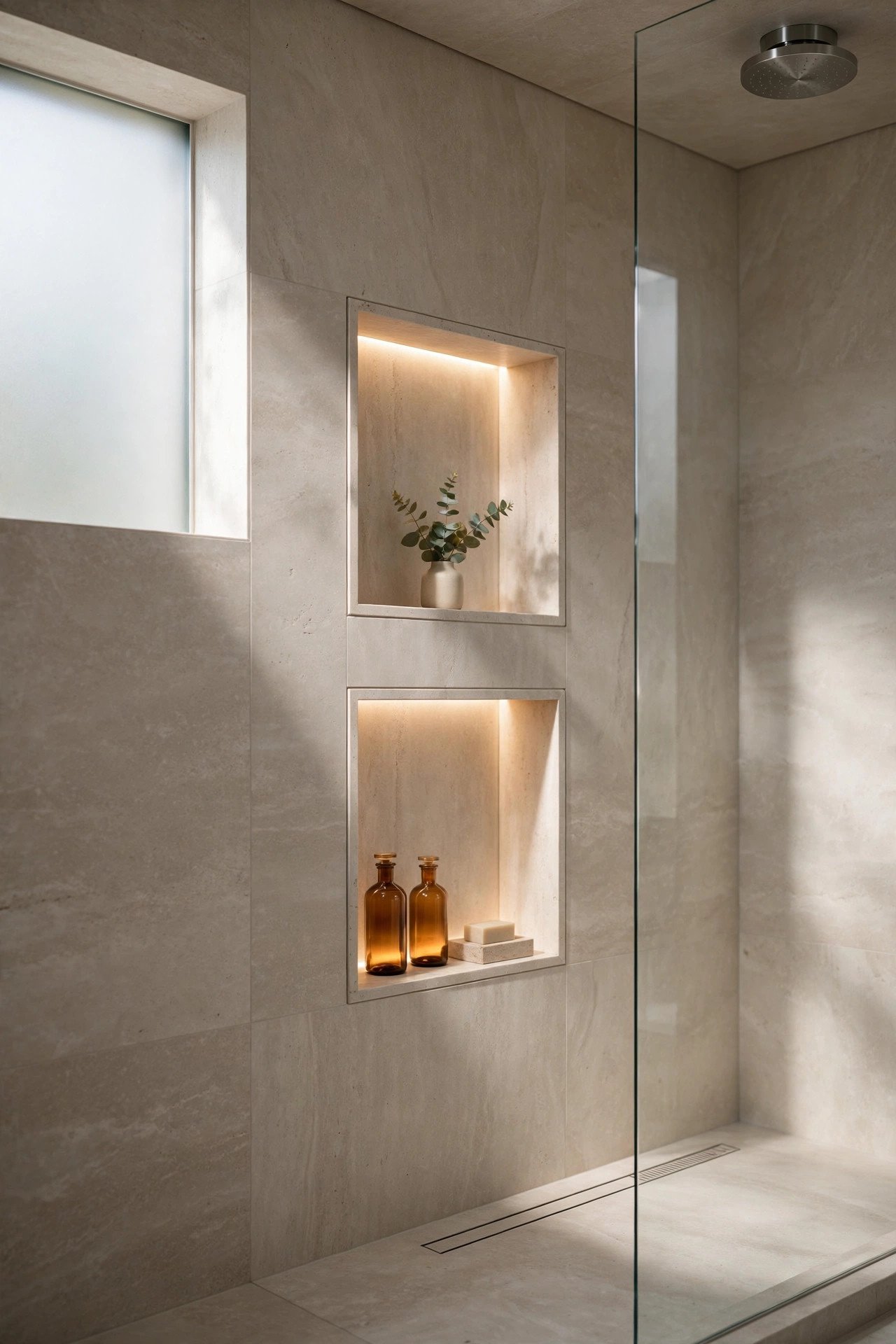
Plan niches during rough-in, positioning them at a comfortable reaching height and away from direct water spray. Line them with the same tile as the shower walls for a seamless look, or use a contrasting stone for a subtle framed effect. A slight slope on the niche shelf prevents water from pooling.
Size the niche generously: a tall, wide opening holds full-size bottles without crowding, and a divided niche separates products neatly. In a double shower, add one niche per user. LED strip lighting inside the niche turns practical storage into a glowing design detail at night.
Keep the styling minimal by decanting products into matching simple bottles and limiting the niche to true essentials. An overstuffed niche defeats its purpose. Done well, a recessed niche is invisible storage at its finest, preserving the clean shower lines minimalism requires.
12. Minimalist Freestanding Tub
A freestanding tub is sculpture you can bathe in, and in a minimalist bathroom it becomes the undisputed centerpiece. Clean oval or soft rectangular forms with thin rims and no visible jets keep the silhouette pure. Placed with breathing room around it, the tub reads as art rather than appliance.
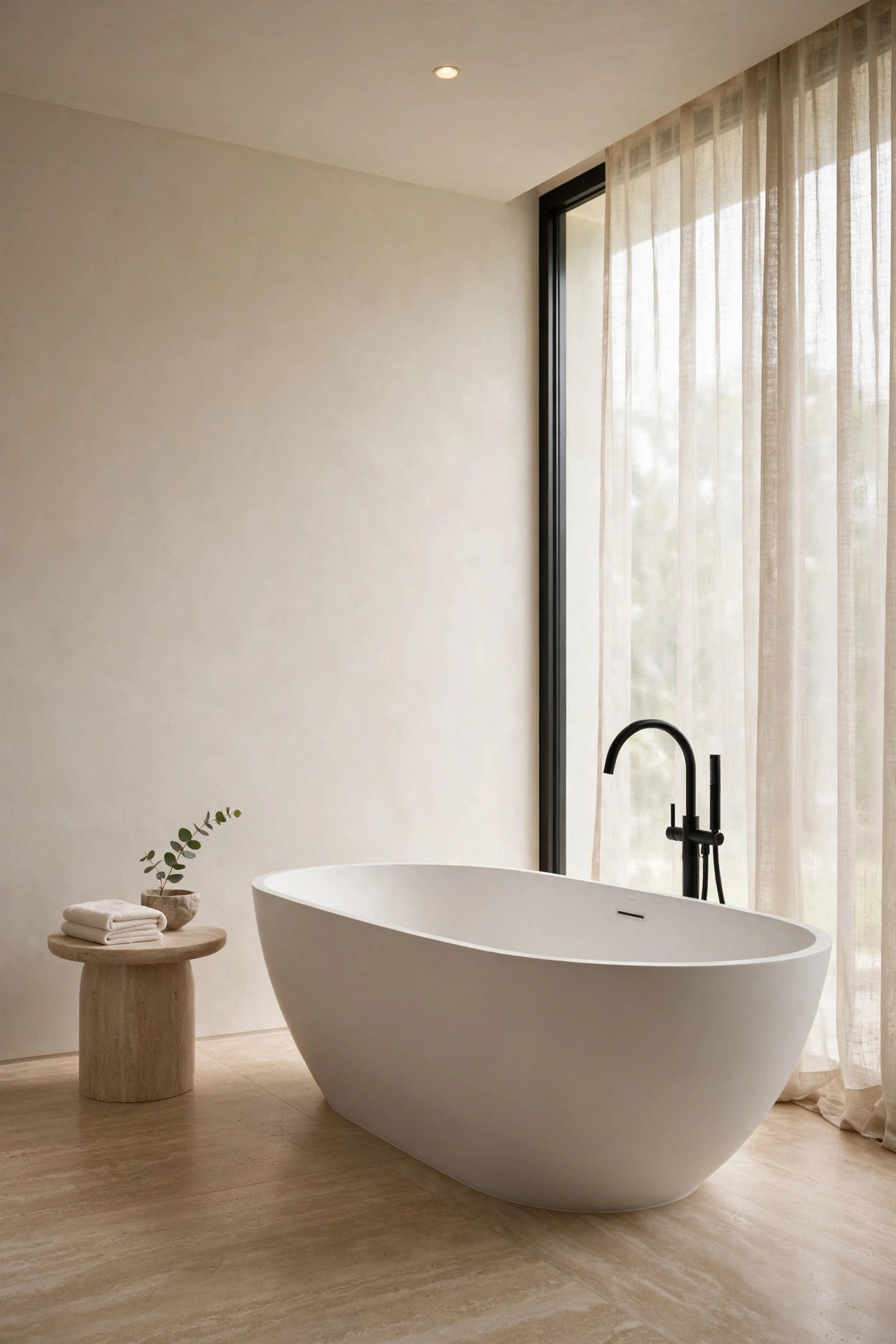
Choose solid-surface or stone-resin tubs in matte white for a seamless, monolithic look that hides water spots and feels warm to the touch. Position the tub near a window for daylight or against a textured feature wall for contrast. A floor-mounted filler in matte black or chrome keeps the rim completely clear.
Scale matters: a compact deep soaker suits smaller bathrooms, while a generous oval needs room to breathe on all sides. Check floor loading and door clearances before delivery, since one-piece tubs are heavy and unforgiving. The surrounding floor should be a single continuous material for maximum calm.
Style the tub zone with restraint: a small wooden stool holding a folded towel, perhaps a single candle, and nothing else. Dimmable lighting nearby turns evening soaks into ritual. A minimalist freestanding tub proves that one perfect object can carry an entire room.
13. Neutral Stone Tiles
Large-format stone tiles in neutral tones give a minimalist bathroom a quiet, geological richness that flat ceramic cannot match. Limestone, travertine, and honed marble in soft beige, gray, and ivory bring subtle natural variation while staying firmly within a restrained palette. The stone adds depth without adding noise.
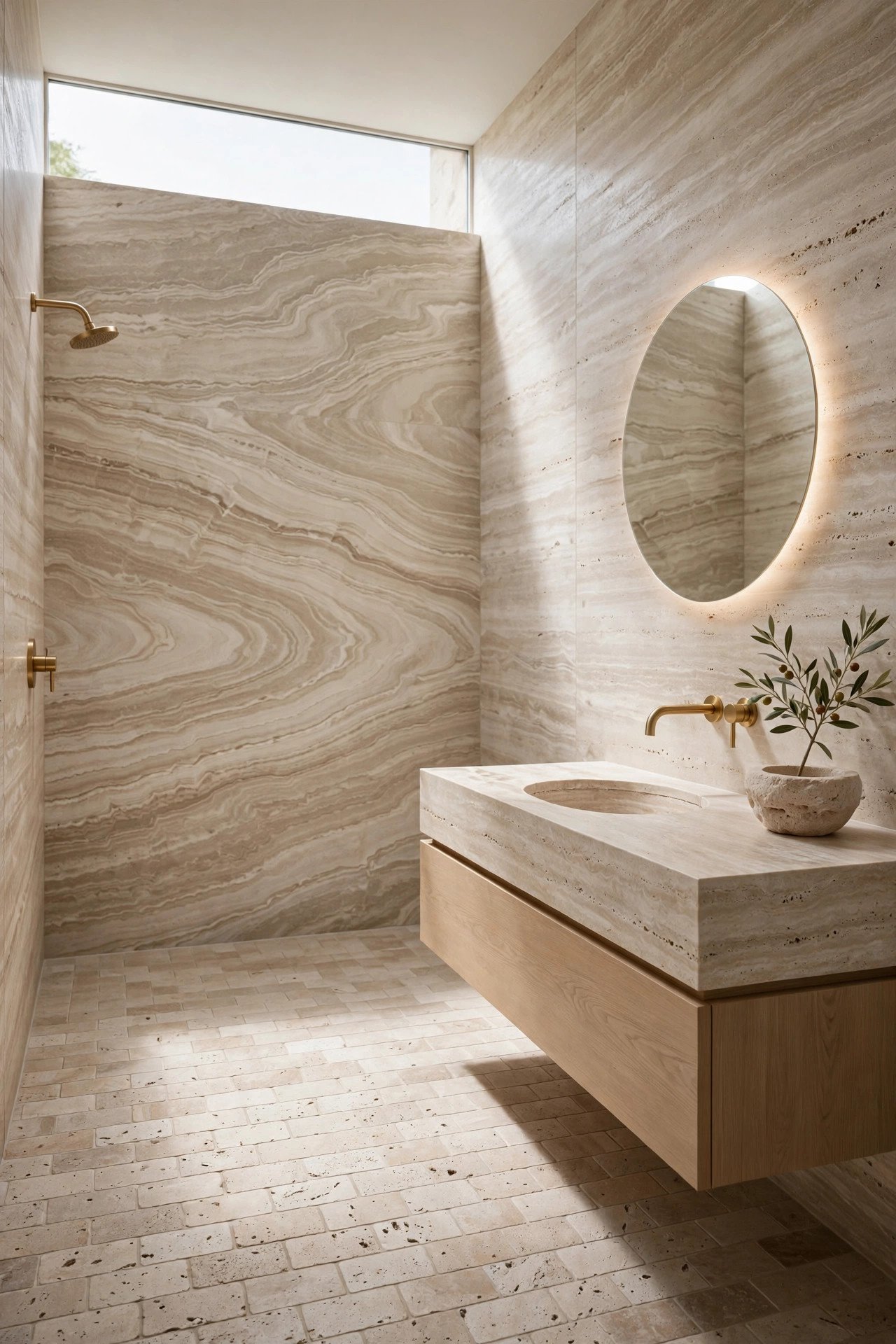
Choose the largest format your space and budget allow, since fewer grout lines mean a calmer, more continuous surface. Rectified edges allow tight joints that nearly disappear. Keep grout in a matching tone so the tile reads as one flowing plane from wall to floor.
Honed and matte finishes suit minimalism better than polished, offering a soft, light-absorbing surface that feels serene rather than showy. Seal natural stone properly for shower and floor use, and select slip-resistant finishes underfoot. One stone used consistently beats a patchwork of competing materials.
Let the stone be the only pattern in the room: pair it with plain walls, simple fixtures, and minimal accessories. The natural veining provides all the visual interest a minimalist space needs. Neutral stone tiles are timeless, tactile, and the foundation of countless serene bathrooms.
14. Clutter Free Countertops
Clear countertops are the visible proof of minimalism, and achieving them requires both design and discipline. A completely clear vanity top instantly makes a bathroom feel larger, calmer, and more luxurious. The goal is a surface that holds nothing except, at most, one beautiful object.
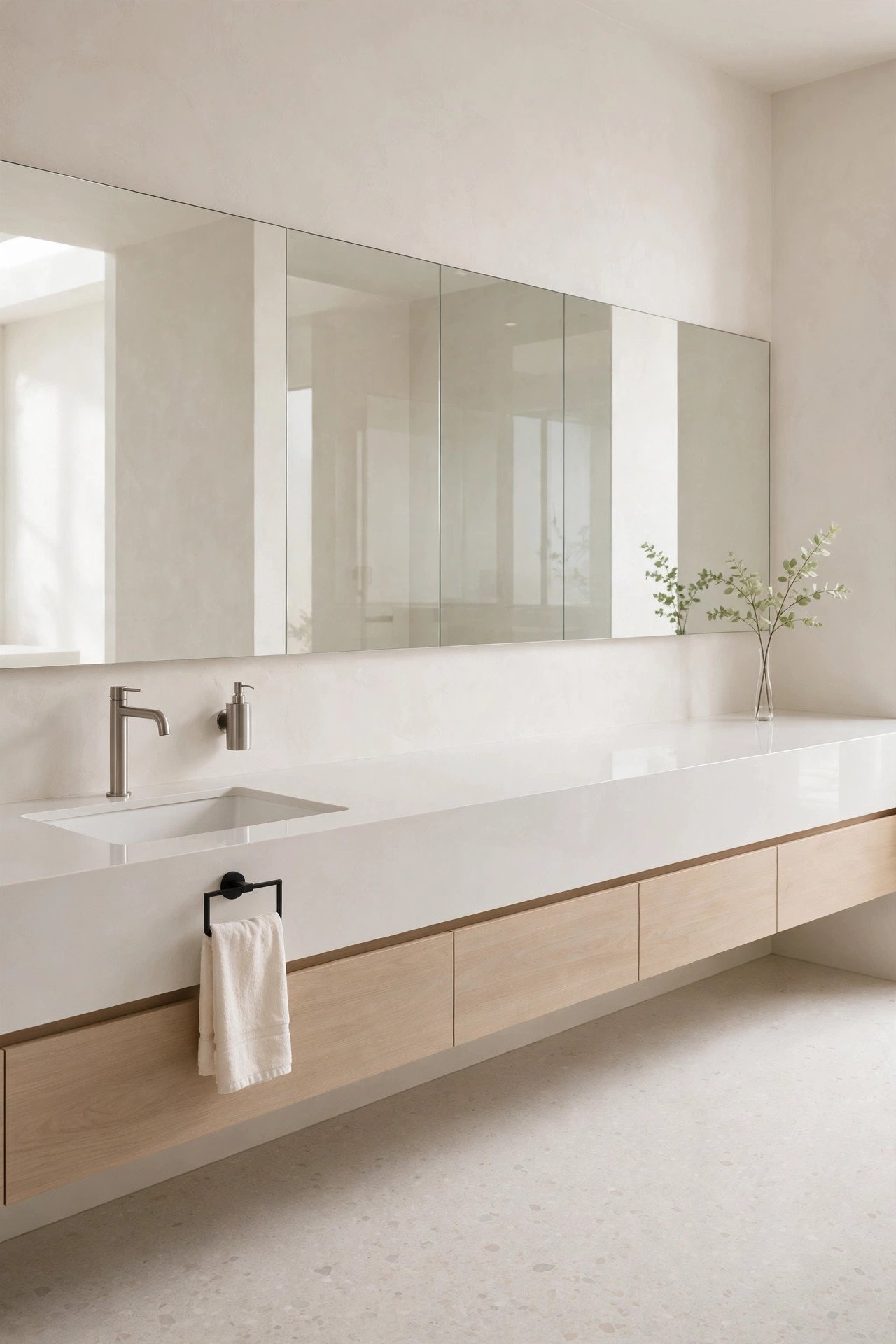
Design for it from the start: deep drawers with organizers swallow daily toiletries, a recessed medicine cabinet holds grooming essentials, and wall-mounted soap dispensers eliminate bottles from the deck. A wall-mounted faucet frees even more counter space. Every item needs a hidden home.
Maintain the standard with a simple daily habit: return each product to its drawer after use, without exception. Corral the few remaining items, like hand soap and a small vase, on a single small tray so they read as one intentional grouping. Decant everyday products into matching minimal containers for a cohesive, spa-like look.
The payoff is both visual and mental: a clear counter removes hundreds of tiny visual interruptions and makes cleaning a thirty-second wipe. Clutter-free countertops are where minimalist philosophy becomes daily practice, and the calm they create is worth every bit of discipline.
15. Linear Drain Detail
A linear drain is a small detail with an outsized minimalist impact, replacing the round center drain with a slim channel that nearly disappears into the floor. It allows large-format tiles to run continuously through the shower with a single subtle slope, preserving the calm, unbroken plane minimalism demands.
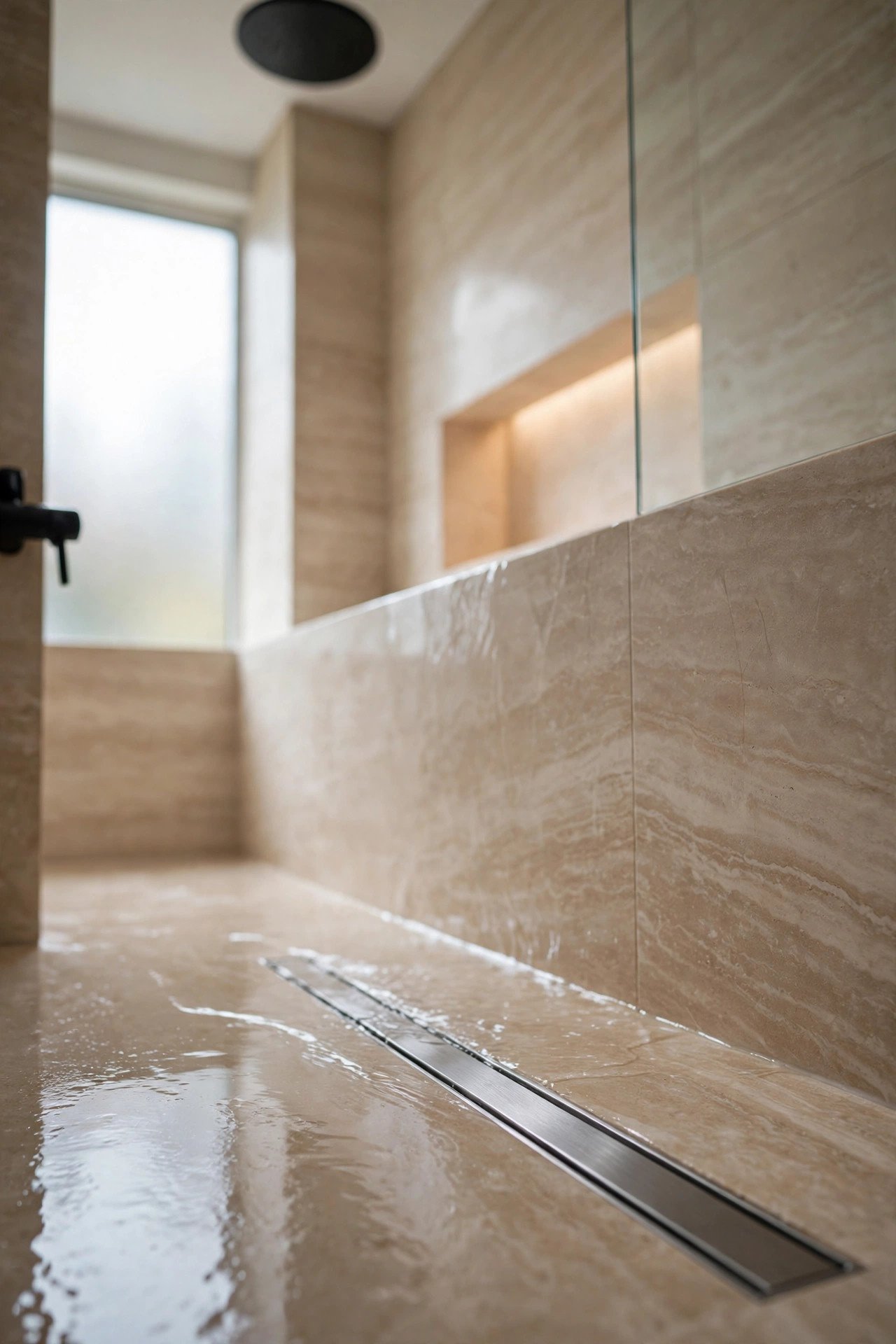
Position the drain along the shower wall or at the entry threshold so the tile layout stays simple and elegant. Choose a drain cover in a finish that matches your fixtures, or select a tile-in insert that makes the drain virtually invisible. Either way, the shower floor reads as pure, continuous surface.
Linear drains handle high water flow beautifully, making them ideal for rainfall showerheads and wet-room layouts. The single-slope floor is also easier to waterproof correctly than the complex four-way slope a center drain requires. Your tile installer will appreciate the simpler cuts as well.
Keep the channel clean with an occasional lift of the cover and a quick rinse. This tiny architectural detail signals a thoroughly considered design. In a minimalist bathroom, the linear drain is proof that true luxury lives in the details you barely notice.
Minimalist Bathroom Planning Guide
| Project Area | Budget Range | Best Material Picks | Style Pairing Tip |
|---|---|---|---|
| Vanity and storage | $800 – $3,500 | Floating slab-front vanity, deep drawer organizers | Wall-mount everything to reveal continuous flooring |
| Shower enclosure | $1,500 – $5,000 | Frameless 10mm glass, single fixed panel | Continue one tile through walls and floor |
| Toilet upgrade | $600 – $1,800 | Wall-hung rimless bowl, concealed carrier frame | Match the flush plate finish to your faucets |
| Walls and surfaces | $1,200 – $4,500 | Microcement, large-format porcelain, honed stone | One material wall-to-wall keeps sightlines calm |
| Fixtures and fittings | $500 – $2,000 | Matte black or chrome single-lever sets | Repeat one finish across every fitting |
| Mirror and lighting | $300 – $1,200 | Backlit round mirror, 2700K-3000K dimmable LEDs | Layer ambient, task, and accent light sources |
| Flooring and drainage | $1,000 – $4,000 | Large-format stone-look porcelain, linear drain | Curbless entry with a single-slope floor |
| Tub statement | $1,500 – $6,000 | Matte solid-surface freestanding soaker | Give it breathing room; style with restraint |
| Textiles and warmth | $100 – $400 | Turkish cotton towels, teak mat, linen curtain | One wood tone repeated twice is enough |
| Finishing details | $100 – $600 | Recessed niche, wall-mounted dispenser, single stem vase | Edit ruthlessly: every object must earn its place |
16. Soft Daylight Maximizing
Natural light is the most beautiful minimalist material, and maximizing it transforms a bathroom more than any fixture can. Daylight reveals true colors, makes small rooms feel expansive, and supports the calm, honest atmosphere minimalism seeks. Design every decision around welcoming more of it in.
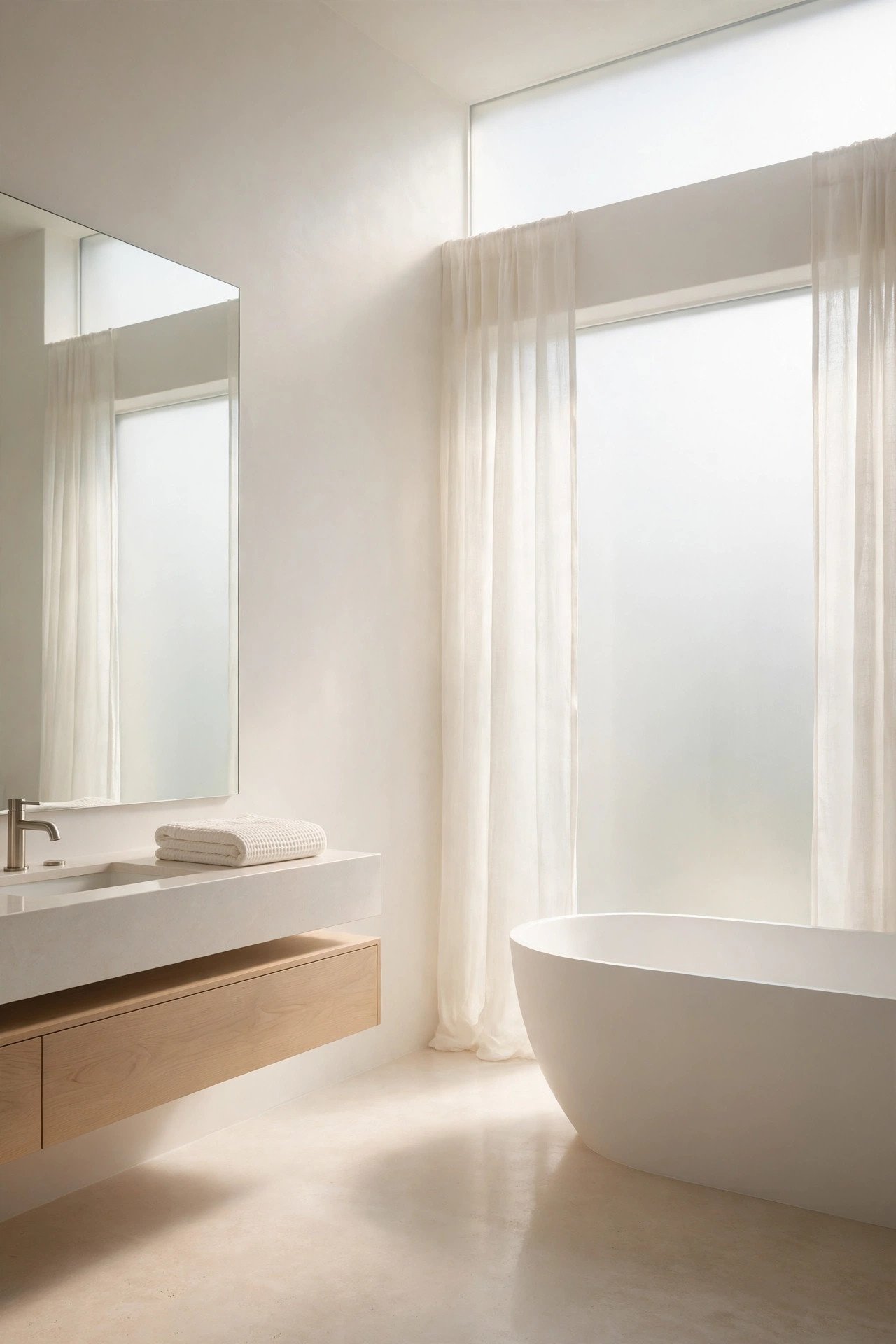
Keep window treatments minimal or absent: frosted glass, sheer linen panels, or top-down bottom-up shades provide privacy while transmitting soft, diffused light. Avoid heavy curtains and busy blinds that chop the window into visual noise. If privacy allows, leave the glass completely bare.
Amplify what enters with reflective surfaces: large mirrors, glossy tile accents, and pale walls bounce daylight into every corner. Position the mirror opposite or adjacent to the window to double the effect. Even a small skylight or sun tunnel can flood a windowless bathroom with natural light.
Supplement with daylight-balanced artificial lighting at 4000 to 5000 Kelvin for daytime grooming accuracy, switching to warm tones in the evening. Clean windows and mirrors regularly, since film dulls the light you worked to invite. Soft daylight is minimalism’s free luxury; design to receive it fully.
17. Minimalist Towel Display
Even towels become design objects in a minimalist bathroom when displayed with intention. A short stack of perfectly folded towels in a single tonal family, hung on one slim rail or a simple ladder, adds softness without clutter. The display should feel curated, like a spa shelf, not a linen closet spillover.
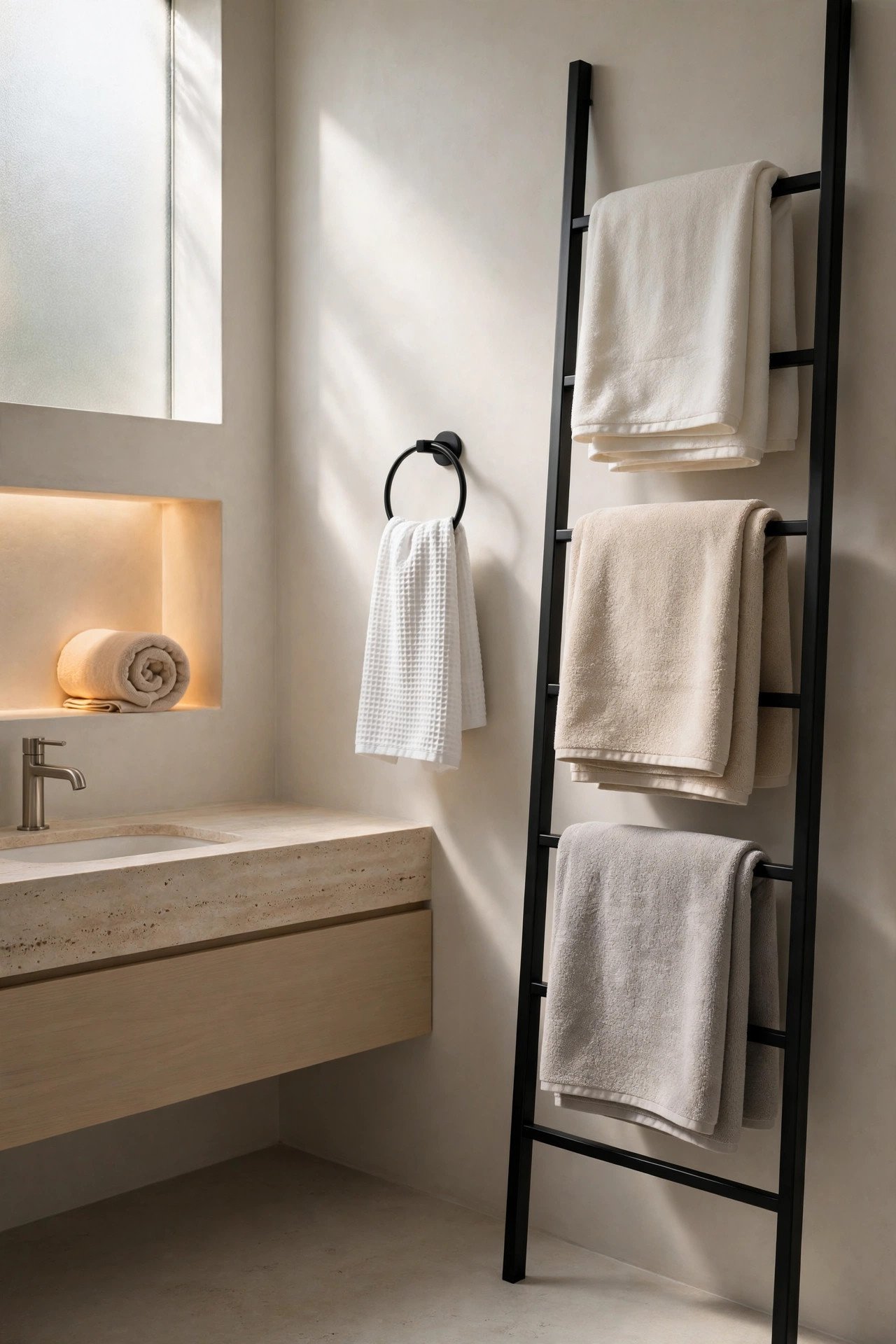
Limit the palette to whites, warm grays, or soft beiges that blend with the room. Choose thick, high-quality cotton with a subtle texture, such as waffle or ribbed weave, so the towels contribute tactile interest. Fold or roll them uniformly; consistency is what makes a small stack look deliberate.
Give towels a dedicated, visible home: a floating oak shelf, a wall-mounted rail, or a slim freestanding ladder in a quiet finish. Keep daily-use towels here and store the rest out of sight. One rail with two towels beats a crowded rack every time in minimalist terms.
Launder and rotate regularly so the display always looks fresh, and replace thinning towels before they fray. In a minimalist bathroom, textiles are among the few decorative elements allowed, so let them be beautiful. A restrained towel display proves that function, styled well, is decoration enough.
18. Single Slab Countertop
A single-slab countertop with no seams or joints creates the unbroken horizontal plane that minimalist vanities need. Whether in quartz, solid surface, or honed stone, one continuous slab reads as calm and architectural. The eye glides across it without interruption, which is the essence of the style.
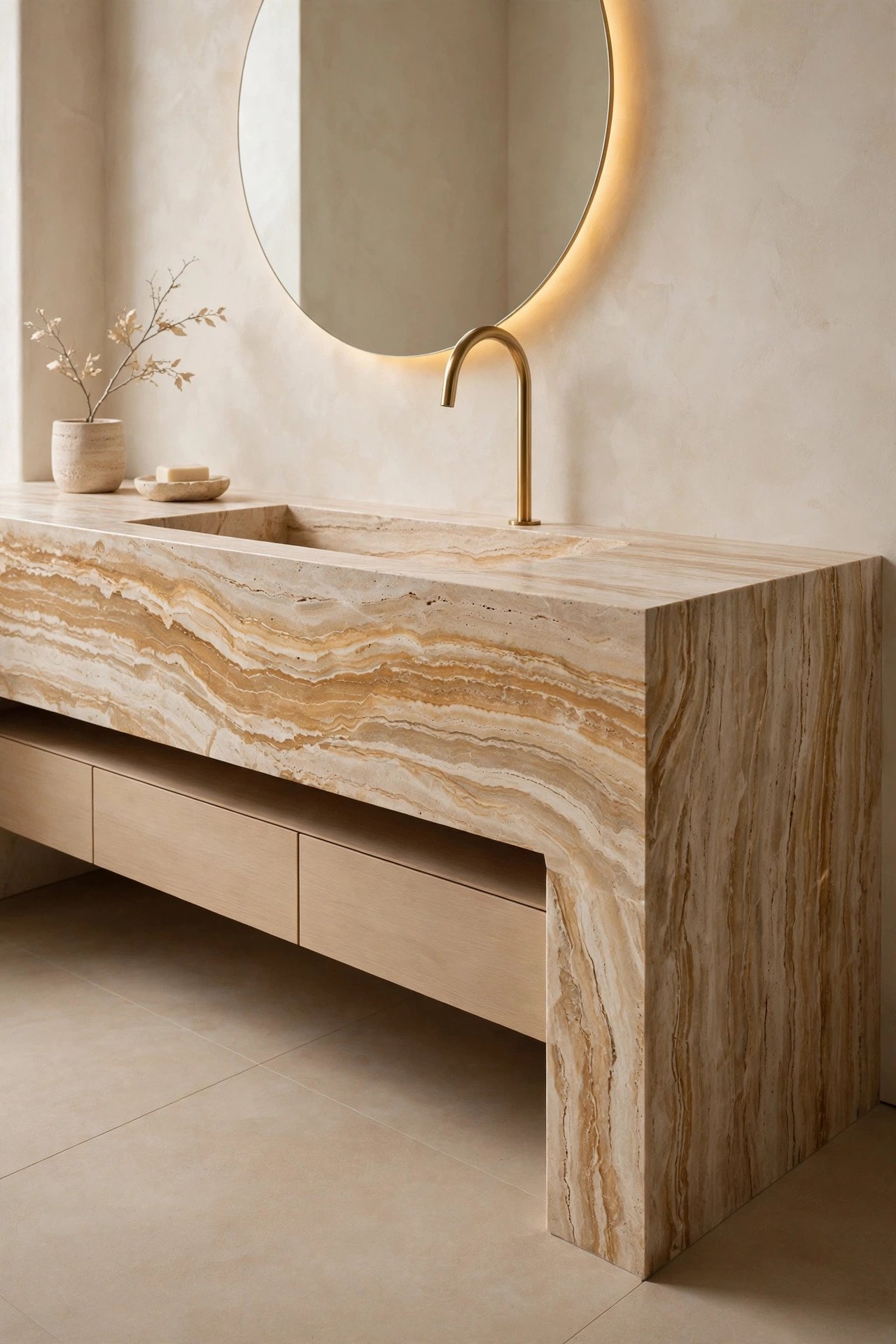
Choose an integrated sink carved from the same material for the ultimate seamless composition, or pair the slab with a slim undermount basin that keeps the top plane clean. A wall-mounted faucet eliminates deck holes entirely. Keep the slab thickness modest, around two to three centimeters, for a light, precise edge.
Material choice sets the tone: matte white solid surface feels crisp and modern, honed Carrara-effect quartz adds soft veining, and warm concrete-look slabs bring organic texture. Whichever you choose, let the slab run wall to wall with no backsplash clutter; a simple sealed joint at the wall is enough.
Maintain the seamless look with daily wipe-downs and prompt attention to stains, since a flawless surface shows everything. The reward is a vanity top that looks sculpted from a single block. A single-slab countertop is minimalism in one gesture: continuity as beauty.
19. Handleless Cabinetry
Handleless cabinetry removes the last bit of visual noise from bathroom storage, presenting doors and drawers as pure, uninterrupted planes. Without knobs or pulls breaking the surface, the vanity becomes a quiet architectural volume. It is a subtle detail that the eye registers as profound calm.
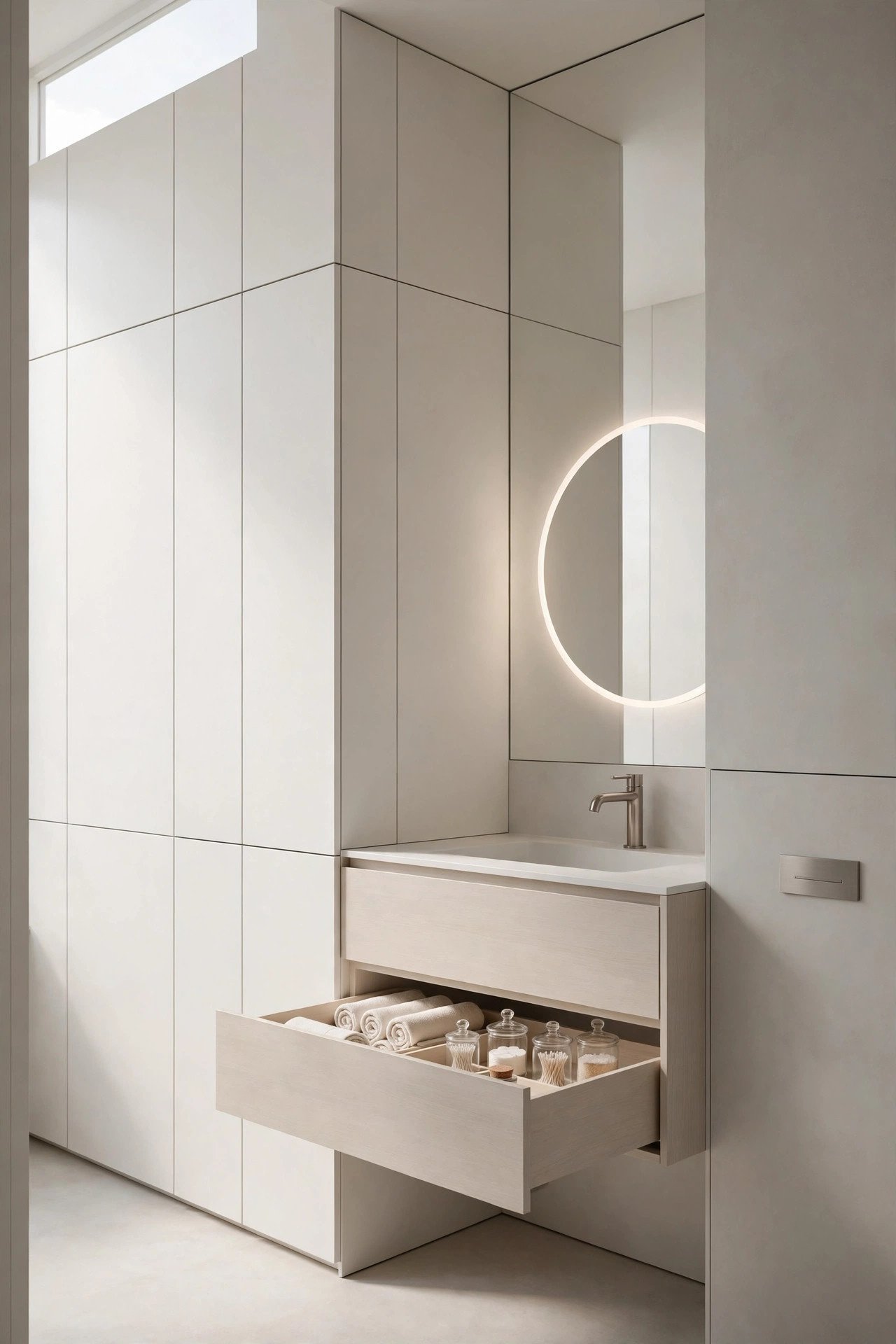
Achieve the look with push-to-open mechanisms, integrated finger pulls routed into the door edge, or a recessed shadow gap between cabinet and countertop. Each method keeps the front perfectly flat. Soft-close hardware is essential, since handleless doors get pushed rather than pulled and should glide silently shut.
Handleless fronts work in any minimalist finish: matte lacquer, pale wood veneer, or microcement-clad panels. Keep the cabinetry aligned in a single horizontal band, and run the same finish on tall storage units for a built-in, furniture-free look. Precision installation matters; gaps must be perfectly even.
The clean fronts are easier to wipe down than handled doors, with no hardware collecting grime. Inside, use full-extension drawers with dividers so function matches the serene exterior. Handleless cabinetry proves that in minimalism, what you remove matters as much as what you keep.
20. Calm Beige Minimalism
Beige brings warmth to minimalism without breaking its discipline, softening the starkness that all-white schemes can sometimes carry. Warm greige walls, sandy stone floors, and oatmeal textiles create a minimalist bathroom that feels like a quiet morning: calm, gentle, and deeply restful. It is minimalism with a human heartbeat.
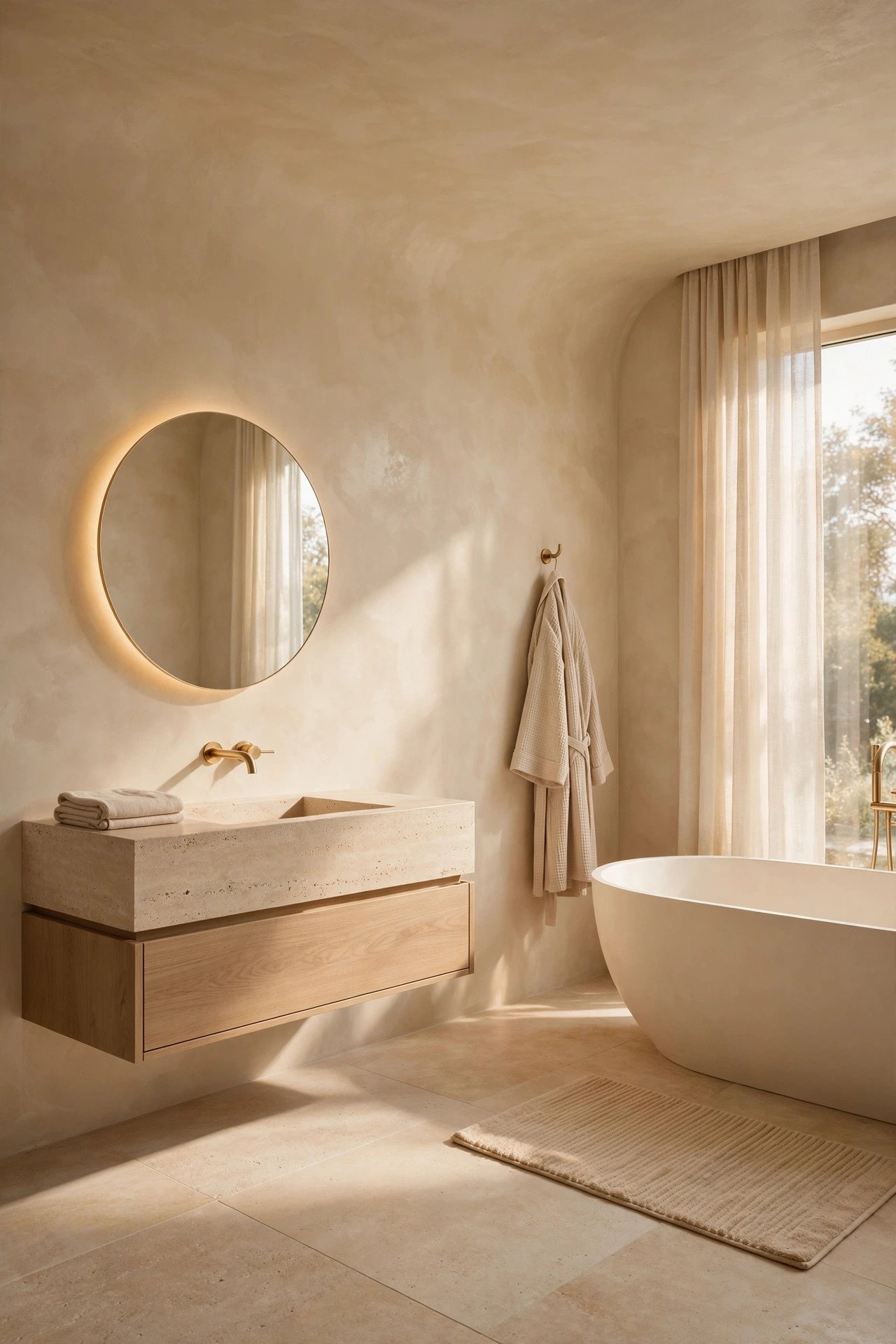
Build the palette from three close tones: a pale warm white for ceilings and fixtures, a mid greige for walls, and a slightly deeper taupe for textiles or a single accent. The narrow range keeps the minimalist calm while the warmth prevents sterility. Natural light makes these tones glow beautifully.
Pair beige minimalism with light oak, travertine, and brushed brass for an organic, cohesive material story. Keep forms simple and rectilinear, letting the warm palette provide the softness that curves might otherwise add. One green plant or a single dried stem completes the serene composition.
Beige minimalism suits those who find pure white too clinical but still crave visual quiet. It hides daily wear gracefully and feels timeless rather than trendy. This is minimalism at its most livable: restrained, warm, and quietly luxurious in every detail.
21. Greenery Single Statement
One plant, chosen well and placed deliberately, is all a minimalist bathroom needs from nature. A single sculptural stem, a small potted fern, or a trailing pothos adds life, color, and organic shape that contrasts beautifully with hard tile and porcelain. Restraint makes the greenery more powerful, not less.
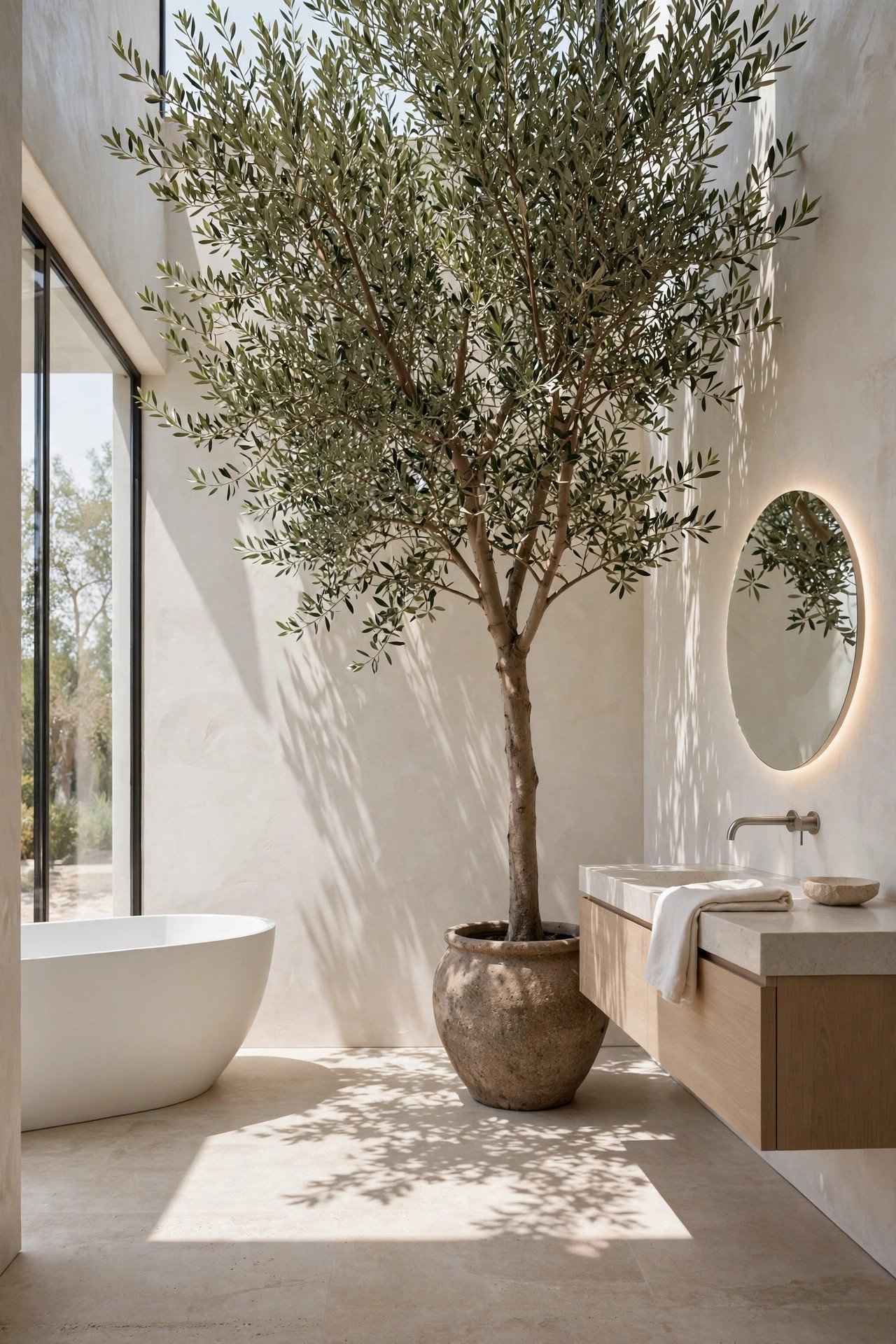
Choose humidity-loving varieties that thrive in steamy, low-light conditions: pothos, snake plants, ferns, and peace lilies are reliable performers. A tall snake plant fills an empty corner with vertical architecture, while a trailing pothos softens a high shelf. Match the plant scale to the room so it accents rather than crowds.
Keep the vessel minimal: a simple white ceramic pot, a clear glass vase with a single eucalyptus stem, or a raw stone planter. The container should disappear into the palette so the plant itself is the statement. Avoid patterned pots or colorful planters that introduce visual noise.
Care for it simply with a monthly check on water and light, wiping leaves occasionally to keep them dust-free. If your bathroom has no natural light, a high-quality faux stem in a beautiful vase achieves the same visual calm with zero maintenance. One green note keeps minimalism feeling alive.
22. Spa Like Serenity
A minimalist bathroom naturally borrows from spa design, where calm is the entire product. Think like a spa designer: uncluttered surfaces, soft indirect lighting, natural materials, and a sensory experience built from warmth, scent, and quiet. The goal is a room that lowers your heart rate on entry.
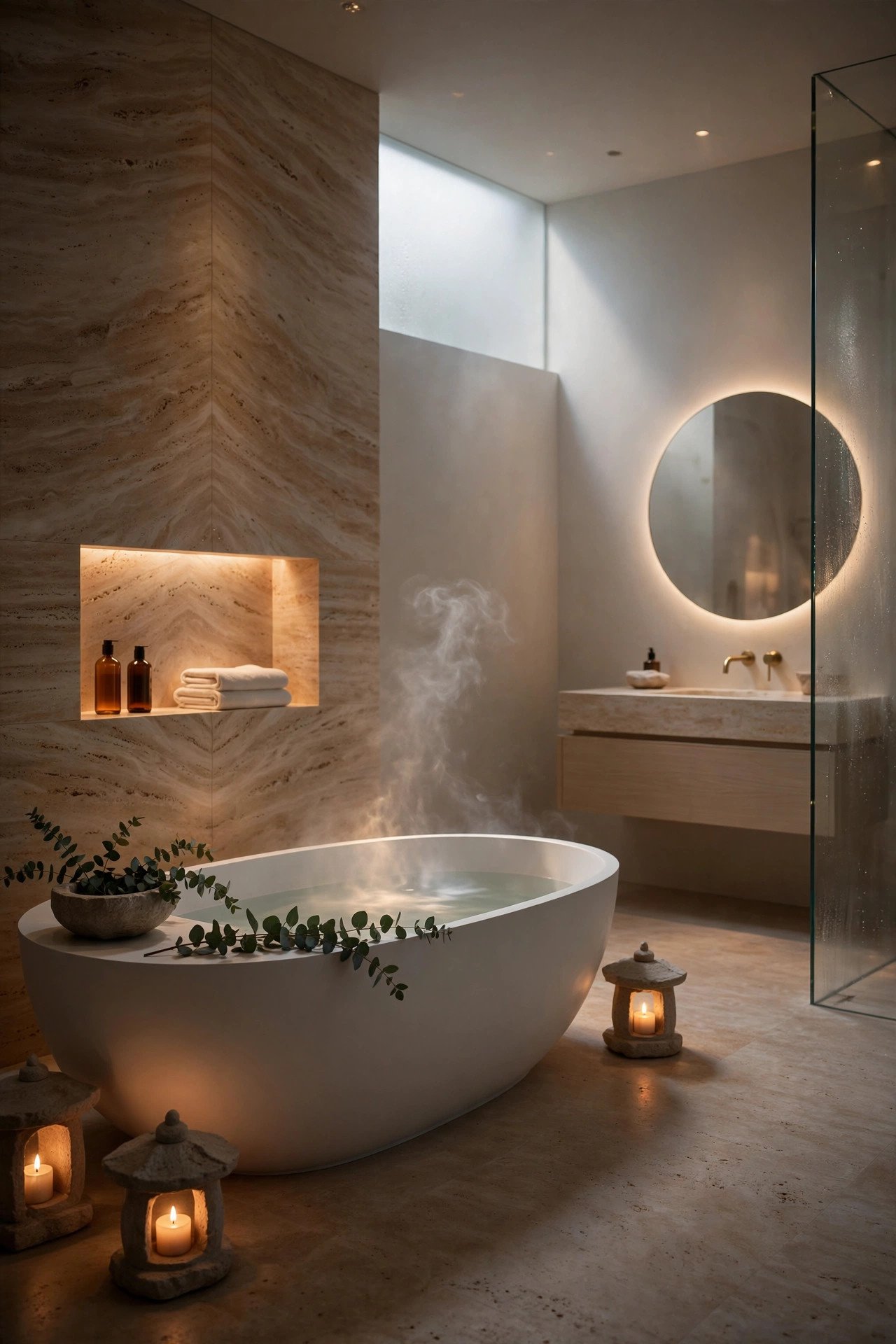
Layer the sensory details: heated floors or a warm towel rail for touch, a reed diffuser with eucalyptus or sandalwood for scent, and dimmable warm lighting for sight. Keep the visual field empty so these subtle sensations take center stage. Spas understand that luxury is felt more than seen.
Adopt spa rituals in your styling: a short stack of rolled towels, a wooden bath tray with a candle, and a small stool beside the tub holding a carafe of water. Each element should look placed with intention and serve a real moment of relaxation. Remove anything that does not contribute to calm.
Maintain the serenity with simple routines: clear surfaces nightly, refresh towels weekly, and replace diffuser reeds before the scent fades. A spa-like minimalist bathroom turns daily routines into restorative rituals. Serenity, it turns out, is a design choice you can make every day.
23. Small Bathroom Minimalism
Small bathrooms are where minimalism pays its highest dividends, since every removed visual interruption makes tight quarters feel larger. A disciplined palette, floating fixtures, and continuous surfaces can make a tiny bathroom feel calm and generous rather than cramped. Constraints become the design advantage.
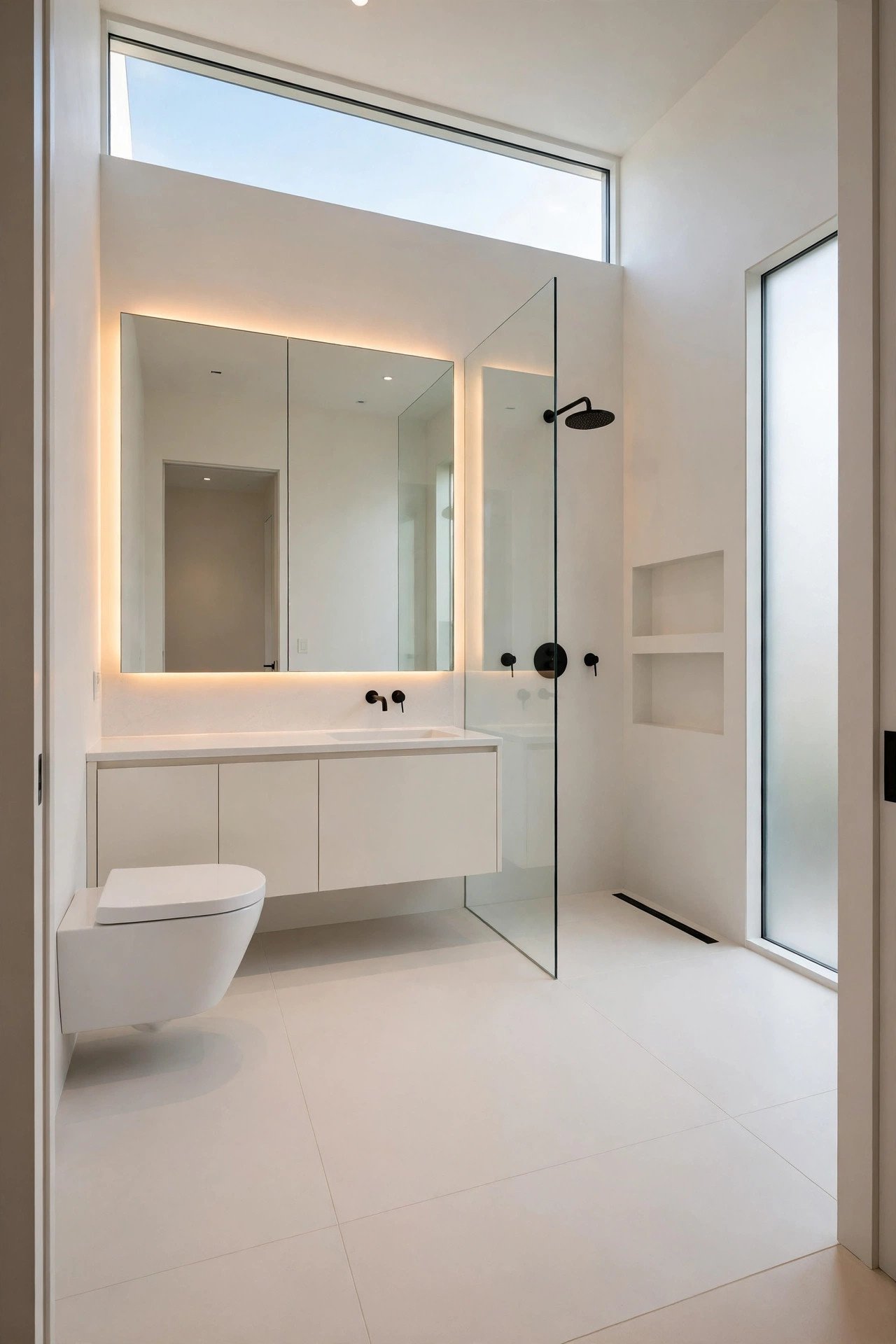
Choose a wall-hung vanity and toilet to reveal maximum floor, run one tile from floor to ceiling, and install a large mirror that spans the vanity width. A frameless glass shower or a wet-room layout eliminates the enclosure that would otherwise chop the room in half. Light tones throughout amplify the effect.
Storage must be ruthlessly efficient: a recessed mirrored cabinet, deep vanity drawers, and a single shower niche hold everything without protruding into precious space. Edit belongings to true essentials, since small minimalism tolerates no overflow. Every item needs a hidden home.
Light the small space generously with layered sources so no corner falls into shadow, and keep the doorway sightline clean and composed. Add one beautiful detail, like a backlit mirror or a single oak stool, to give the tiny room a focal point. A small minimalist bathroom proves that square footage is not the measure of luxury; clarity, light, and calm are.
24. Minimalist Lighting Layers
Minimalist lighting is invisible by day and transformative by night, built from layers that serve different moments. Ambient ceiling light for cleaning, flattering task light at the mirror, and soft accent glows for evening soaks each have a role. Dimmers on every circuit let one room shift through many moods.
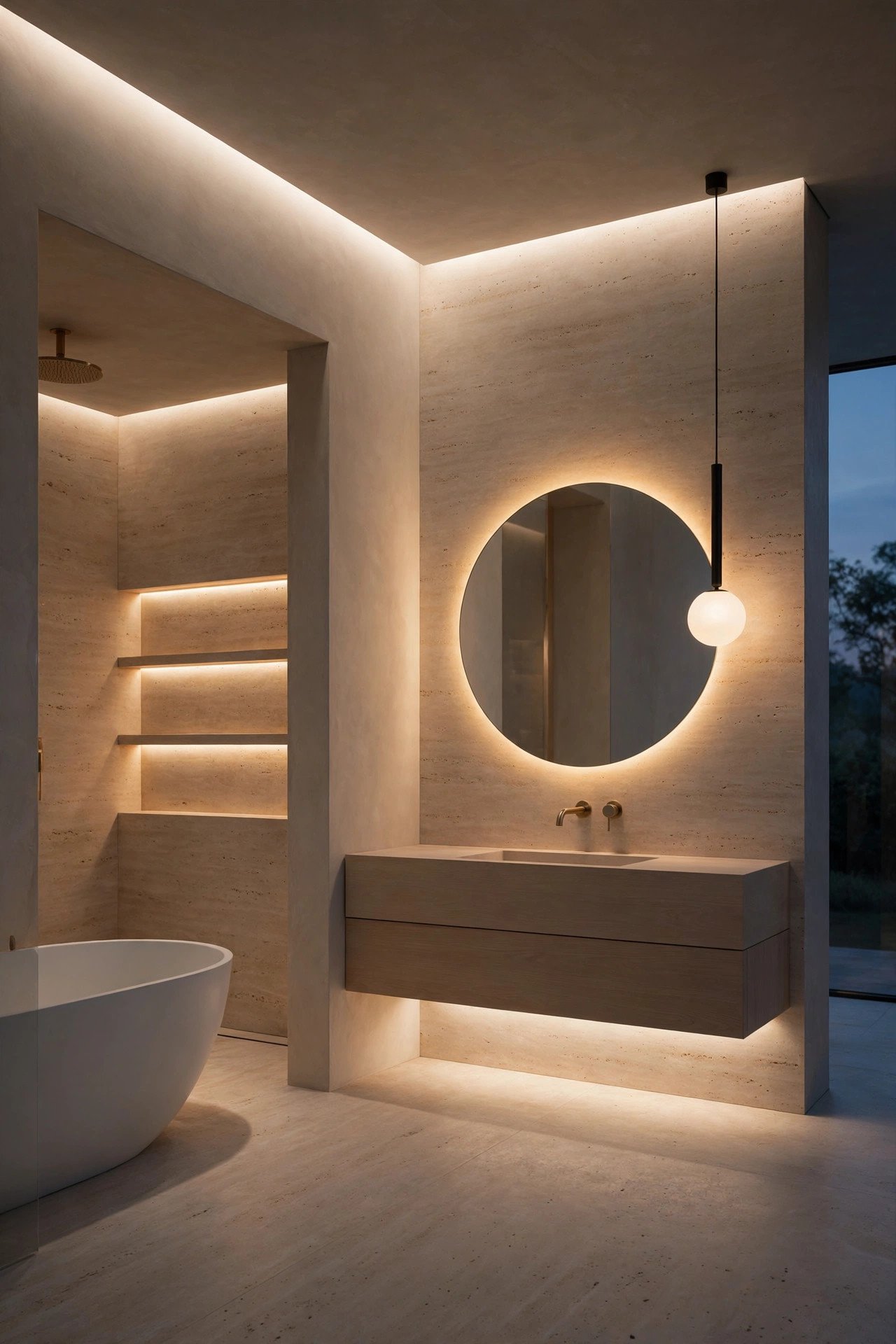
At the mirror, place sconces at eye level on both sides or choose a backlit mirror for shadow-free grooming light. Recessed ceiling spots should be positioned to wash walls rather than create harsh pools. Under-vanity LED strips and niche lighting add the spa-like accent layer that makes evenings feel special.
Keep fixtures themselves minimal: slim recessed spots, a simple pendant with a paper or opal glass shade, or a linear LED channel. The fixtures should disappear, leaving only beautiful light. Choose warm 2700 to 3000 Kelvin for evening calm, with cooler options only where precise daytime grooming demands it.
Put thought into controls: separate switches or a simple scene system let you move from bright morning routine to candle-like evening soak effortlessly. Good lighting layers make a minimalist bathroom feel designed rather than merely empty, proving that light is the most powerful material of all.
25. Textured Plaster Walls
Textured plaster walls give minimalist bathrooms a handcrafted depth that flat paint cannot offer, with subtle trowel marks and tonal shifts that catch light beautifully. In soft white, warm gray, or pale clay tones, plaster adds artisanal warmth while remaining perfectly neutral. It is texture as quiet luxury.
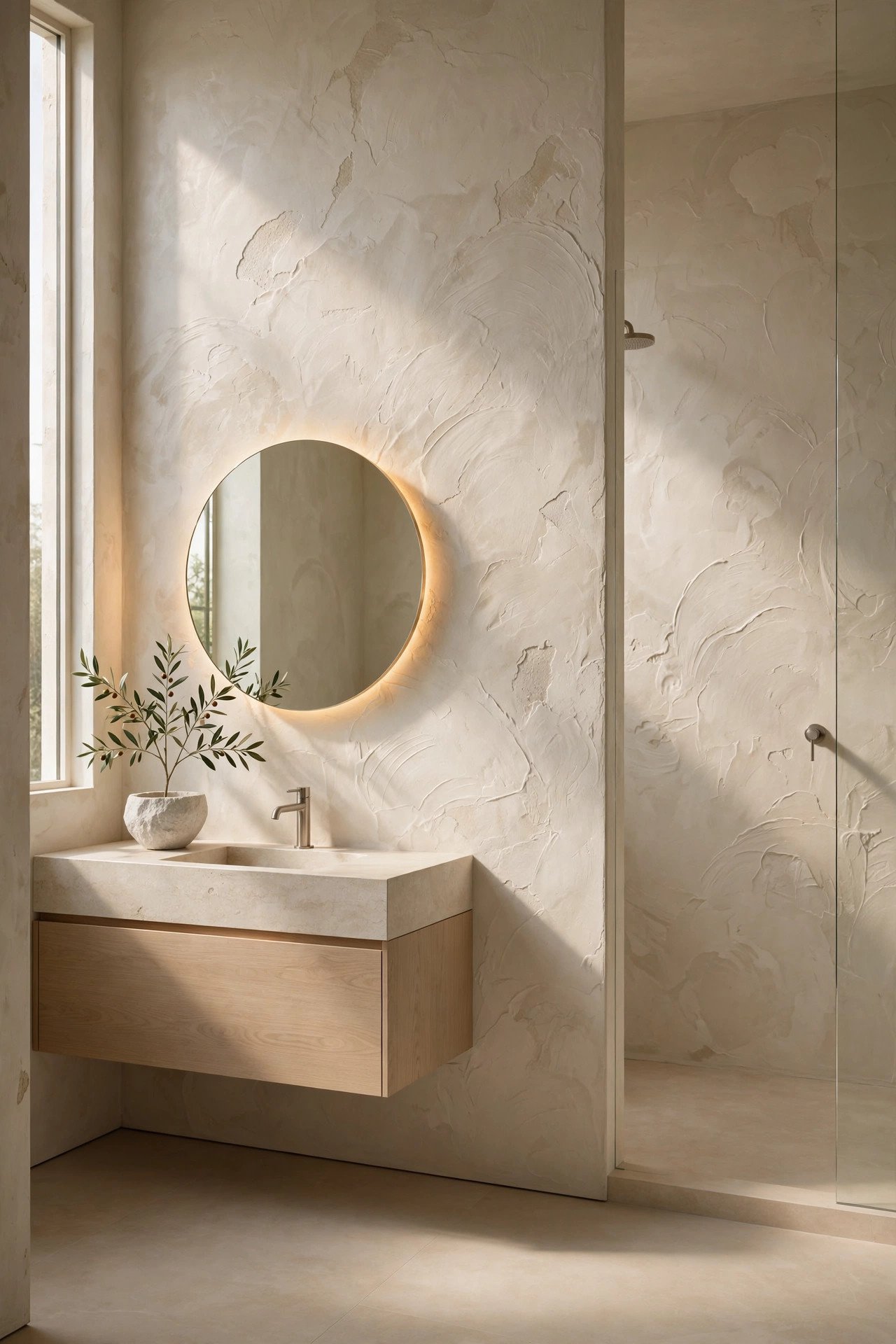
Traditional lime plaster and modern limewash paints both achieve the effect, with limewash offering an easier DIY path. Apply in loose, overlapping strokes for an organic, cloud-like finish. The slight mottling is the point: it gives walls a living quality that keeps minimalism from feeling sterile.
Pair plaster walls with simple, honest materials: a stone basin, an oak stool, matte black or brass fixtures. Keep the rest of the room equally quiet so the walls can be the textural hero. Plaster suits both shower walls, when properly sealed, and dry areas alike.
Choose moisture-appropriate products and sealers for bathroom use, and work with the natural variation rather than fighting it. Textured plaster proves that minimalist walls need not be boring; they can be the most beautiful surface in the room while saying almost nothing at all.
26. Monolithic Stone Basin
A monolithic stone basin, carved from a single block of travertine, marble, or basalt, brings raw geological beauty to a minimalist bathroom. Each piece is unique, with veining and texture formed over millennia. Sitting on a simple vanity or a stone plinth, it is functional sculpture at its most elemental.
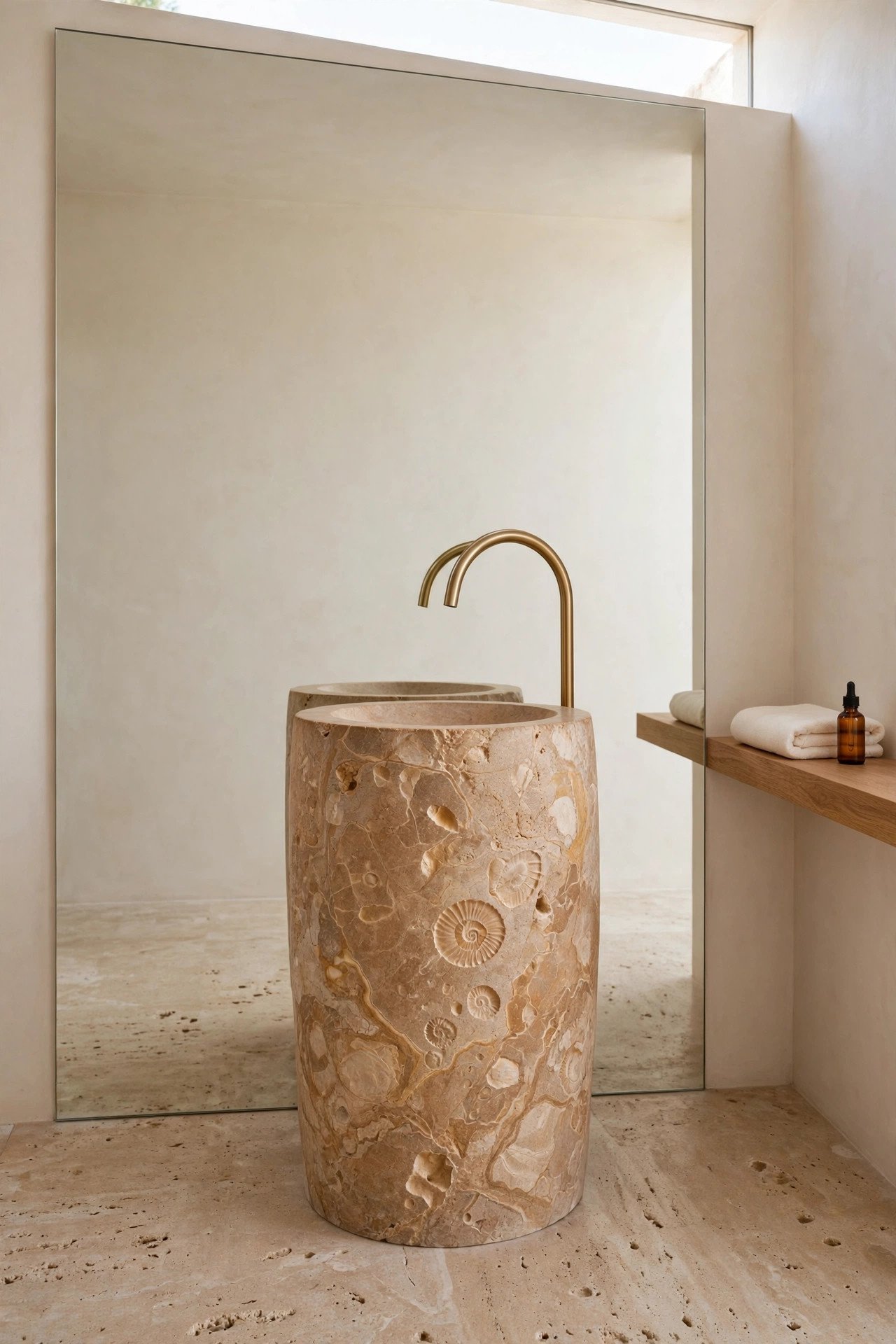
Let the basin be the undisputed focal point by keeping everything around it quiet: a plain wall, a simple round mirror, and a wall-mounted faucet that keeps the stone surface clear. The contrast between ancient stone and crisp minimalist geometry is striking and deeply calming.
Consider practicalities before committing: stone basins are heavy and require sturdy support, and porous stones need regular sealing to resist staining from soap and toothpaste. A honed finish hides wear better than polished. Choose a bowl depth that minimizes splashing for daily comfort.
Style around it with almost nothing: perhaps a small stone tray with soap and a single folded towel nearby. The basin itself provides all the visual richness the composition needs. A monolithic stone basin reminds us that minimalism, at its best, is about choosing fewer things of extraordinary quality.
27. Concealed Cistern Design
Concealing the toilet cistern inside the wall removes the last bulky remnant of traditional bathroom plumbing, leaving only a clean bowl and a slim flush plate visible. The wall becomes a smooth, uninterrupted plane that can even carry tile or plaster straight across. It is minimalism applied to the most functional corner of the room.
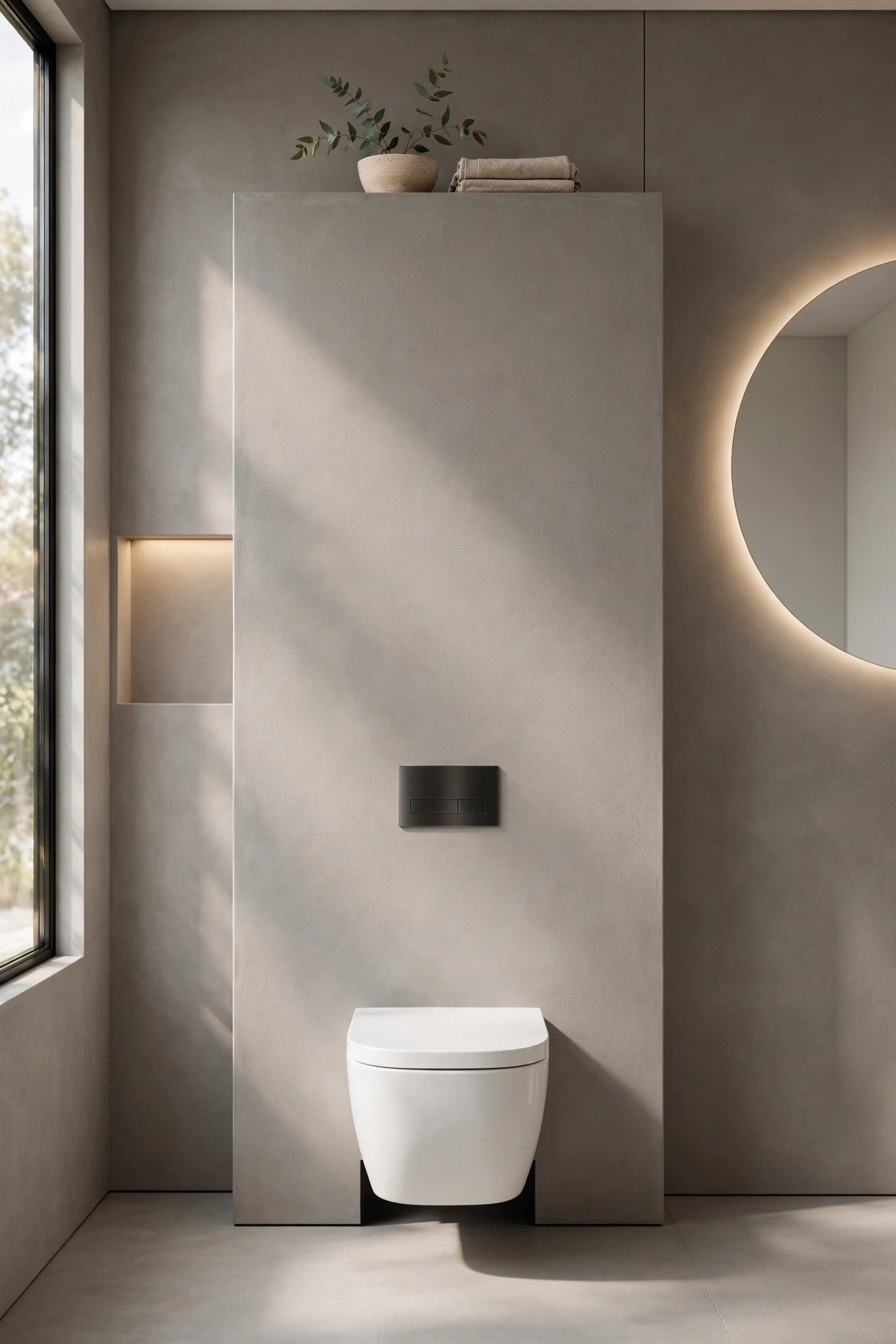
The system centers on an in-wall carrier frame installed during rough-in, which supports a wall-hung bowl and hides the cistern, pipes, and connections. Access for maintenance comes through the flush plate opening, so choose a reliable brand with readily available parts. This is proven, mainstream technology, not an experiment.
Design the flush plate as a deliberate detail: slim rectangles in chrome, matte black, or white that echo your fixture finishes. Some plates offer dual-flush water saving and touchless operation. Keep the surrounding wall free of decoration so the clean plane reads as intentional architecture.
The concealed cistern also simplifies cleaning dramatically, with no tank edges or pipe gaps collecting dust. Pair it with a wall-hung bowl for the full floating effect. This hidden engineering is the quiet backbone of the serene, seamless minimalist bathroom.
28. Minimalist Color Blocking
Color blocking brings quiet drama to minimalism by dividing the bathroom into a few large, deliberate planes of restrained color. A deep green or warm clay accent wall against pale surroundings, or a two-tone split of tile and plaster, adds architectural interest without pattern or ornament. Boldness through simplicity.
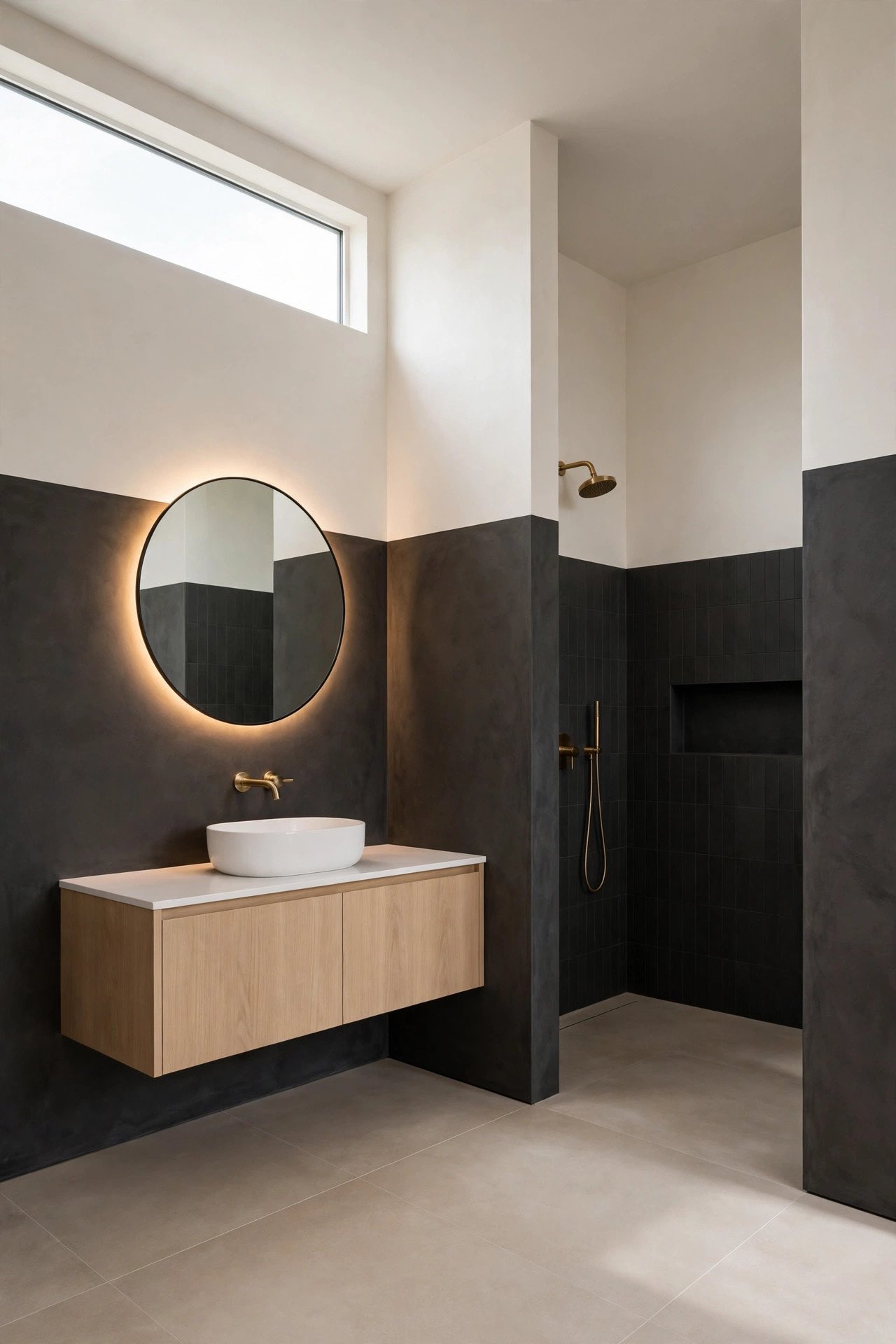
Limit the palette to two, at most three, muted tones: think sage with warm white, charcoal with pale gray, or terracotta with cream. The blocks should follow architectural lines, such as a full wall, a wainscot-height band, or the shower enclosure, so the color feels structural rather than decorative.
Keep everything else in the room neutral so the blocked color carries the full design weight. Fixtures, textiles, and accessories should echo the quieter tones. The restraint of the surrounding palette is what makes the single bold plane feel sophisticated instead of loud.
Test large swatches in the actual light before committing, since bathroom lighting shifts color significantly. Color blocking proves minimalism is not the absence of color but the discipline of it: one confident gesture, executed with precision, can define an entire room.
29. Japanese Inspired Simplicity
Japanese design philosophy is minimalism’s spiritual home, built on principles of ma, the beauty of empty space, wabi-sabi, the acceptance of imperfection, and shibui, quiet understated elegance. A Japanese-inspired bathroom favors natural materials, soft light, and uncluttered calm that feels meditative rather than merely tidy.
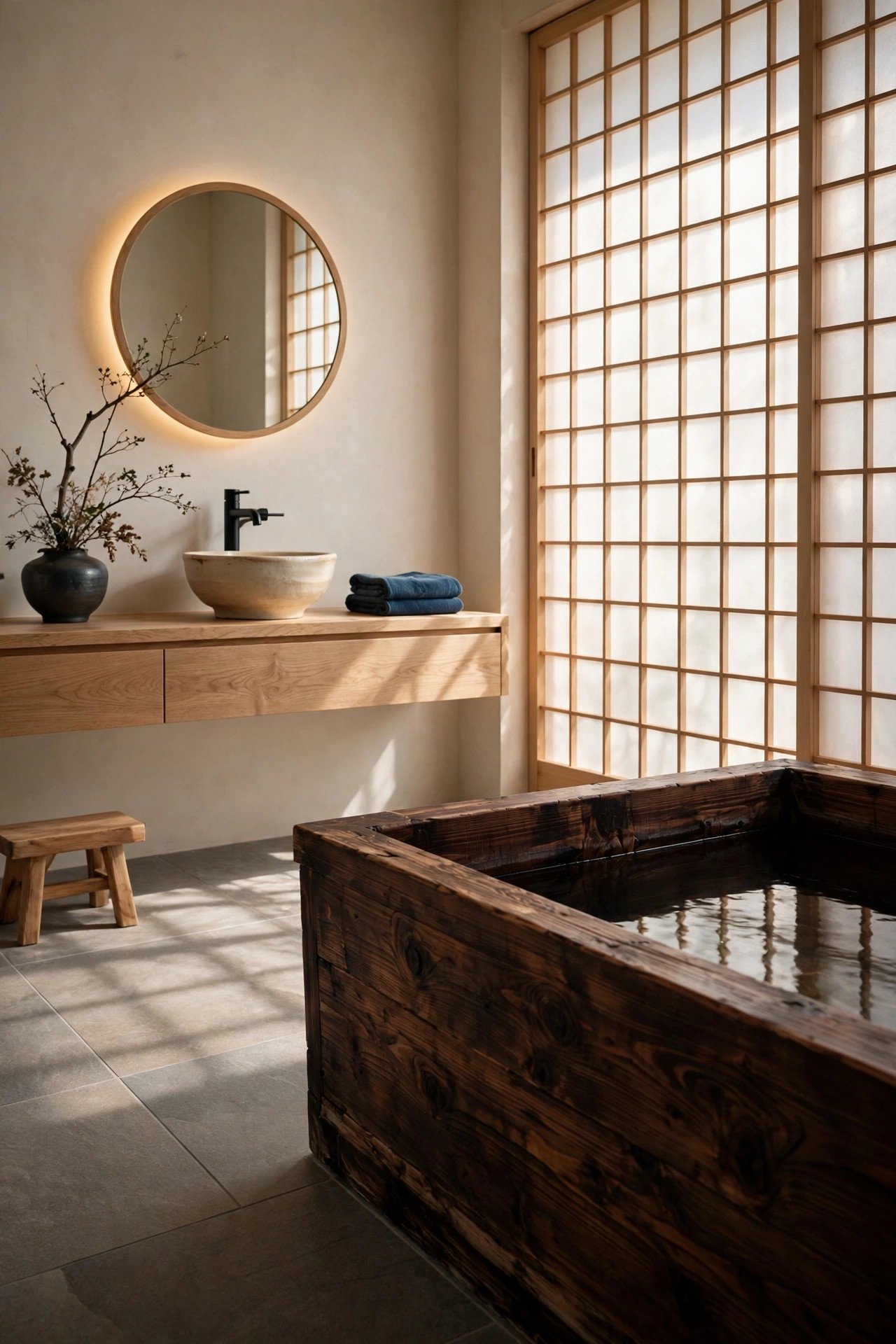
Incorporate a deep soaking tub reminiscent of an ofuro, hinoki wood accents or a cypress bath mat, and stone or pebble textures underfoot. Shoji-inspired frosted glass panels diffuse light softly while maintaining privacy. Keep the palette to warm whites, natural wood, and soft grays drawn from nature.
Embrace imperfection as beauty: a handmade ceramic vessel, a slightly irregular stone tile, or the visible grain of oiled wood adds the wabi-sabi warmth that keeps the room human. Arrange elements with generous negative space, allowing each object room to breathe and be appreciated individually.
Complete the atmosphere with restraint: a single branch in a vase, soft indirect lighting, and perhaps the scent of hinoki or yuzu. Japanese-inspired simplicity turns the bathroom into a place of daily renewal, proving that the deepest minimalism is a philosophy, not just a style.
30. Finishing Touch Ritual
The final minimalist idea is not a product but a practice: a finishing-touch ritual that keeps the bathroom serene every day. Minimalism only survives through maintenance, and a simple two-minute reset each evening preserves the calm your design created. The ritual is the design’s immune system.
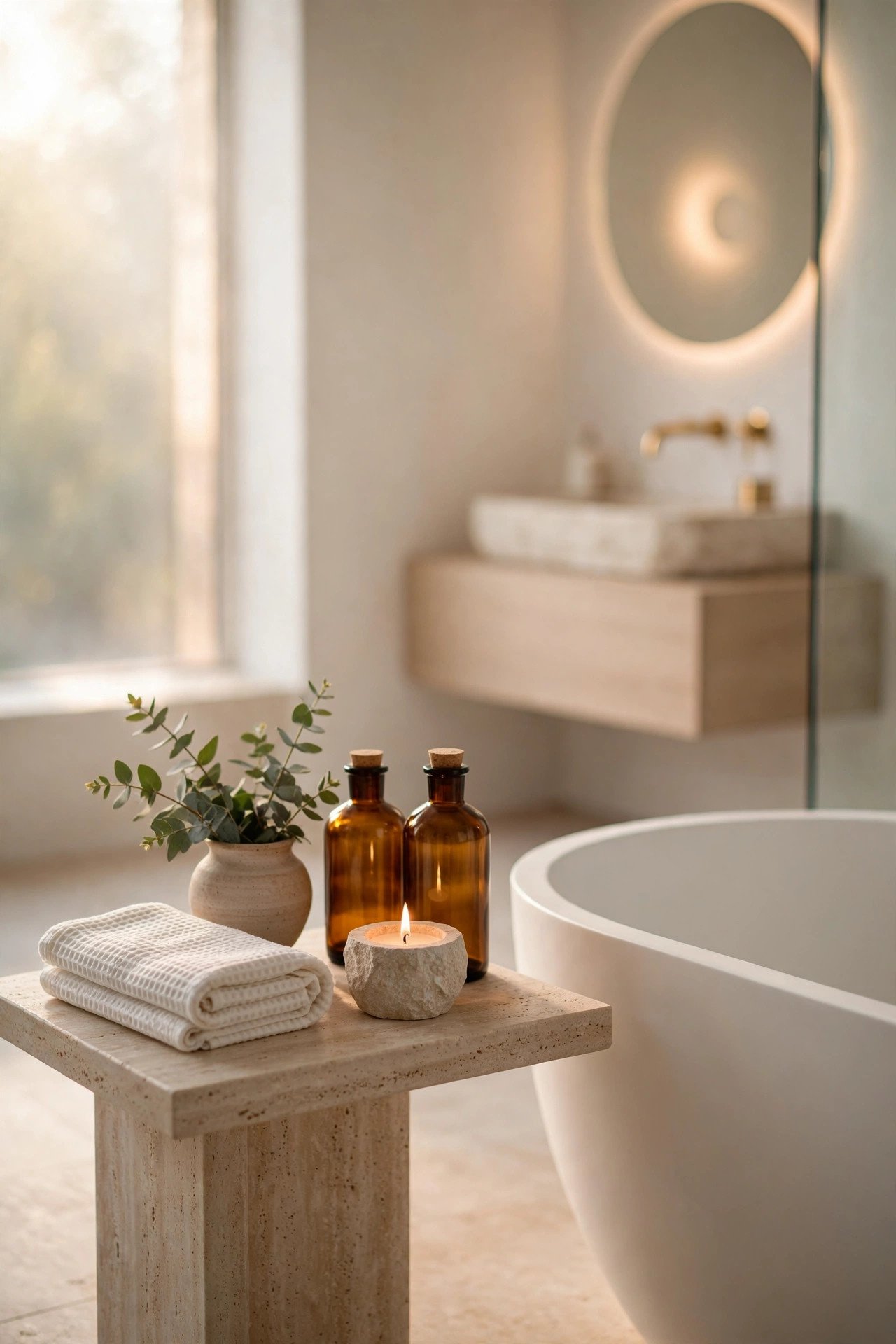
Build the habit: wipe the counter, return products to their hidden homes, hang towels neatly, and empty the bin. Keep cleaning supplies in one caddy inside the vanity so the reset takes moments. A squeegee on the shower glass after use prevents buildup and keeps frameless panels crystal clear.
Make the ritual pleasurable rather than dutiful: a beautiful tray that corrals the few counter items, matching dispensers that look good enough to display, and a diffuser that greets you with scent. When maintenance tools are beautiful and accessible, the habit sustains itself.
This daily practice is what separates minimalist bathrooms in magazines from ones that stay minimalist in real life. Design creates the potential for calm; ritual protects it. The finishing touch ritual is the thirty-first idea hidden inside the thirty: care, repeated daily, as the ultimate luxury.
Conclusion
Minimalism in the bathroom is ultimately an act of respect: for your space, your time, and your peace of mind. Across these thirty ideas, one truth repeats itself. Calm does not come from emptiness alone but from intention, from every fixture, finish, and object earning its place through beauty or function, preferably both. A floating vanity, a frameless shower, hidden storage, and layered light each remove a little noise, and together they compose a room that feels like a deep, unhurried breath.
Start wherever you are. A weekend of editing, decanting, and clearing surfaces can shift the mood dramatically, while a planned remodel lets you build in the bigger moves like wall-hung fixtures, microcement walls, and curbless showers. Keep your palette restrained, your lines clean, and your surfaces clear, and the minimalist calm will follow. Remember that minimalism is a practice, not a purchase: the daily two-minute reset protects everything your design achieves. The most beautiful minimalist bathrooms are not the emptiest ones; they are the ones where every remaining choice was made with care.
Key Takeaways
- Float the vanity and toilet and conceal plumbing in the wall to maximize visible floor and create effortless calm.
- Commit to one restrained palette, all-white, warm beige, or soft gray, and let texture rather than color create depth.
- Hide every toiletry in deep drawers, recessed cabinets, and shower niches so countertops stay completely clear.
- Use frameless glass, linear drains, and curbless entries to keep sightlines continuous and the room feeling larger.
- Layer dimmable lighting, task light at the mirror plus soft accent glows, to shift from bright mornings to serene evenings.
- Add warmth through one natural material, light oak, travertine, or a single plant, so minimalism feels human, not sterile.
- Protect the calm with a two-minute daily reset ritual, because minimalist design only survives through maintenance.