30 Mediterranean Bathroom Ideas That Bring Sun-Drenched Coastal Charm Home

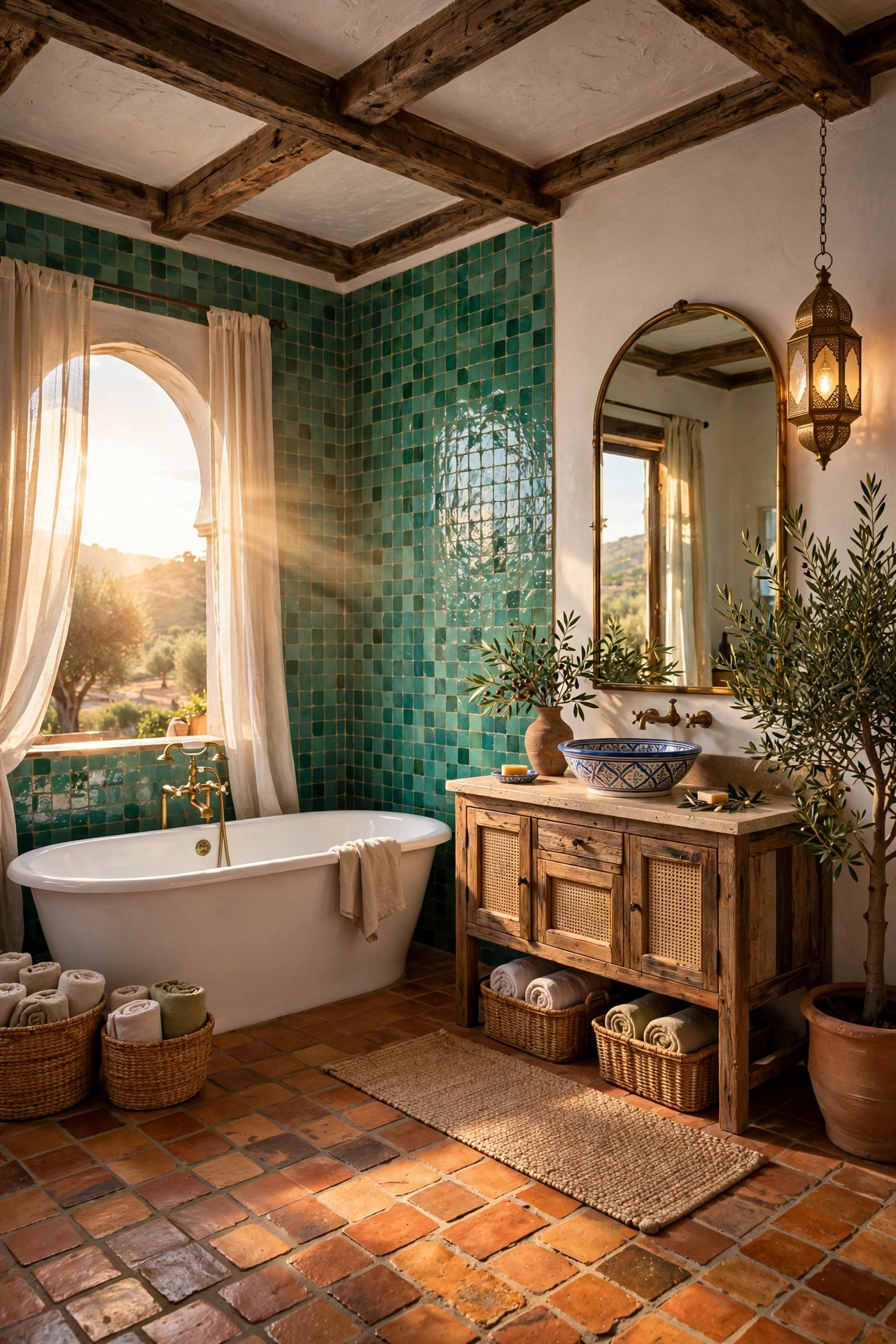
Close your eyes and picture a Mediterranean bathroom: sun-warmed terracotta underfoot, glossy zellige tiles catching the light, a softly arched niche holding folded linens, and air that seems to carry a hint of sea salt and citrus. It is a style shaped by centuries of coastal living, where beauty and practicality were never separate things.
The Mediterranean look is really a family of styles — Spanish hacienda, Italian villa, Greek island, Moroccan riad, Portuguese quinta — united by warm natural materials, handcrafted tile, and rooms designed to stay cool and calm. Think limewashed plaster walls, weathered wood beams, wrought iron, and mosaics in sea blues and sun-baked earth tones.
You do not need a villa on the Amalfi Coast to capture it. A single arched mirror, a hand-painted basin, or a floor of terracotta-look tile can shift an ordinary bathroom toward the Mediterranean in a weekend. The secret is layering: one hero feature, a few honest materials, and styling that feels gathered rather than staged.
In this guide you will find thirty distinct ideas, from dramatic mosaic fountains to the smallest citrus-print towel. Whether you are planning a full renovation or simply want to bring a little coastal warmth into the room you have, there is something here to inspire your next move.
1. Terracotta Tile Flooring
Nothing says Mediterranean like terracotta underfoot. Those warm, sun-baked clay tiles — in shades from pale honey to deep rust — have floored homes around the Mediterranean for centuries, and they bring instant warmth to any bathroom. Their natural variation means no two tiles look alike, which is precisely the charm.
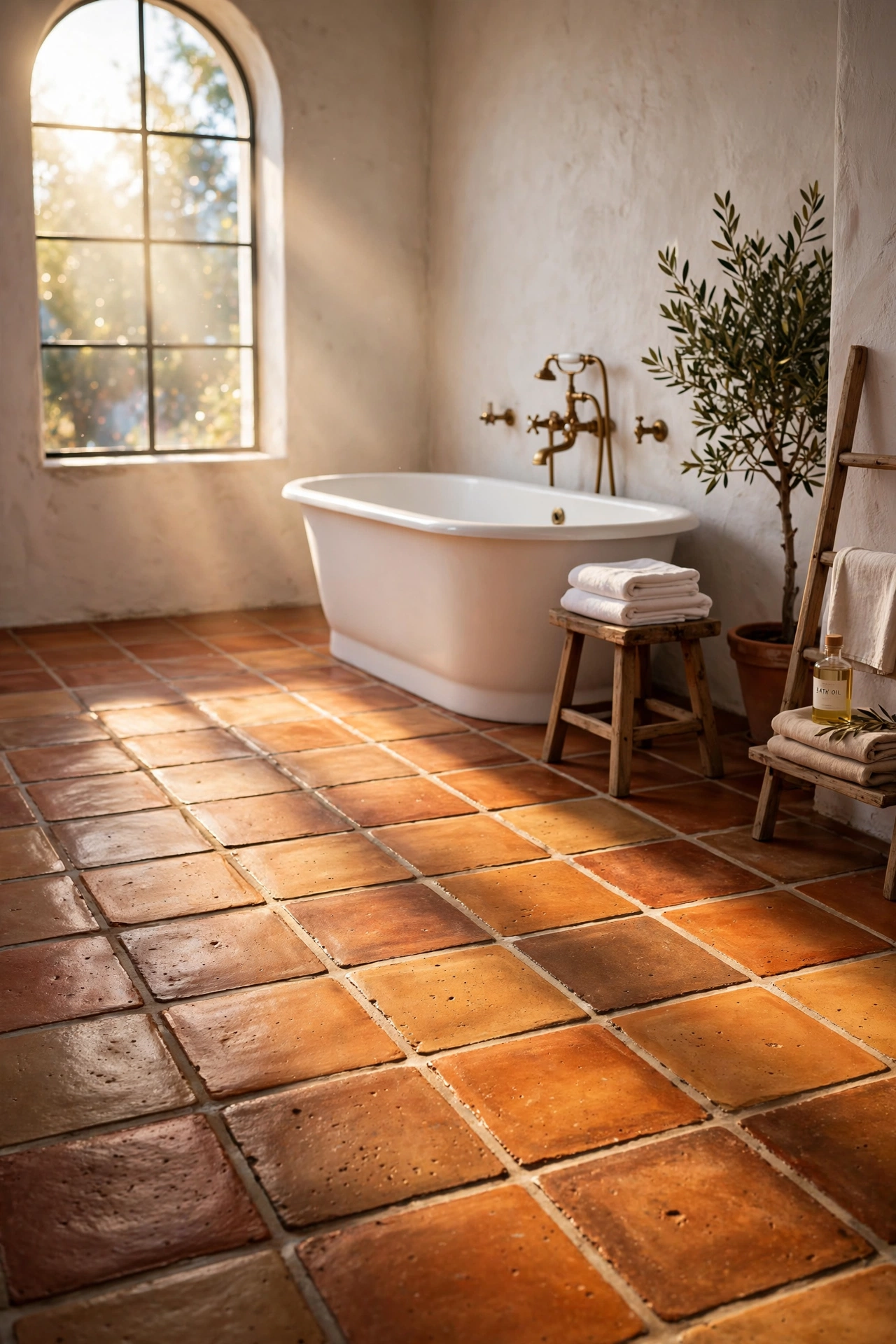
Traditional terracotta is wonderfully tactile and stays cool in summer, a quality old Mediterranean builders prized. In a modern bathroom, seal it properly with a penetrating sealer and it will handle daily splashes beautifully. Choose square, hexagonal, or handmade-look formats for different moods — hexagons feel Spanish, large squares feel Tuscan.
If natural clay feels like too much maintenance, porcelain lookalikes capture the colour and variation with near-zero upkeep. Pair terracotta floors with whitewashed walls and the contrast does all the decorating for you: the floor glows while the walls recede into calm.
Finish with a simple woven runner and let the floor be the star. Terracotta grounds the whole room in warmth, and everything you place on it — a wooden stool, a potted olive, folded white towels — looks instantly more intentional.
When ordering terracotta, buy ten percent extra and keep a box of spares — handmade tiles vary between batches, and spares make future repairs invisible. A breathable natural sealer, reapplied every couple of years, keeps the clay glowing.
2.Glossy Zellige Wall Tile
Zellige — the hand-cut, hand-glazed tile of Morocco — is the jewel of Mediterranean bathrooms. Each small square varies slightly in tone and surface, so a whole wall shimmers with handmade life that machine-made tile can never imitate. In sea greens, deep blues, or warm whites, it turns a shower or splashback into art.


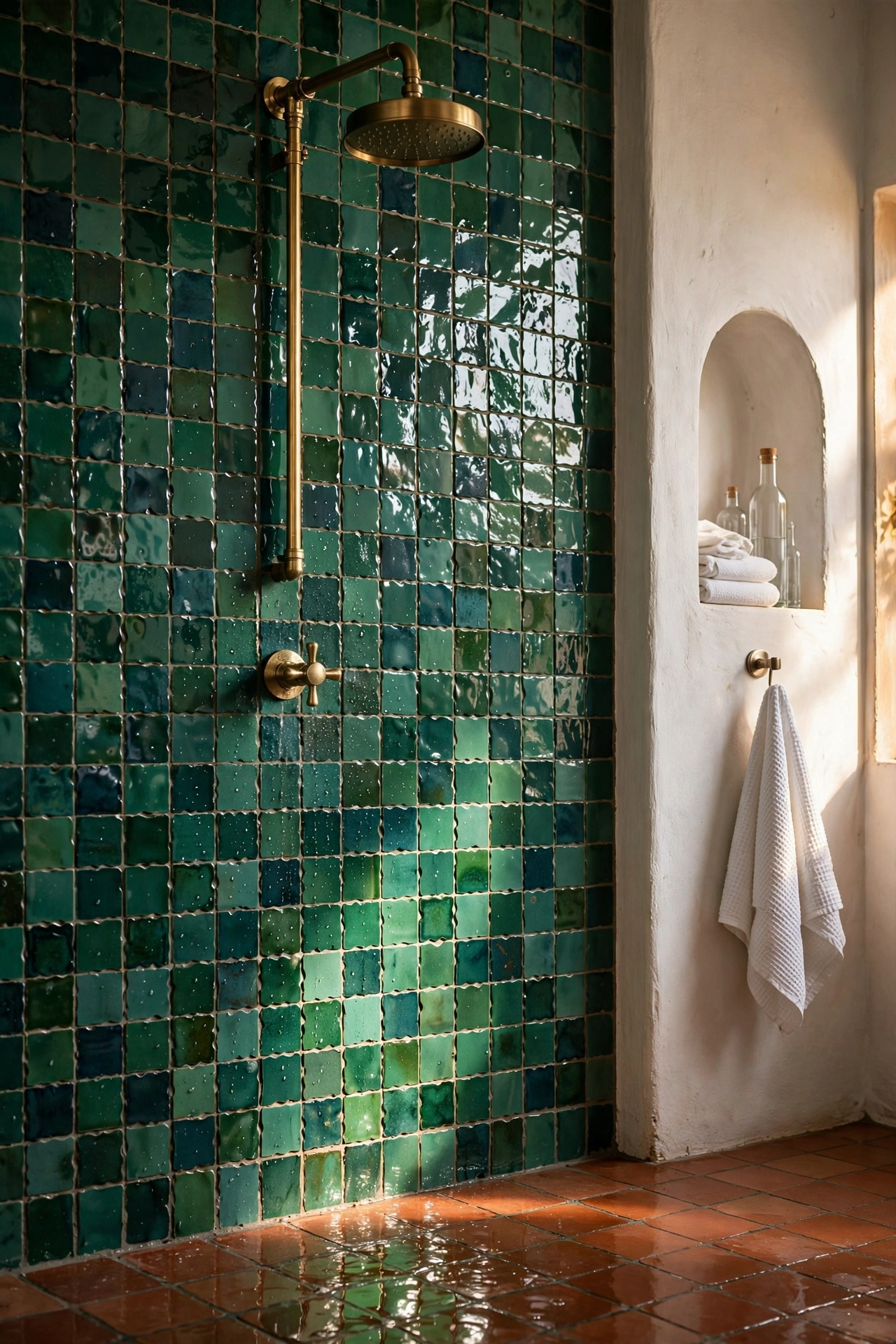
The classic application is a shower wall or a full-height feature wall behind the vanity. Because zellige tiles are small and irregular, they forgive imperfect walls and create beautiful plays of light, especially under warm lighting or beside a window. The grout lines, kept tight, become part of the texture.
Genuine zellige is a craft product with a craft price, so use it strategically: a single feature wall, a shower niche lining, or a border band. Porcelain zellige-look tiles give a similar shimmer at a friendlier price for larger areas, and mixing the two is a well-kept designer secret.
Pair zellige with simple plaster walls and one strong material — terracotta, wood, or brass — so the tile’s shimmer stays the hero. This is a surface people will touch; make sure it earns the attention.
Because every zellige tile is slightly different, blend tiles from several boxes as you lay them so the variation spreads evenly. A good tiler will dry-lay a section first — ask to see it before adhesive goes down.
3.Arched Shower Alcove
The arch is the Mediterranean’s signature shape, and an arched shower alcove brings instant old-world architecture into the bathroom. Whether carved into a thick plastered wall or framed with tile, the curved opening softens the room’s geometry and creates a delicious sense of enclosure.
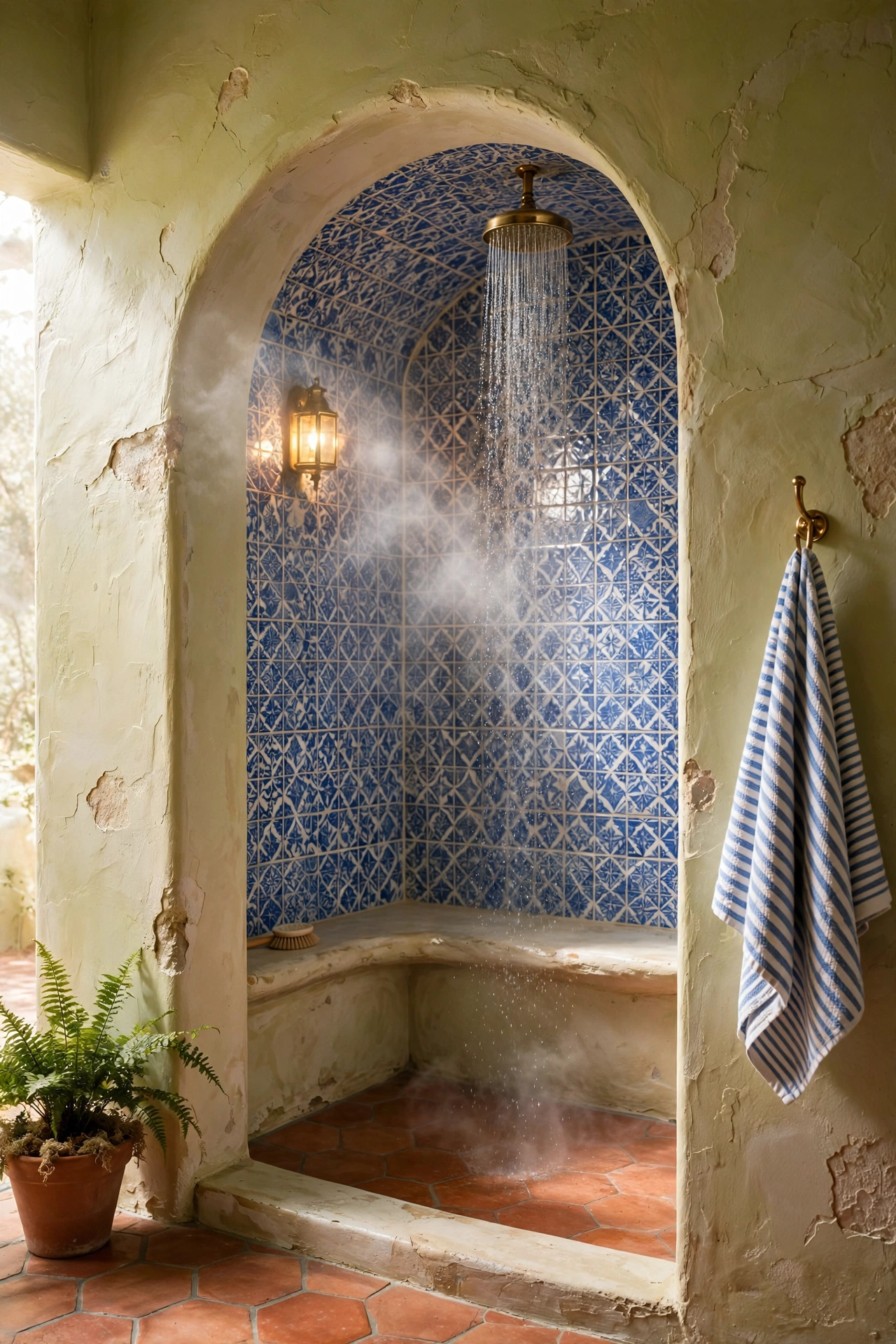
Arches work at any scale. A full walk-in shower set into a barrel-vaulted or arched recess feels like a Roman bathhouse; a smaller arched niche inside a standard shower gives you the same romance in a fraction of the space. The curve can be formed with flexible backer board during a renovation, or faked convincingly with an arched tile border.
Tile the inside of the arch in something special — zellige, small mosaics, or a contrasting terracotta — so stepping through feels like entering a different, more luxurious zone. A brass rain showerhead on the curved back wall completes the grotto effect.
Even without plumbing changes, an arched mirror or an arched doorway into the bathroom nods to the same language. Once you start seeing arches, you will want them everywhere.
If you are forming an arch during a renovation, photograph the framing before the plasterer closes it up; future you will thank present you when hanging anything heavy nearby. Arches also hide a multitude of sins in older, uneven walls.
4. Limewashed Plaster Walls
Limewash is the soul of Mediterranean walls: a traditional lime-based paint that dries with soft, cloudy movement, giving flat walls the depth of old plaster. In warm whites, pale ochres, and soft clay tones, it wraps a bathroom in a glow that flat emulsion can never match.
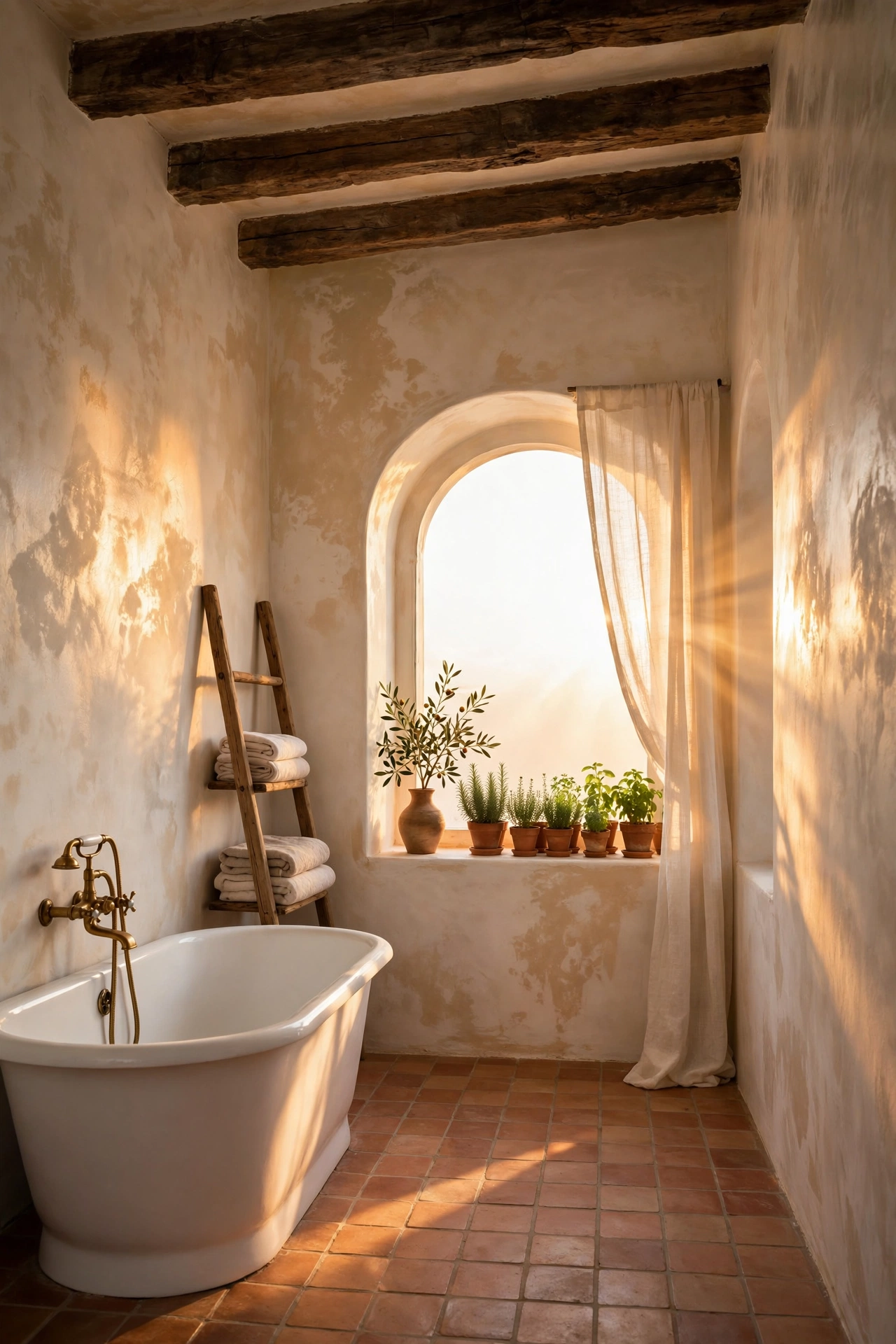
Beyond looks, limewash is naturally breathable and mildly antimicrobial — qualities that made it the finish of choice in humid coastal homes for centuries. Modern mineral paints based on the same chemistry handle bathroom steam well, especially with good ventilation.
Application is forgiving and even enjoyable: broad, crisscross brush strokes build the characteristic mottled effect, and a second coat deepens the movement. Choose a warm white for a Greek-island feel, or a pale terracotta or sage for Spanish warmth.
Keep the rest of the palette quiet so the walls can do their subtle work. Limewash pairs beautifully with wood beams, terracotta floors, and aged brass — materials that share its handmade, time-softened character.
Limewash keeps best when the room is well ventilated — run the extractor for twenty minutes after steamy showers. Touch-ups blend invisibly, so keep a small pot of the same batch for scuffs and you will never see a repair.
5.Exposed Wooden Ceiling Beams
Dark wooden beams crossing a whitewashed ceiling are pure Mediterranean drama. They add architectural weight, draw the eye upward, and instantly suggest a farmhouse in Andalusia or a villa in Provence — even in a new-build bathroom.
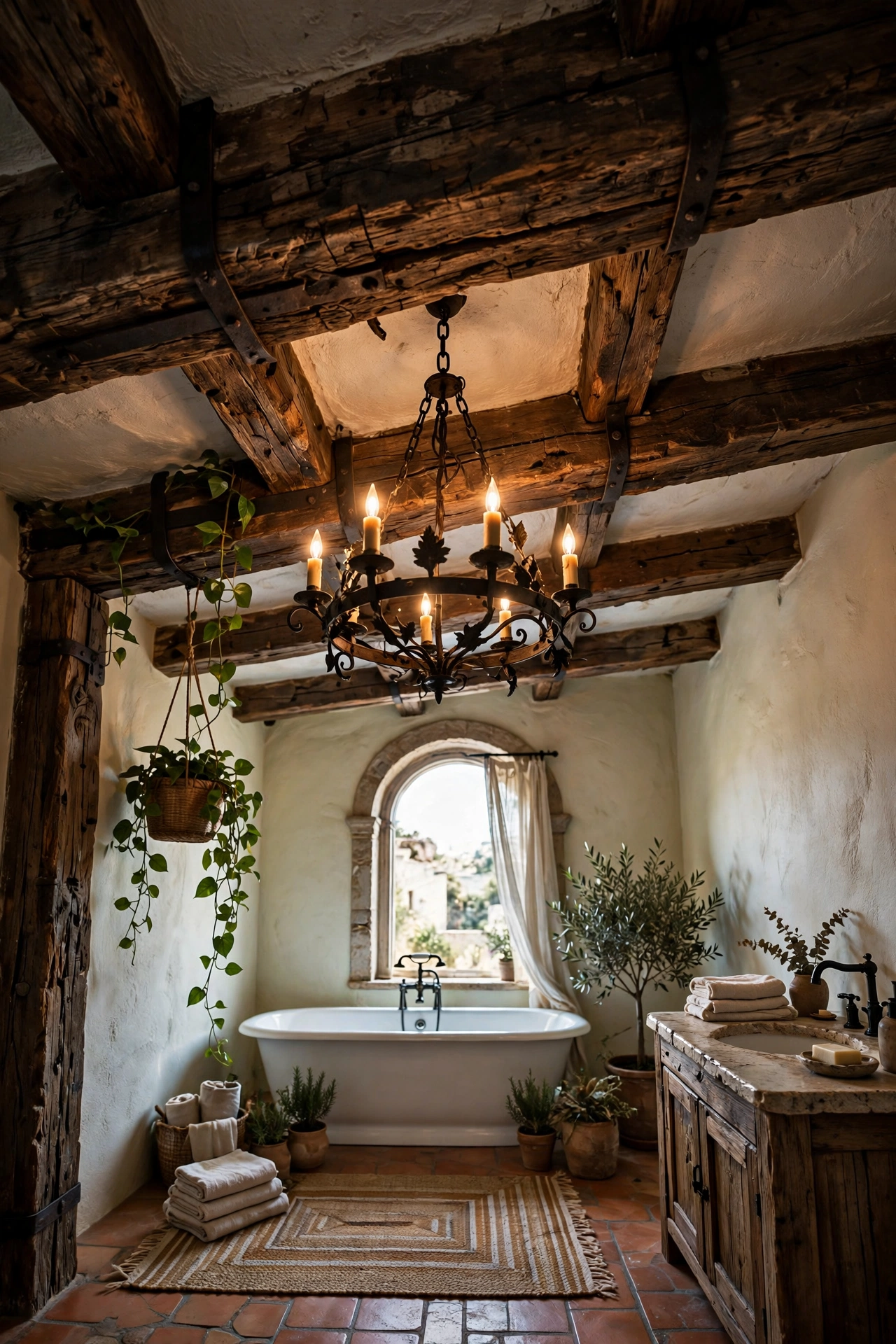
Real structural beams are a gift if you have them; simply clean and seal them. If not, lightweight faux beams in wood-look polyurethane or reclaimed-look timber install easily and convince completely from below. Stain them in a warm walnut or weathered grey-brown to contrast with white plaster.
Beams also solve a practical problem: they give you something beautiful to hang things from. A wrought-iron chandelier, a cluster of pendant lanterns, or even trailing plants suspended from a beam all feel natural and unforced.
Balance the heaviness above with lightness below — white sanitary ware, pale walls, a simple floor. The beams provide the character; everything else can stay calm and let them speak.
Before installing faux beams, check what is above the ceiling — pipes and wiring routes matter more than looks. Stain all sides before lifting them into place; touching up overhead is miserable work best avoided.
6.Hand-Painted Ceramic Sink
A hand-painted ceramic basin is the Mediterranean bathroom’s piece of jewellery. Whether it is Spanish Talavera, Italian majolica, Portuguese azulejo-style, or Moroccan patterned ware, the painted vessel turns the most-used fixture in the room into a work of art.
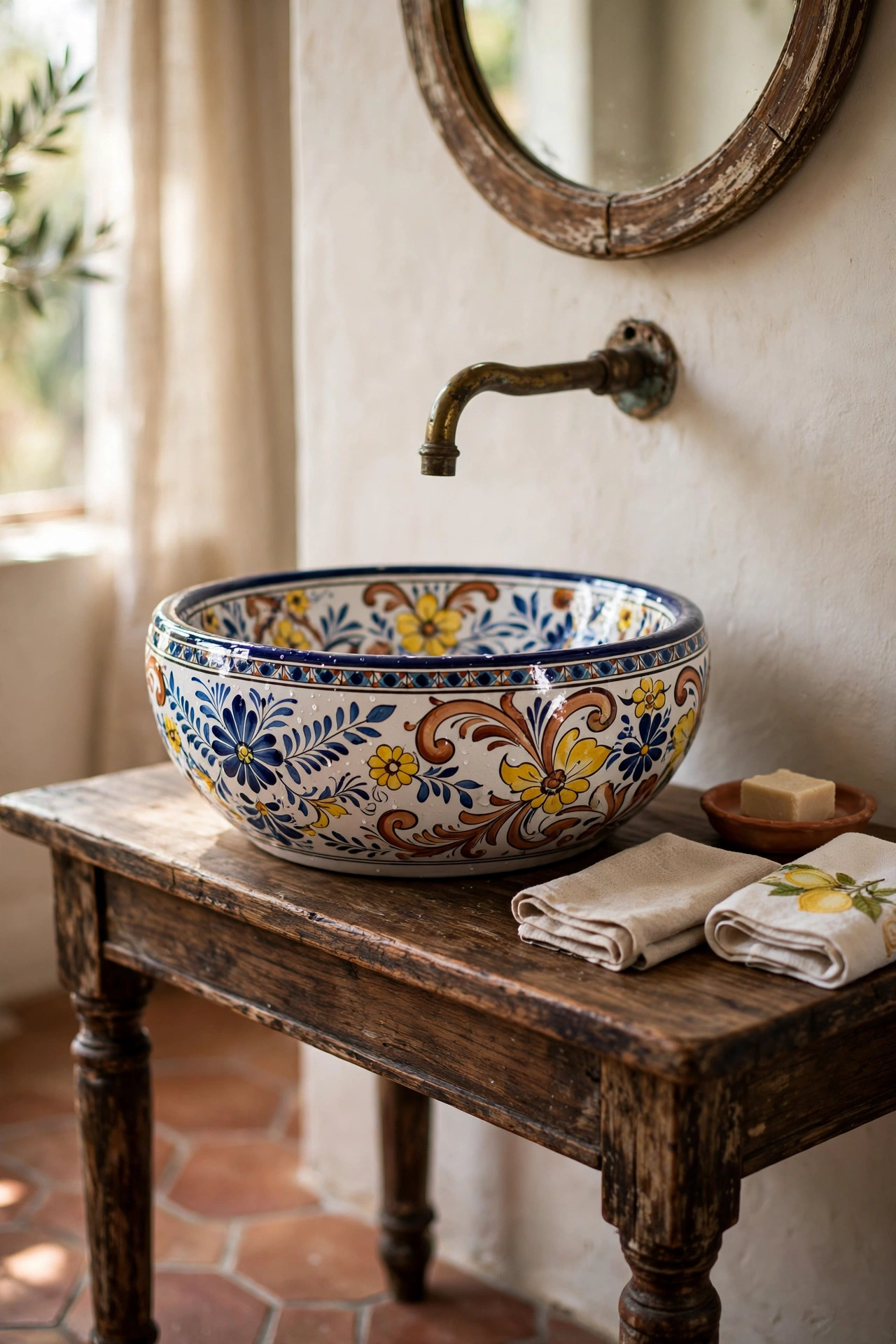
Vessel basins show off painted designs best, sitting proud on a wooden or stone vanity like a beautiful bowl. Choose blues and whites for a classic coastal feel, or rich multicolour patterns for a Moroccan-riot-of-colour moment. One painted basin is a statement; a matching pair on a double vanity is pure luxury.
Because the basin is the artwork, keep its surroundings simple: a plain stone or wood top, a quiet wall, minimal clutter. Let the painting be the only pattern in the immediate vicinity.
These basins are widely available from artisan importers and also as high-quality reproductions. Either way, buy from a maker who fires for bathroom use so the glaze stands up to daily water and cleaning.
When buying a painted basin, ask for the maker’s care sheet and keep harsh limescale removers away from the glaze. A soft cloth and mild soap preserve hand-painted detail for decades of daily use.
7.Indoor Mosaic Fountain
Few things say Mediterranean luxury like the sound of trickling water. A small wall-mounted mosaic fountain — tiled in blues, greens, and golds — brings the courtyard riad indoors and turns the bathroom into a genuine retreat.
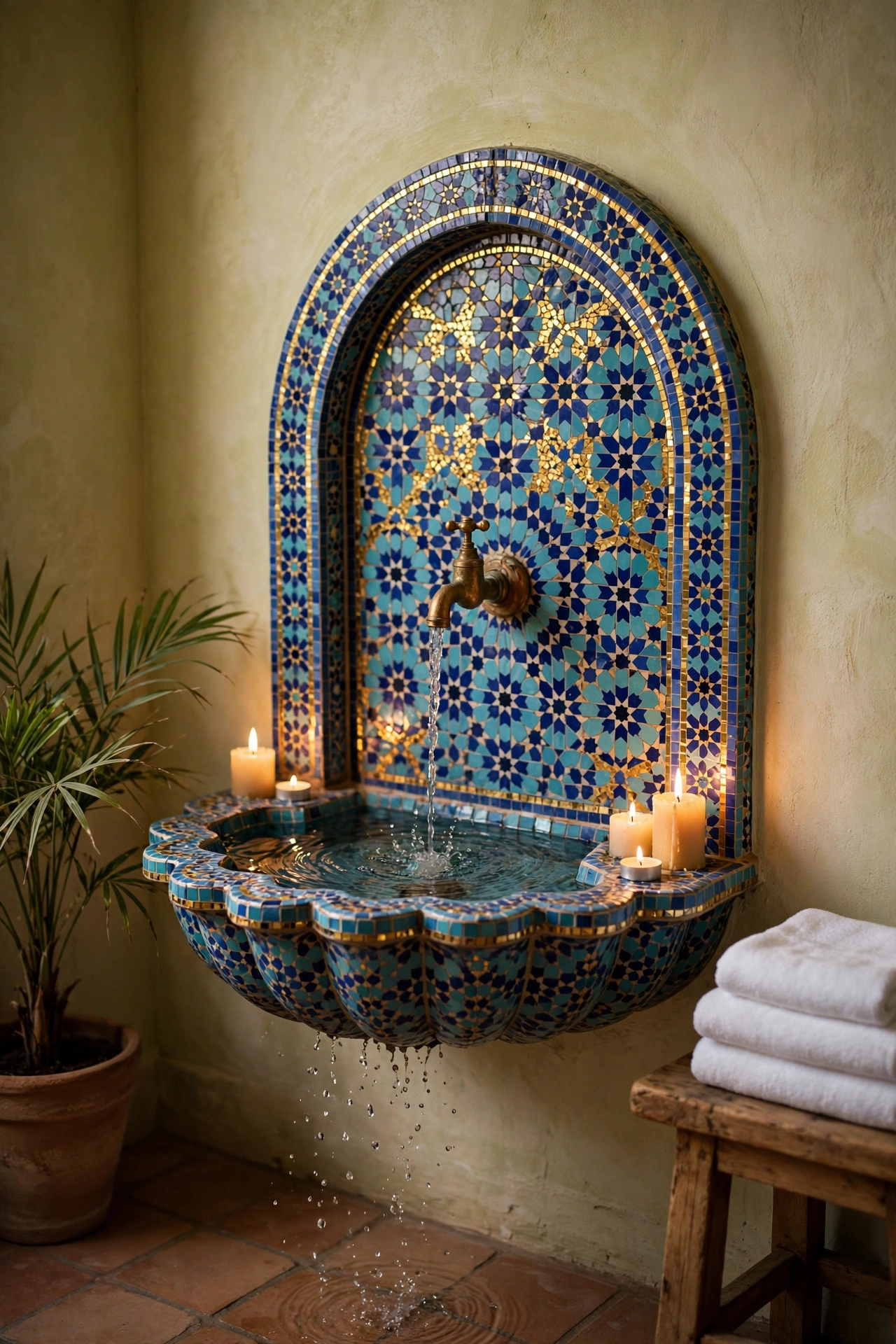
You do not need a palace for this. Compact electric wall fountains designed for interiors recirculate water quietly and mount like a piece of art. Surround one with mosaic tile, set a small basin beneath to catch the flow, and you have a spa soundtrack on demand.
Style the fountain as a vignette: potted ferns or a small citrus tree beside it, candles on the ledge, a stack of folded towels nearby. The combination of moving water, greenery, and warm light is deeply calming.
If a real fountain is too much, even a fountain motif delivers the mood — a mosaic tile panel depicting water, or a basin shaped like a traditional courtyard spout. The suggestion of water is almost as soothing as the thing itself.
Choose a fountain with an adjustable pump so you can tune the trickle from lively to barely-there. Top up the water weekly — evaporation in a warm bathroom is faster than you expect — and the pump will run quietly for years.
8.Sea-Glass Blue Cabinetry
Sea-glass blue — that soft, weathered blue-green of old bottles tumbled by the sea — is the Mediterranean’s perfect cabinet colour. Painted on a vanity or storage cupboard, it brings coastal calm without the cliché of bright nautical blue.
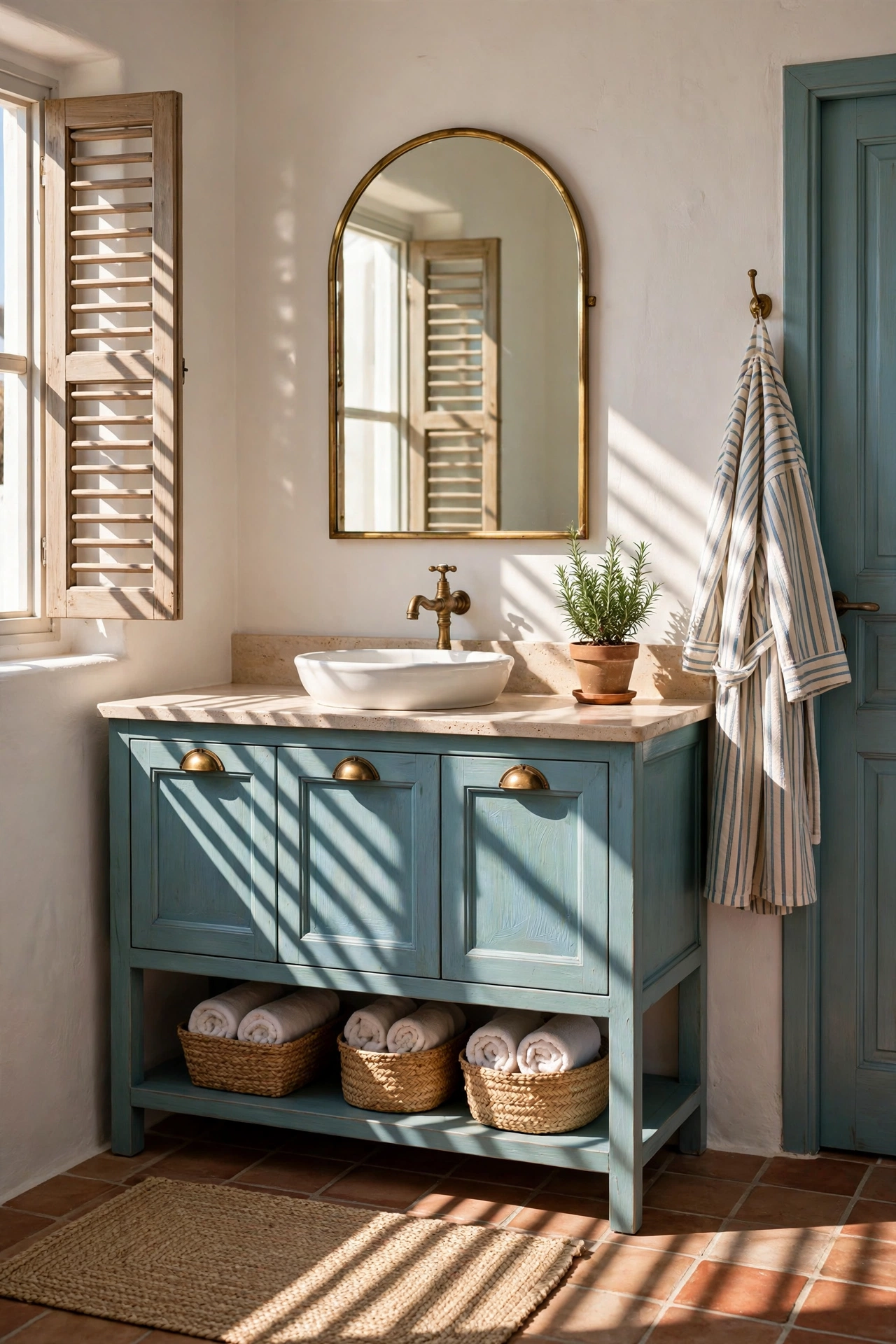
The colour works because it sits between blue and green, reading as natural rather than decorative. Pair it with warm whites, terracotta, and brass, and it glows; the warm metals stop it feeling cold, while the pale walls keep it fresh.
Use a moisture-resistant satin or eggshell paint made for bathrooms, and do not skimp on prep — sand, prime, and seal for a finish that survives steam. If a full vanity in colour feels bold, try it on a small linen cupboard or the inside of open shelving first.
Style blue cabinetry with natural textures: woven baskets, linen towels, a wooden-framed mirror. The contrast of soft blue against warm wood is one of the Mediterranean palette’s happiest marriages.
Test your sea-glass blue in the actual bathroom light before committing: north-facing rooms cool blues down, while warm bulbs bring out the green. Paint a large sample board and live with it for three days.
9.Wrought Iron Lighting
Wrought iron light fixtures bring old-world craft to the Mediterranean bathroom. Curved arms, scrolled details, and candle-style bulbs recall Spanish haciendas and Italian farmhouses, casting warm pools of light that flatter both tile and skin.
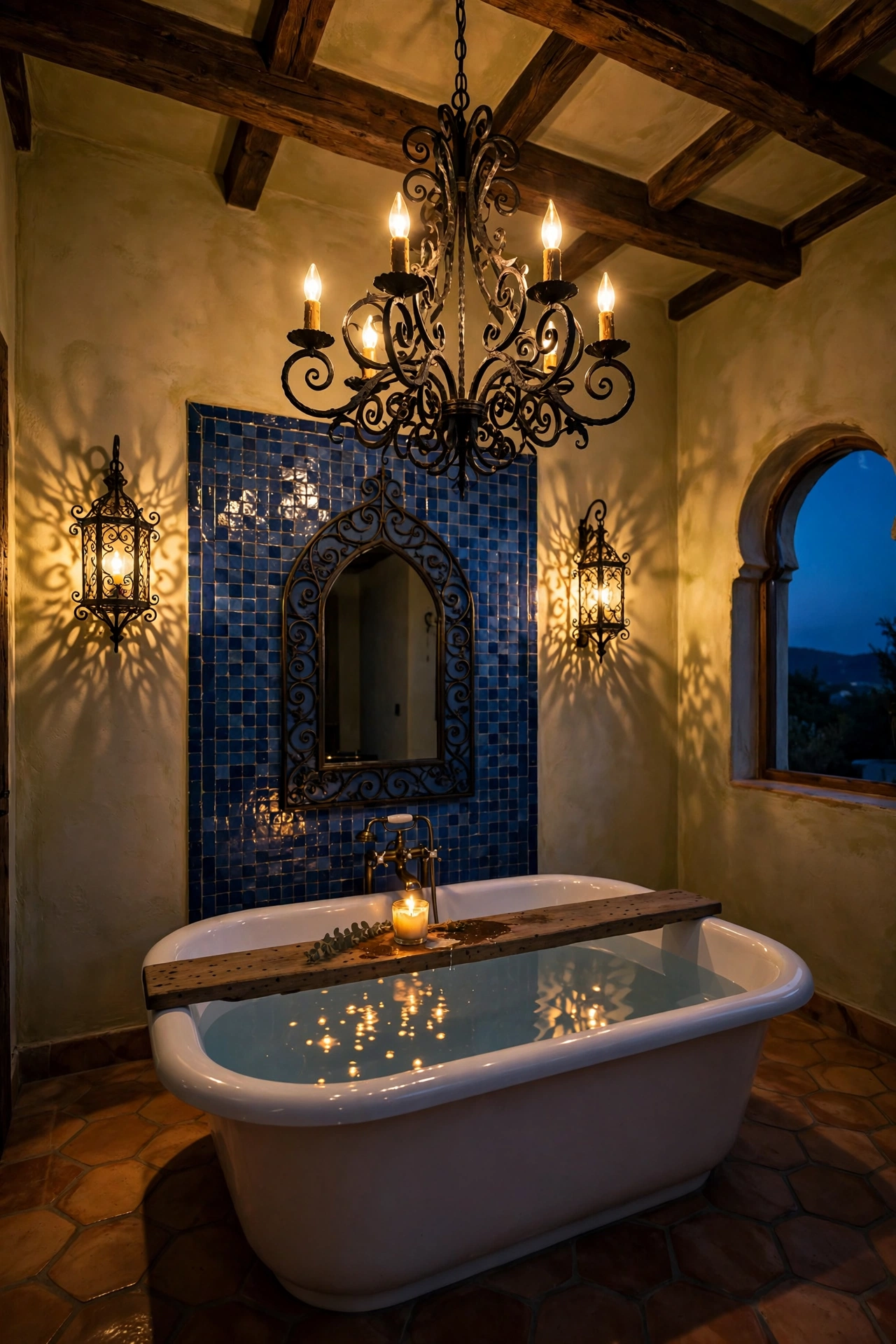
A wrought-iron chandelier over a freestanding tub is the showstopper move, but smaller gestures work beautifully too: a pair of scrolled wall sconces flanking a mirror, or a single iron pendant over the vanity. Look for hand-forged pieces — their slight irregularities are the whole point.
Keep the finish dark and matte — blackened iron or oil-rubbed bronze — so the fixtures read as silhouettes against pale walls. In a bathroom, always confirm the fitting is rated for damp zones, and use warm-toned LED filament bulbs for candlelight glow without the heat.
Iron pairs naturally with wood beams, terracotta, and plaster. It is the dark punctuation that keeps all that sunlit softness from floating away.
Put every bathroom light on a dimmer — wrought iron fixtures look twice as good at half brightness. Dimmers also extend bulb life and let you shift from bright morning routines to candlelit evening soaks.
10.Olive Branch Styling Touches
The olive branch is the Mediterranean’s quiet emblem — silvery-green leaves, gnarled beauty, a symbol of peace that suits a bathroom perfectly. A single branch in a tall vase brings sculptural calm to a vanity, shelf, or bathtub corner.
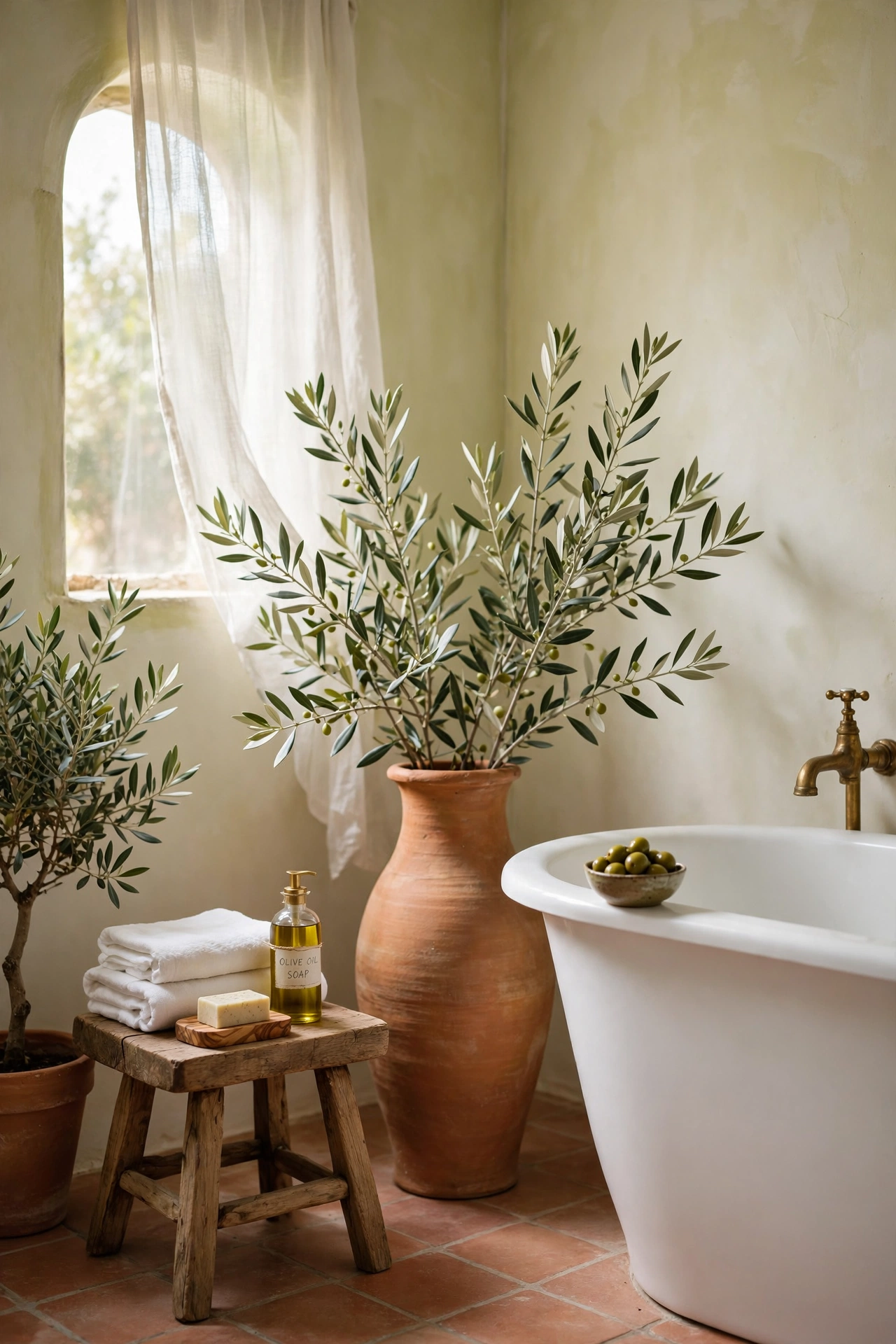
Fresh olive branches last well in water and dry gracefully if you forget them, turning a soft silver-grey that looks intentional. For a no-maintenance version, high-quality faux olive stems are now remarkably convincing; choose ones with varied leaf tones rather than flat green plastic.
Olive motifs extend beyond the living branch: olive-print textiles, a small potted olive tree in a terracotta pot by the window, or olive-wood accessories like a soap dish or bath caddy. Each nods to the same landscape.
Keep olive styling sparse — one branch, one tree, one motif. Like the landscape it comes from, this styling works through restraint: a single silvery note against warm plaster and terracotta.
A tall, narrow vase keeps olive branches upright without crowding the vanity, and a few pebbles in the base stop it tipping. Change the water weekly and trim stems at an angle to keep fresh branches drinking.
11.Arch-Shaped Mirror
An arch-shaped mirror is the fastest way to give a bathroom Mediterranean bones. The curved top echoes the doorways, windows, and niches of old coastal architecture, softening all the room’s hard rectangles in a single gesture.
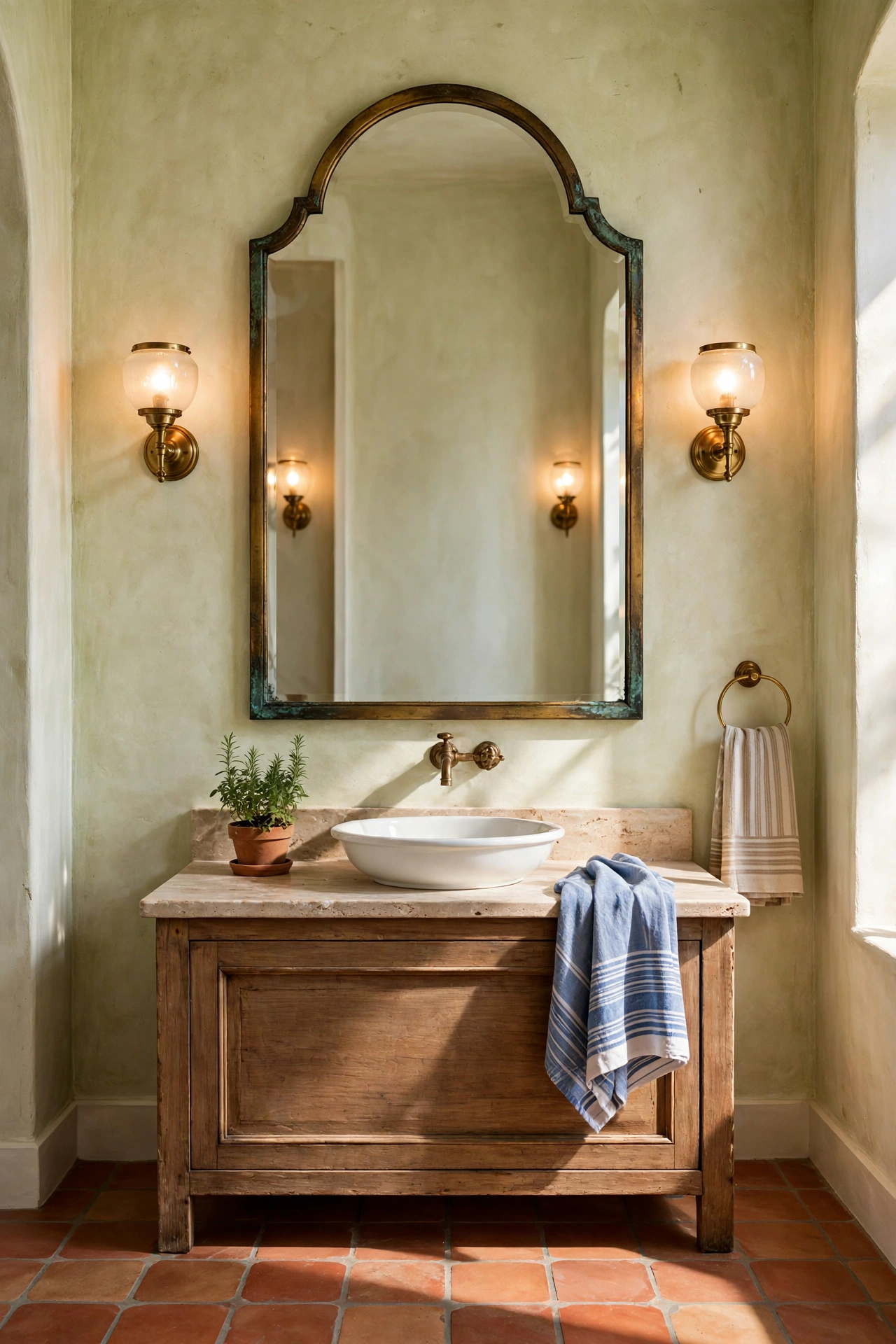
Scale it generously — a tall arch mirror over the vanity becomes the room’s focal point, especially in a slim dark frame or aged brass. Iron frames feel Spanish, brass feels Italian, and a thick whitewashed wood frame feels unmistakably Greek island.
Hang the mirror so its centre sits at eye level, and give it breathing room: a plain limewashed wall behind it lets the silhouette shine. Flank it with simple sconces and the arch will catch and double their warm light beautifully.
For a double vanity, a pair of matching arch mirrors is pure symmetry and pure Mediterranean. Even a small arched mirror in a powder room punches far above its size — the shape does all the work.
When hanging a heavy arched mirror, fix into studs or solid masonry — plasterboard fixings alone are a gamble. Two people, a level, and fifteen unhurried minutes beat a crooked mirror every time.
12.Rattan Storage Baskets
Rattan and wicker baskets bring natural texture and honest practicality to the Mediterranean bathroom. Rolled towels, spare toilet paper, bath toys, laundry — everything looks better corralled in warm woven fibres.
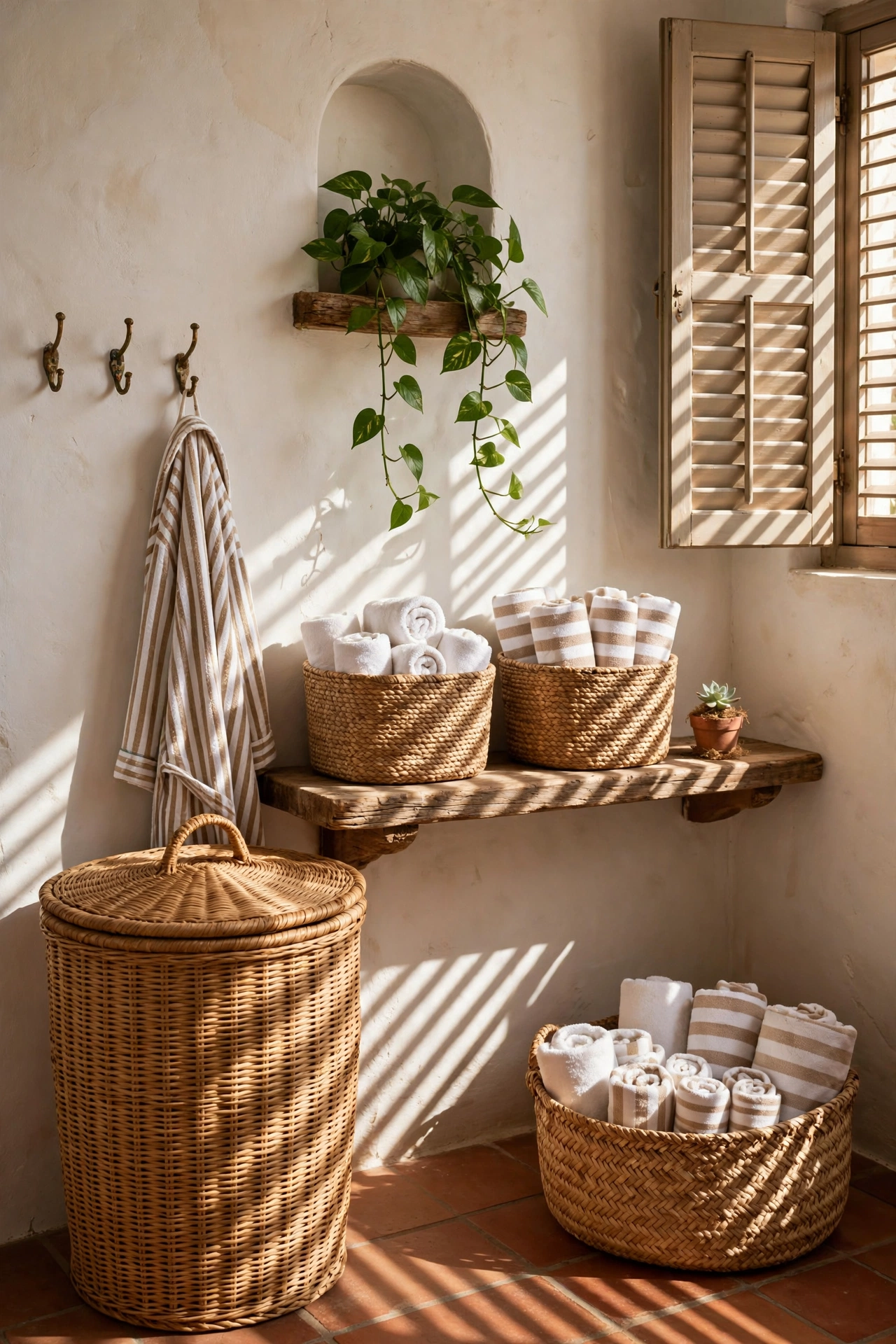
Choose tightly woven seagrass or rattan in honey tones, and look for baskets with lids for a tidier look on open shelves. A large lidded hamper, a pair of lidded baskets under the vanity, and one open basket of rolled towels is a complete storage story.
In a humid bathroom, keep baskets off constantly wet floors — a low wooden stand or the vanity shelf underneath works well — and choose washable or well-sealed weaves. Good-quality rattan handles bathroom air fine with basic ventilation.
The real magic is textural: woven fibres against cool tile, smooth plaster, and gleaming brass. That contrast of rough and smooth is at the heart of Mediterranean interiors, and baskets deliver it for very little money.
Label-free baskets look calmer, so decant everyday items into simple jars before they go in. Once a month, empty each basket completely — it is the only way to stop bathroom clutter breeding in the dark.
13.Travertine Vanity Top
Travertine — the pitted, honey-toned limestone of Roman ruins and Tuscan villas — makes a magnificent vanity top. Its natural voids and warm veining give every slab a one-of-a-kind character that polished marble cannot match.
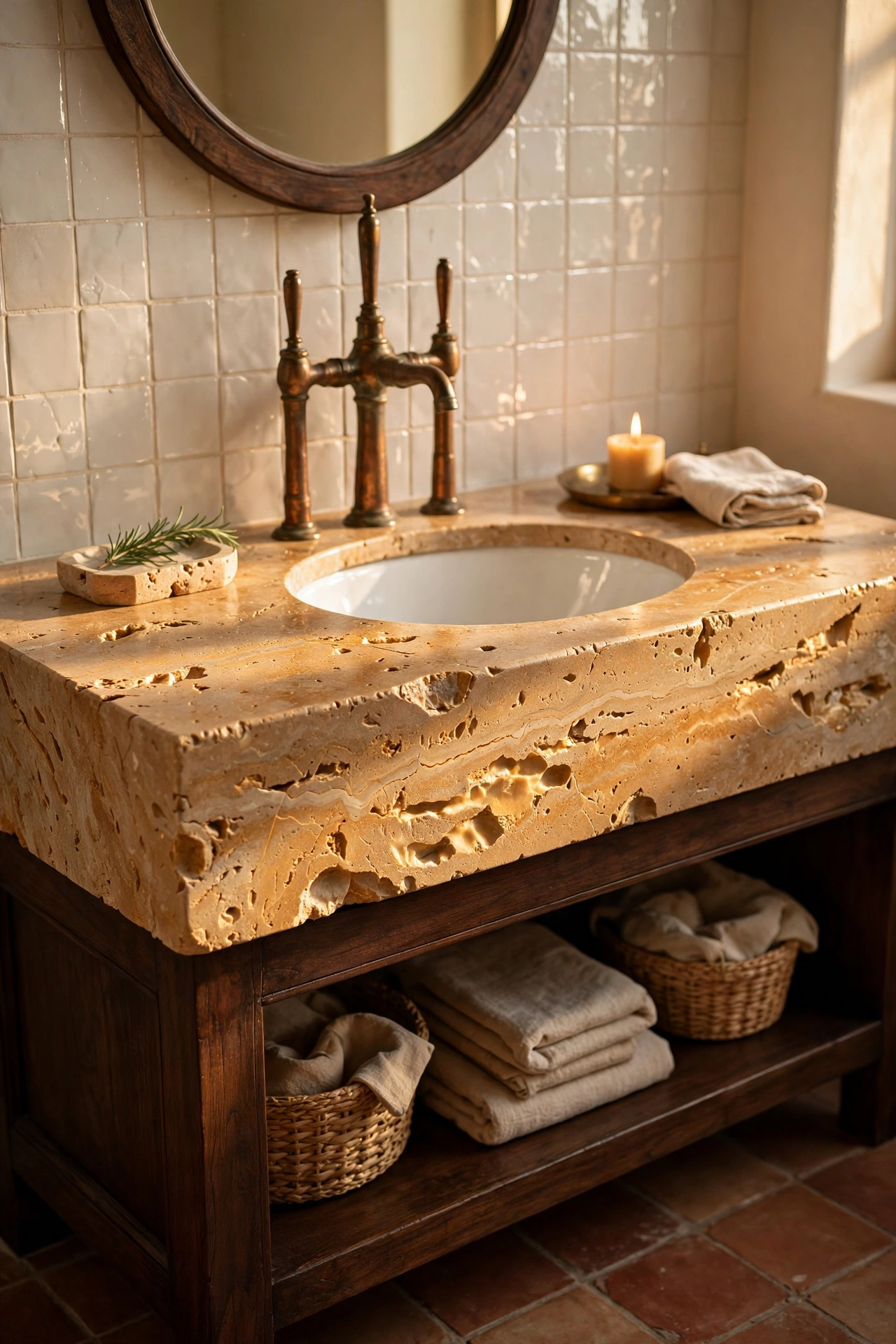
Honed travertine (matte rather than glossy) suits bathrooms best: it hides water spots, feels soft under hand, and reads as ancient rather than flashy. The pits can be left open for a rustic look or filled and honed for a smoother, more practical surface — filled is the easier choice for a busy family bathroom.
Seal travertine well and reseal yearly; it is a porous stone that rewards a little care. Pair it with a simple undermount or vessel basin so the stone stays the star, and warm brass or aged copper taps to echo its honey tones.
Even a small travertine remnant — a shelf, a bath caddy, a soap dish — brings the material’s warmth into the room. But a full vanity top in this stone is the kind of luxury you touch every single day.
Ask your stone supplier for offcuts when pricing a travertine top; a remnant big enough for a vanity costs far less than a full slab. Bring your basin template when you go, so the cutter works to exact measurements.
14.Blue-and-White Patterned Tile
Blue-and-white patterned tile — Portuguese azulejos, Spanish Talavera, Greek island motifs — is the Mediterranean’s most joyful surface. A splashback, shower wall, or floor border in these crisp patterns brings instant holiday spirit.
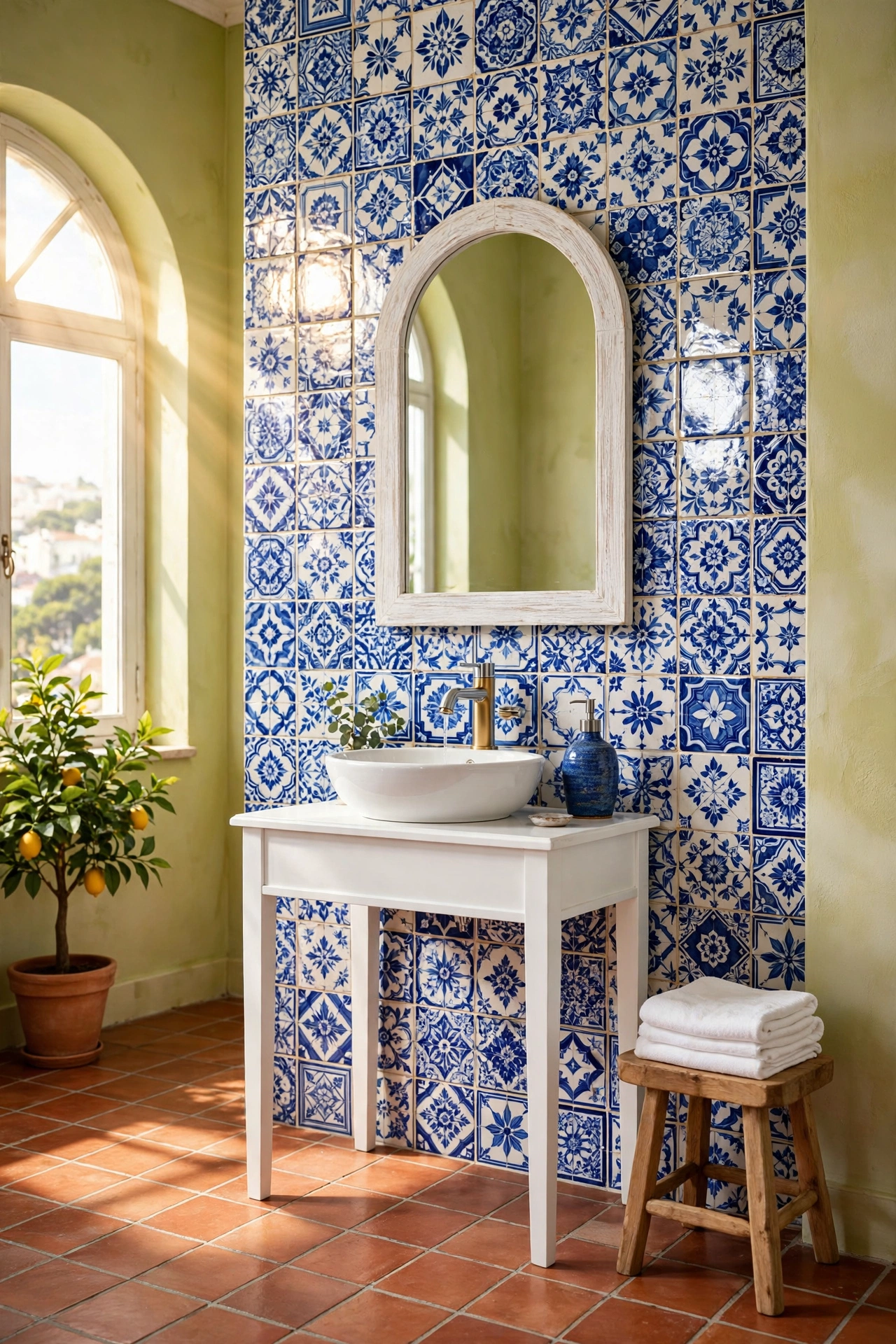
The trick is dosage. A full room of bold pattern can overwhelm; a single feature wall, a shower niche, or a border band at dado height gives you the joy without the chaos. Let the patterned tile be the room’s one loud voice, with quiet plaster and plain floors as its audience.
Mixing patterns within the same colour family is a traditional Mediterranean move — old homes accumulated tiles over decades. If you mix, keep the palette tight (blues and whites only) so the variety reads as collected rather than clashing.
These tiles also make wonderful small moments: a patterned tile tray on the vanity, a framed panel of tiles as art, or stair-riser-style strips on the side of the bath. Pattern, used sparingly, is pure Mediterranean happiness.
Order one extra box of patterned tile beyond your measurements — patterns make cutting wasteful, and matching dye lots later is nearly impossible. Store spares flat somewhere dry; they are gold dust for repairs.
15. Curved Plaster Vanity
A curved, plastered vanity — built from masonry or microcement and finished in smooth lime plaster — is sculptural Mediterranean luxury. With no sharp corners and a soft, seamless surface, it looks carved from the wall itself, like the built-in furniture of old island homes.
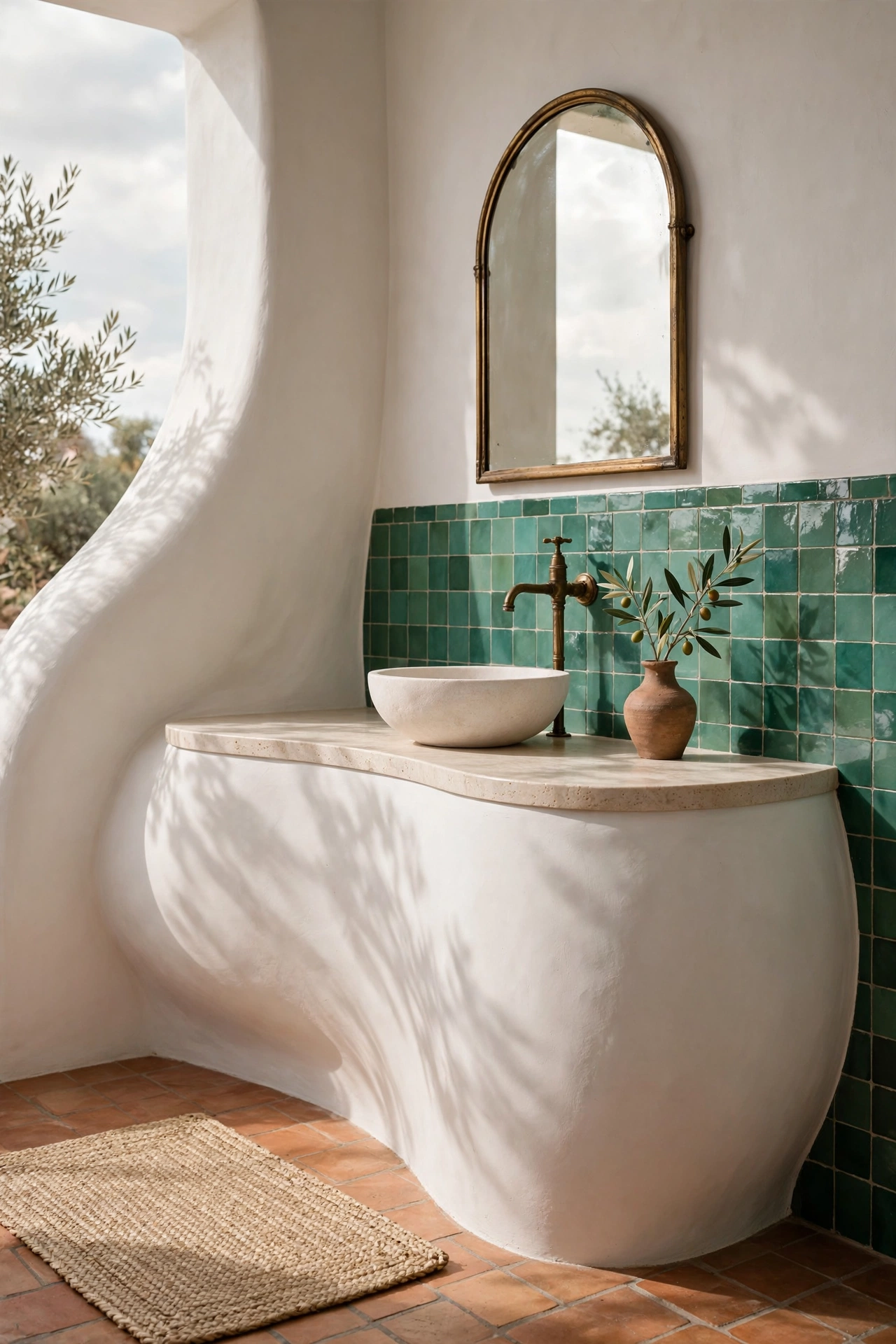
The practical wins are real: curved fronts are kinder to hips in tight bathrooms, seamless surfaces have no grout to scrub, and a floating curved vanity makes the floor easy to clean. Tiled or plastered in zellige or microcement, it becomes a genuine piece of architecture.
This is a bespoke piece, so plan it during a renovation: a mason or specialist plasterer forms the curve, and the top can be stone, wood, or more of the same seamless plaster. Keep the basin simple — a vessel bowl or integrated trough — so the curve stays the hero.
Style it minimally: the vanity is already the sculpture. A single branch in a vase, a folded towel, and beautiful taps are all the dressing it needs.
A curved vanity needs precise plumbing rough-in, so finalise your tap and waste positions before the plasterer starts. Mark them on the floor in tape and live with the layout for a few days first.
Mediterranean Bathroom Feature Budget & Style Guide
| Feature | Budget Range | Notes |
|---|---|---|
| Terracotta or stone-look floor tile | $6—$20 per sq ft | Warm, timeless; seal natural clay well |
| Zellige / handmade wall tile | $15—$45 per sq ft | Use on a feature wall to control cost |
| Arched mirror or alcove detail | $90—$500 | Instant Mediterranean architecture |
| Limewash / mineral wall paint | $40—$90 per gallon | Cloudy old-plaster effect; breathable |
| Faux or reclaimed wood beams | $150—$600 | Big drama; confirm ceiling can take weight |
| Hand-painted ceramic basin | $200—$800 | One statement piece; keep surround plain |
| Wrought iron / lantern lighting | $80—$500 | Must be damp-rated; warm LED bulbs |
| Travertine vanity top | $400—$1,200 fitted | Honed finish; reseal yearly |
| Rattan baskets + linen textiles | $80—$300 | Texture layer that warms the whole room |
| Mosaic fountain or water feature | $150—$700 | Recirculating electric; near-silent pump |
16. Citrus Motif Linens
Lemons, oranges, and their blossoms are the Mediterranean’s happiest motif, and citrus-print linens bring that sunshine straight into the bathroom. Hand towels, a shower curtain, or a bath mat patterned with lemons and leaves feel instantly like an Amalfi summer.
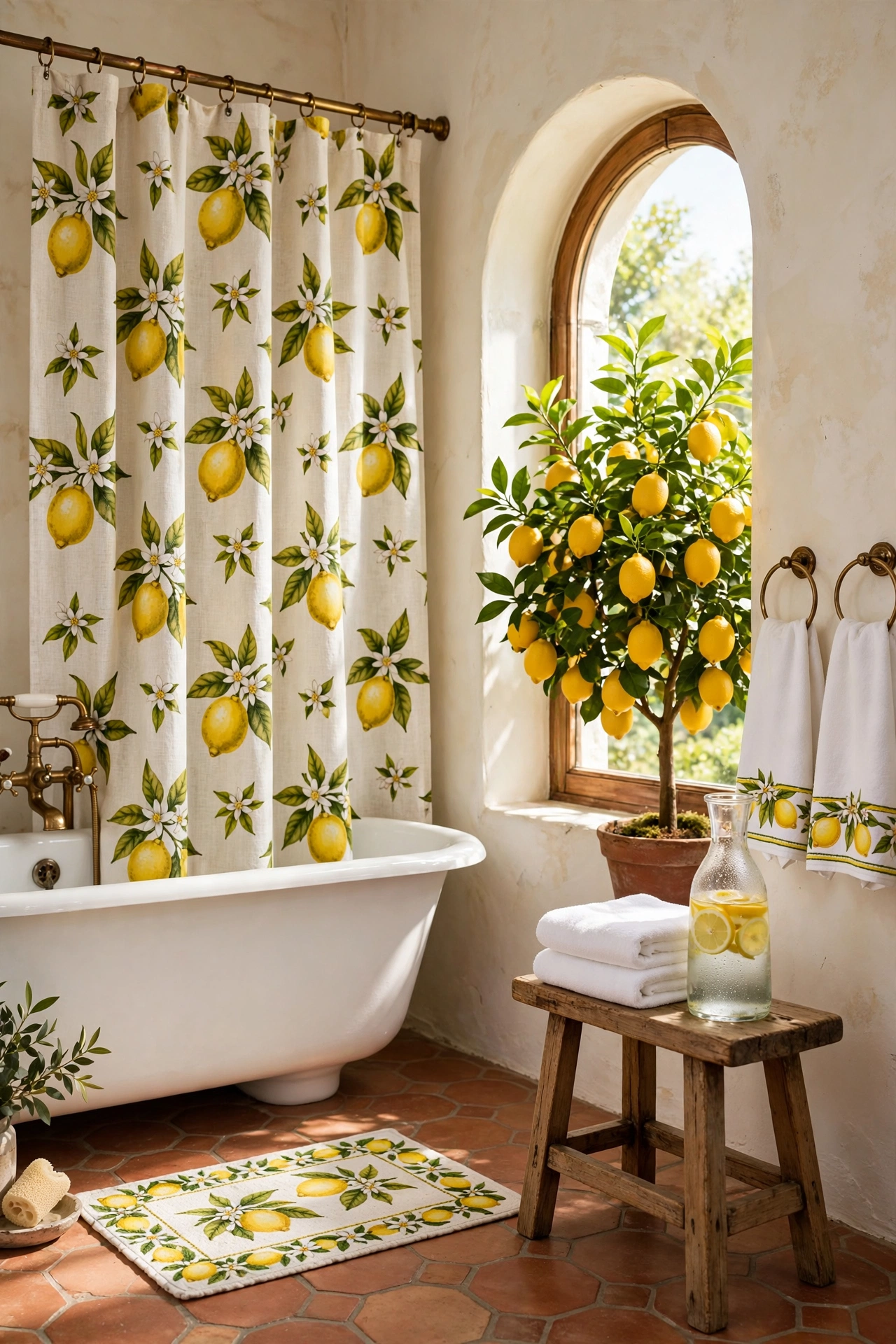
Textiles are the lowest-commitment way to try the Mediterranean look. A set of lemon-print hand towels against white walls, or a citrus shower curtain as the room’s single pattern, delivers the theme for the price of a laundry load — and swaps out with the seasons.
Keep the citrus palette honest: sunny yellows and leaf greens on white or natural linen grounds. Avoid muddy or neon versions; the Mediterranean citrus look is fresh and sunlit, never garish. Pair with plain white bath towels so the print stays special.
Extend the motif with a real potted lemon tree by the brightest window if you have one. Living citrus, printed citrus, and the scent of a lemon verbena candle — the full sensory postcard, no flight required.
Wash citrus-print textiles before first use to set the colours and soften the fabric. Keep a plain white set in reserve for guests who prefer calm — the prints are for joy, not obligation.
17. Aged Copper Fixtures
Aged copper taps and shower fittings bring warm, living metal to the Mediterranean bathroom. Less formal than brass and richer than chrome, copper echoes the pots, stills, and roof details of old Mediterranean towns — and it develops a beautiful patina with use.
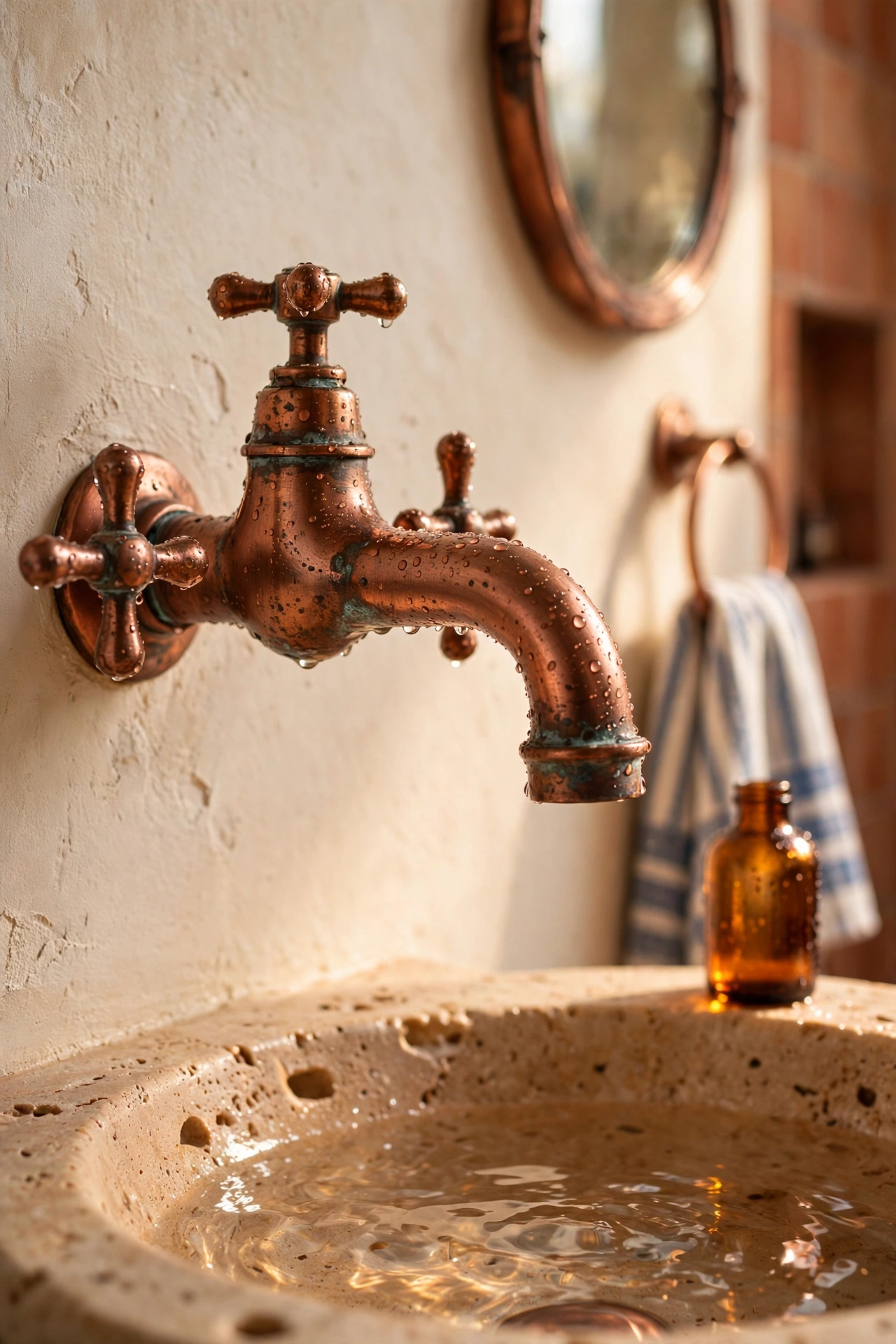
Copper’s antimicrobial properties are a genuine bonus in a bathroom, and its warm rose-brown tones flatter terracotta, travertine, and plaster alike. Choose unlacquered copper if you love evolving patina, or a sealed antique-copper finish for consistent colour with less maintenance.
A copper vessel basin paired with a copper wall-mounted tap is the statement combination; more modestly, copper towel rings, a copper-framed mirror, and copper tap heads on a plain basin deliver the warmth in smaller doses.
Keep copper away from harsh chemical cleaners — mild soap and soft cloths preserve the finish. Treated gently, copper fixtures age like the Mediterranean itself: more beautiful every year.
Unlacquered copper will darken where hands touch it most — embrace the patina or polish it back with lemon and salt. Either way, avoid abrasive pads that scratch the living finish unevenly.
18. Pebble Stone Shower Floor
A pebble stone shower floor turns every shower into a walk on a Mediterranean beach. Smooth, tumbled pebbles in sand, grey, and slate tones massage the feet, drain beautifully, and look utterly natural against plaster walls and wooden accents.
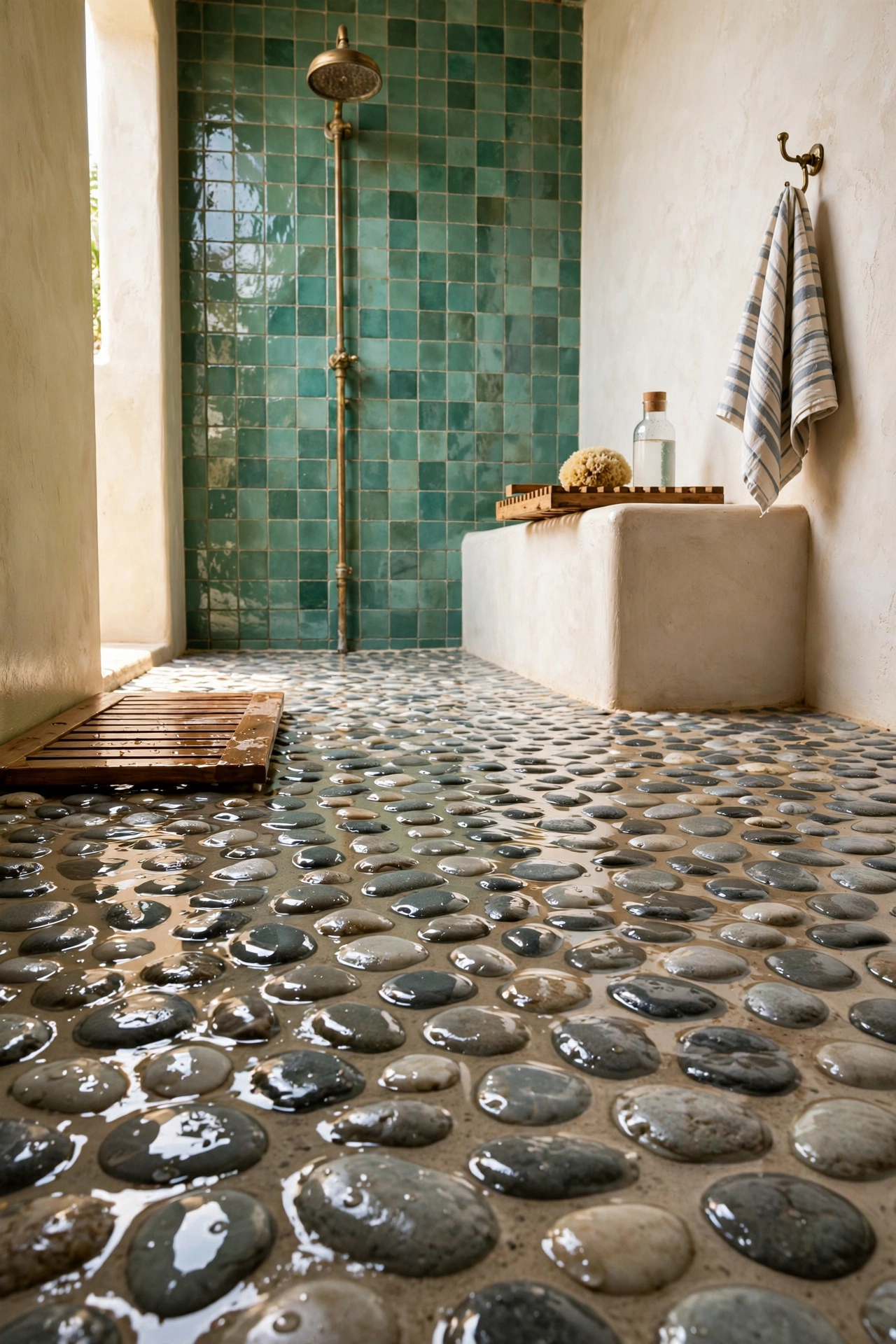
Pebble mosaic sheets make installation straightforward — they lay like any mosaic tile — and the sheer number of grout joints gives superb grip underfoot, a real safety plus. Choose flat, sliced pebbles for a more even walking surface, or full rounded pebbles for maximum massage.
Keep the pebbles’ palette natural and the grout a sandy tone so the floor reads as one continuous beach rather than a patchwork. Seal the grout well, as all those joints need protection in a wet zone.
Pair a pebble floor with simple walls — limewashed plaster or large-format stone tile — and let the floor be the texture. Step in, and the day’s tension seems to drain away with the water.
After grouting a pebble floor, seal twice: once before grouting to protect the stones, once after to protect the grout. A flexible grout additive helps all those joints survive years of foot traffic.
19. Arched Window Nook
If your bathroom has a window, make it an arched one — or dress a plain window to suggest an arch. That curved top transforms daylight into something romantic, framing the view like a painting and bathing the room in soft, shaped light.
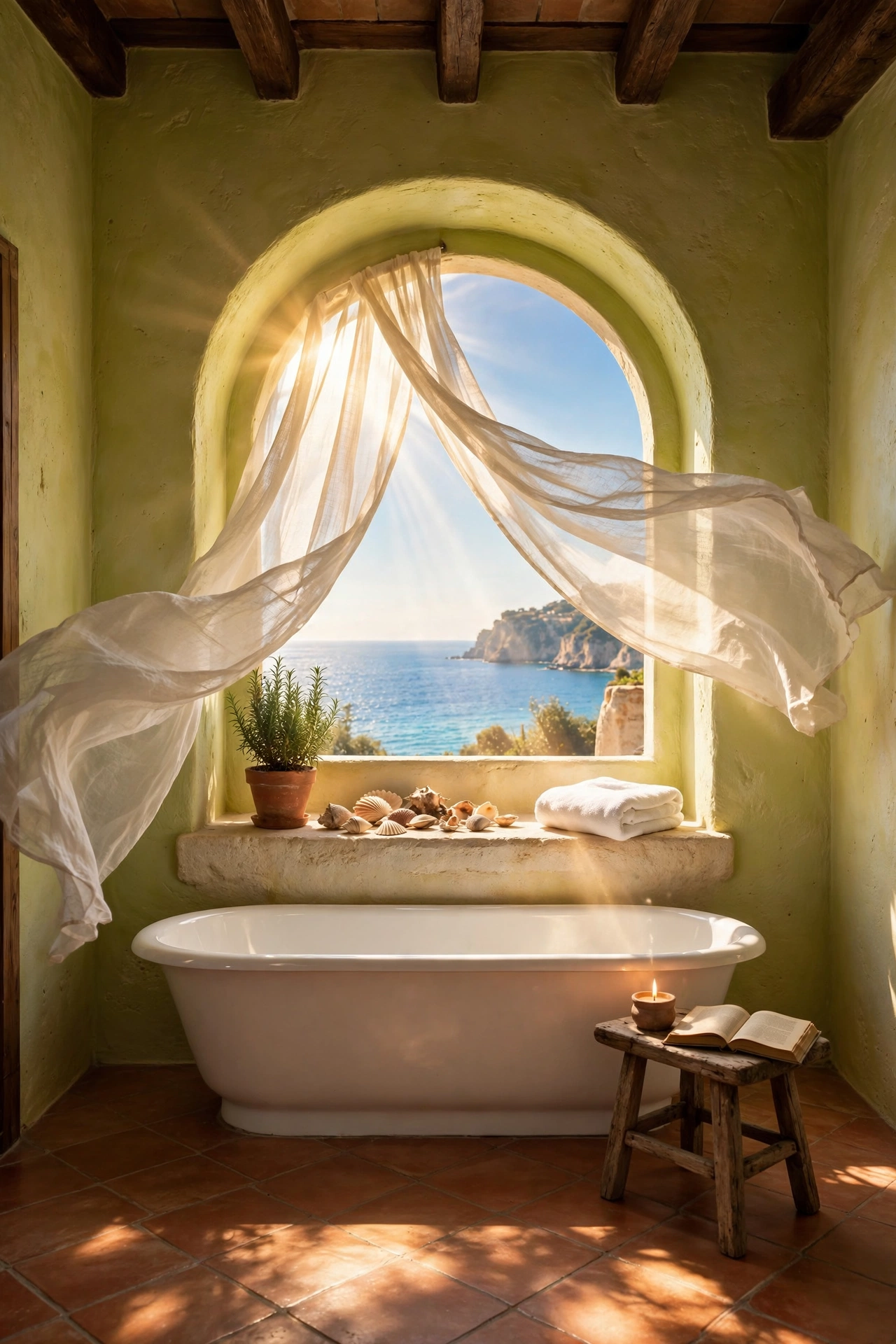
A true arched window is a renovation-level change, but the effect can be suggested: an arched mirror hung to reflect the window, an arched tile border around a rectangular window, or a simple linen curtain hung from a curved track. The eye reads the curve and supplies the romance.
Dress the window simply. Mediterranean windows wear sheer linen or nothing at all — the light is the decoration. A deep sill becomes a styling shelf: a potted herb, a shell collection, a small stack of folded towels catching the sun.
Privacy matters, so consider frosted or reeded glass in the lower half, or a café-height linen panel. You keep the glorious arched light above and modesty below — the best of both worlds.
If you are dressing a rectangular window to suggest an arch, mount the curtain track well above the frame and let the fabric fall in a soft curve. The eye reads the drape, not the frame, and supplies the arch itself.
20. Terracotta Planters
Terracotta pots are the Mediterranean garden brought indoors. A cluster of them — olive, citrus, rosemary, trailing jasmine — turns a bathroom corner into a sunlit courtyard, and the clay’s warm rust tones echo terracotta floors and roofs beautifully.
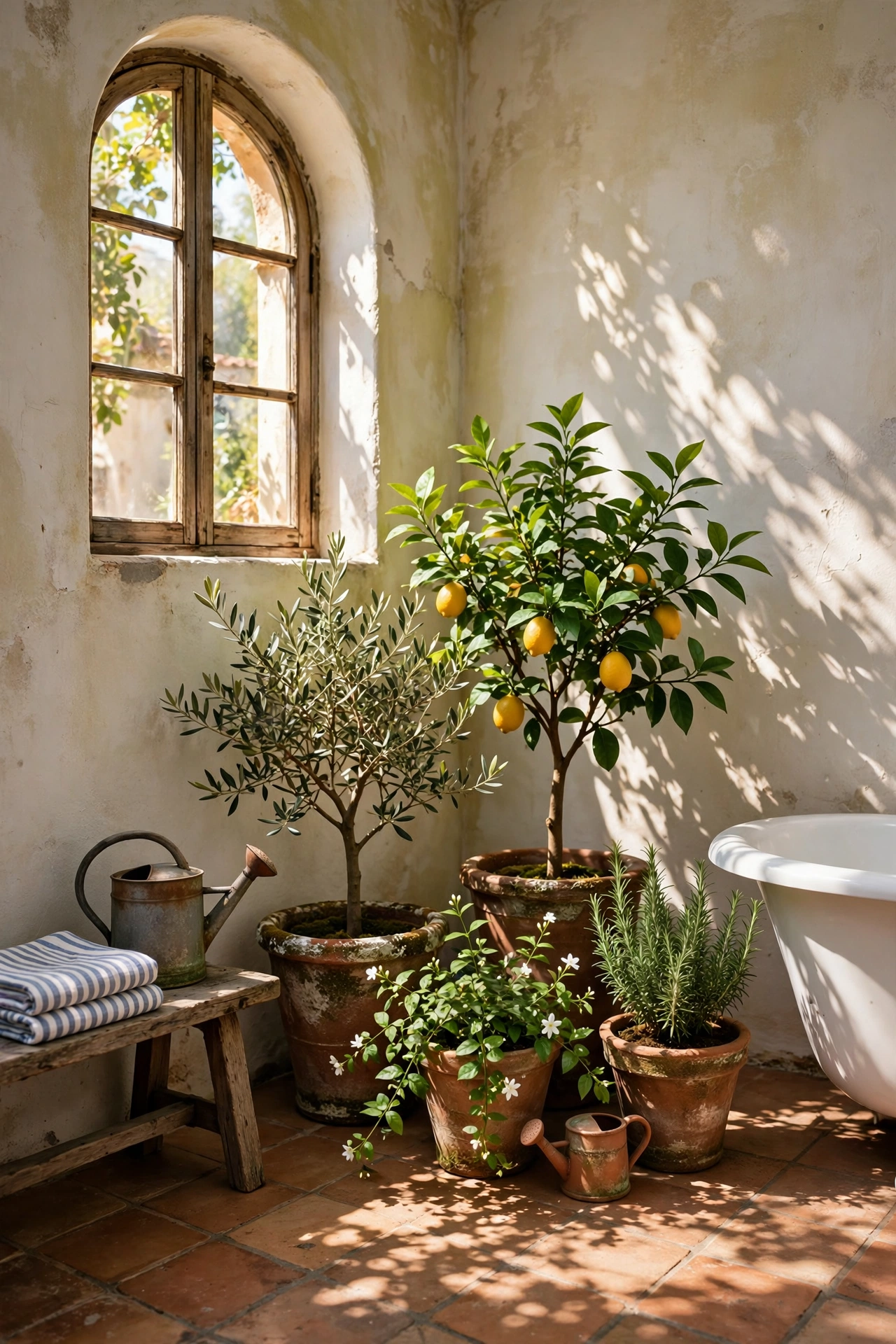
Bathrooms are surprisingly good homes for plants: the humidity suits ferns, palms, and trailing pothos, while a bright window keeps rosemary and small citrus happy. Group pots in odd numbers at varying heights for a natural, gathered look.
Choose unglazed terracotta so the pots breathe, and stand them on saucers or a tiled tray to protect floors. The pots themselves will age — mineral blooms and mossy patches only add to the old-garden charm.
Even one large terracotta planter with a sculptural olive or a tall palm changes the room’s whole atmosphere. Green against warm plaster, clay against tile: it is the Mediterranean palette in its simplest, liveliest form.
Rotate potted plants a quarter turn each week so they grow evenly toward the light. In winter, move tender citrus away from cold glass at night — a bathroom windowsill can chill fast after dark.
21. Decorative Tile Border Trim
A decorative tile border is the Mediterranean’s signature finishing touch. A single band of patterned tile — Greek key, Moorish star, hand-painted floral — running at dado height or as a shower accent turns plain walls into something considered and crafted.
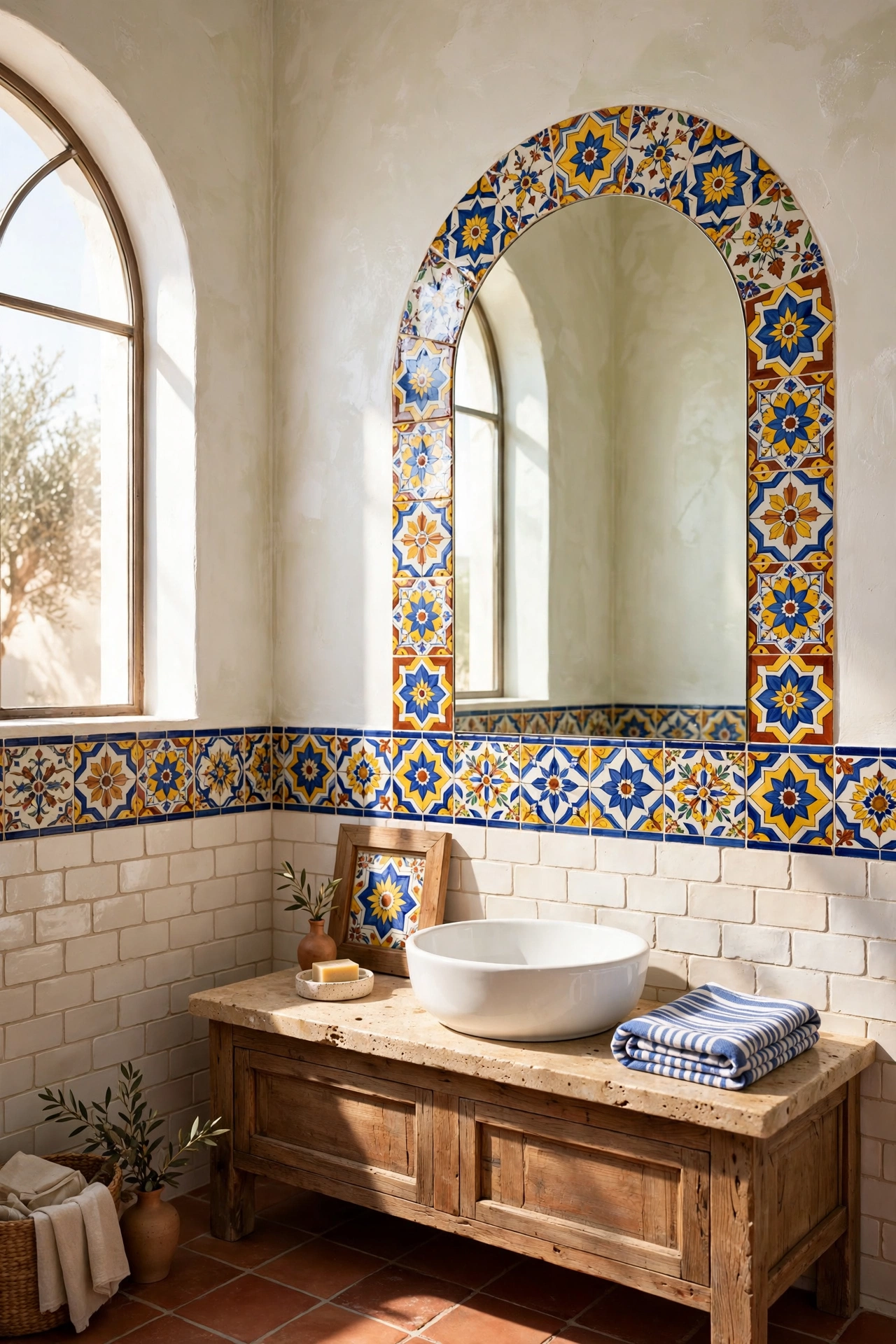
Borders are wonderfully economical: you get the artisan impact for the price of a few linear metres. Run one around the whole room at picture-rail height, frame a mirror or window with it, or use it to edge a plain tiled shower like a picture frame.
Traditional choices include Portuguese azulejo strips, Spanish cenefa borders, and Moroccan patterned liners. Keep the border’s colours echoed somewhere else in the room — a towel, a planter, the cabinet paint — so it feels woven in rather than stuck on.
This is also a renter-friendly idea: tile-effect border stickers and removable decals now mimic the look convincingly. The Mediterranean spirit has always been about ingenuity as much as budget.
When laying a tile border, start at the room’s focal point and work outward so cut tiles land in the least visible corners. A laser level is worth its hire cost for keeping long border lines dead straight.
22. Carved Stone Vessel Basin
A basin carved from a single piece of stone — travertine, limestone, or marble — is Mediterranean luxury at its most elemental. Each one is unique, its surface cool and alive under your hands, like washing in a rock pool.
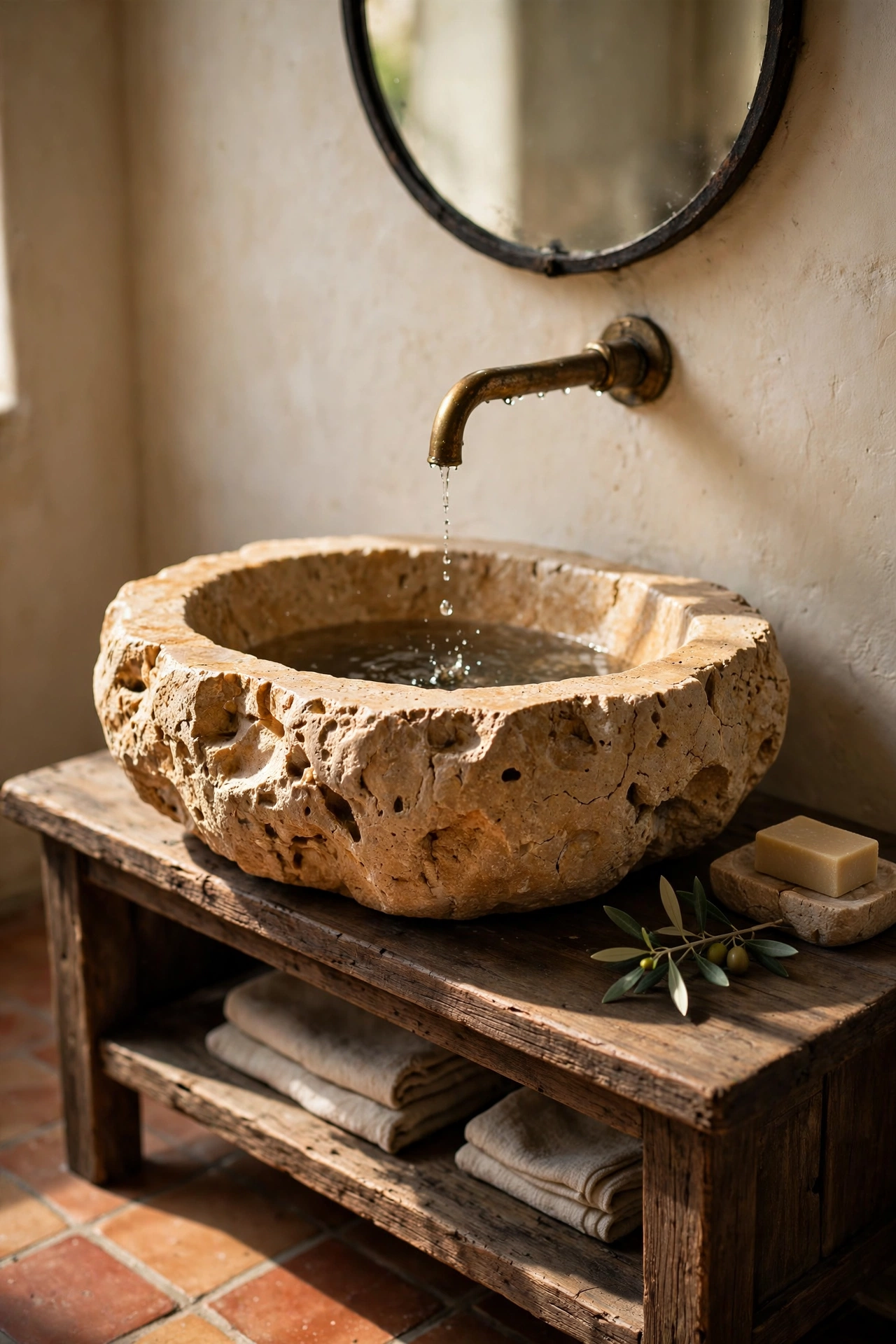
Stone vessels sit beautifully on wooden vanities, curved plaster bases, or simple iron stands. Their weight and presence mean the surrounding styling can stay minimal: the basin is already the sculpture, the geology, and the history all at once.
Choose honed rather than polished stone for a soft, touchable finish, and seal it diligently — stone basins need resealing once or twice a year to shrug off soap and hard water. A slightly irregular, hand-carved profile looks more authentic than a perfect machine-made bowl.
Pair with a tall wall-mounted tap in aged brass or copper so nothing crowds the stone’s rim. Water falling into stone, morning light on travertine: some combinations never get old.
Weigh your vanity base before choosing a stone basin — some carved vessels top twenty kilos. Confirm the unit is rated for the load and that your plumber has fitted a suitably sturdy waste and bracket.
23. Hanging Moroccan Lanterns
Pierced Moroccan lanterns scatter light like nothing else. Hung over a tub or in a bathroom corner, their filigree metalwork throws dancing patterns across plaster walls and tile — instant atmosphere, day or night.
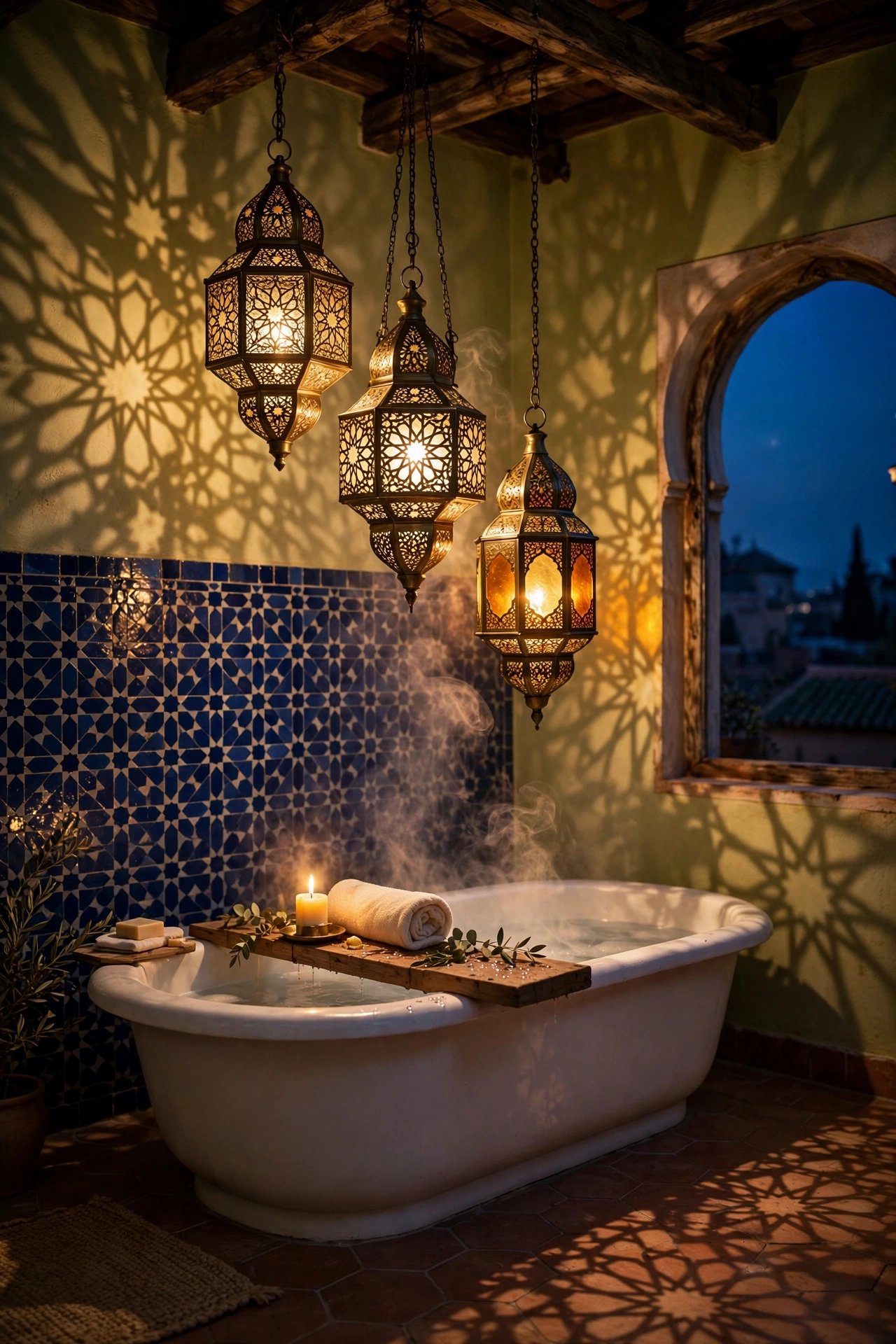
Cluster them at different heights for a souk-market feel, or hang a single large lantern as a pendant over the vanity. Brass and copper finishes glow warmly; coloured glass inserts in amber or teal add jewel tones to the light itself.
In a bathroom, hang lanterns where they will not be splashed and confirm any hardwired fitting is damp-rated. Many beautiful lanterns are sold as candle holders — use LED candles inside for a safe, flickering glow with zero wiring worries.
Lantern light flatters everything Mediterranean: it warms terracotta, gilds zellige, and turns plain plaster into a canvas of shadows. When the sun goes down, this is what makes the room feel like Marrakech.
Dust pierced lanterns with a soft brush monthly; bathroom humidity plus dust dulls the filigree fast. A quick wipe of the glass inserts keeps the patterned light crisp and bright.
24. Linen Shower Curtain
A billowing linen shower curtain brings softness and movement to the Mediterranean bathroom. Unlike stiff vinyl, washed linen drapes beautifully, lets light filter through, and smells faintly of sunshine — the antithesis of a plasticky shower cubicle.
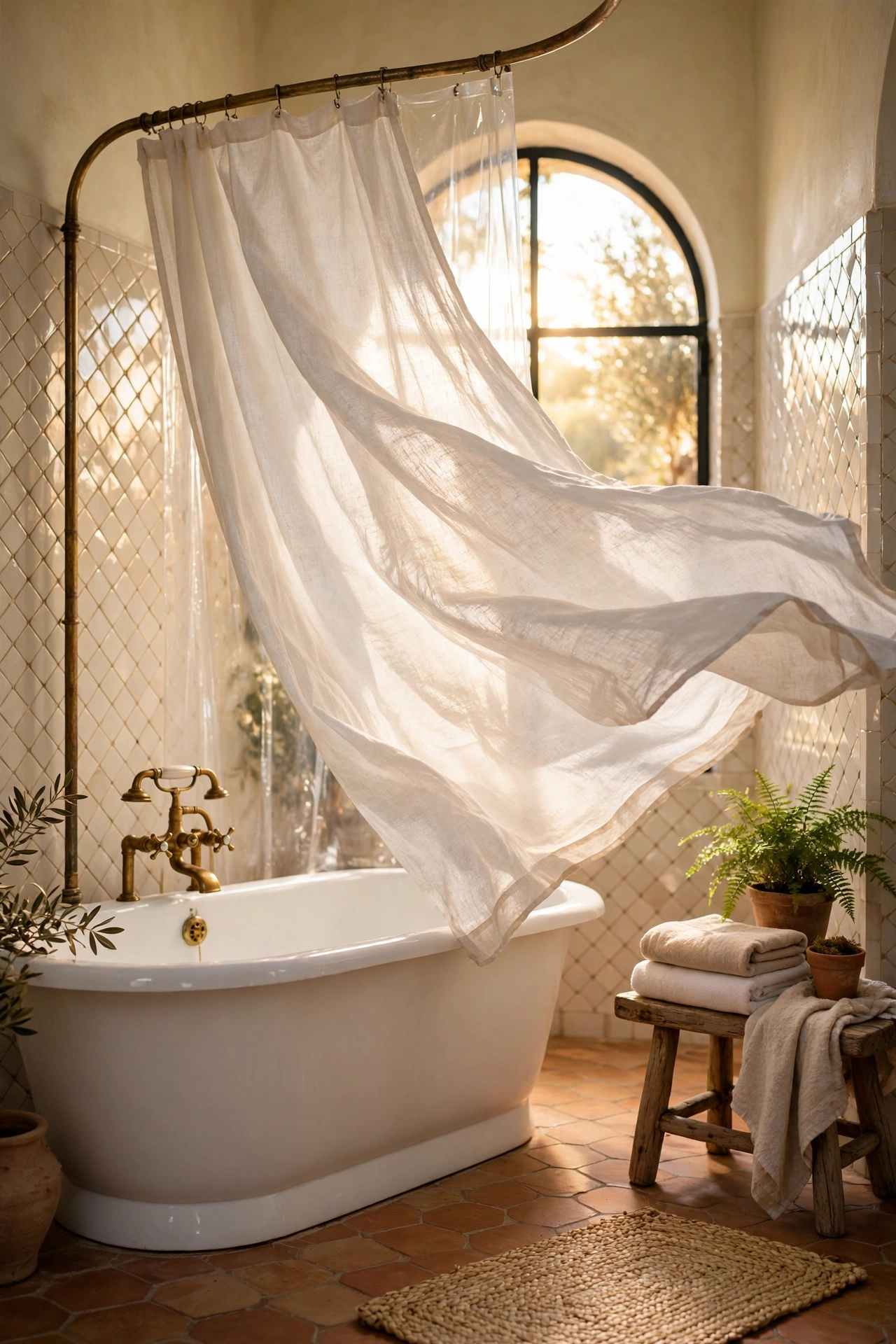
Choose a heavyweight European flax linen in natural, white, or a soft stripe. Use it as the outer curtain with a discreet waterproof liner inside, so the linen stays beautiful and the water stays in. Wash it regularly and it will soften further with every cycle.
Linen curtains suit freestanding tubs and walk-in showers with a curved rail best — the fabric needs room to move. Let it puddle slightly on the floor for a relaxed, villa-like feel, or hem it just above the floor for a crisper look.
The gentle sway of linen in a steamy bathroom, backlit by a window, is one of the style’s loveliest moments. It is a small luxury that makes the whole room feel considered and calm.
Buy two linen shower curtains and rotate them — one in use, one in the wash. Linen dries fast on a line, and a spare means you never face a bare rail on laundry day.
25. Whitewashed Brick Accent Wall
A whitewashed brick wall adds rustic texture and old-farmhouse soul to the Mediterranean bathroom. The wash softens the brick’s redness to a pinkish white, letting the texture show through like a memory of the original wall.
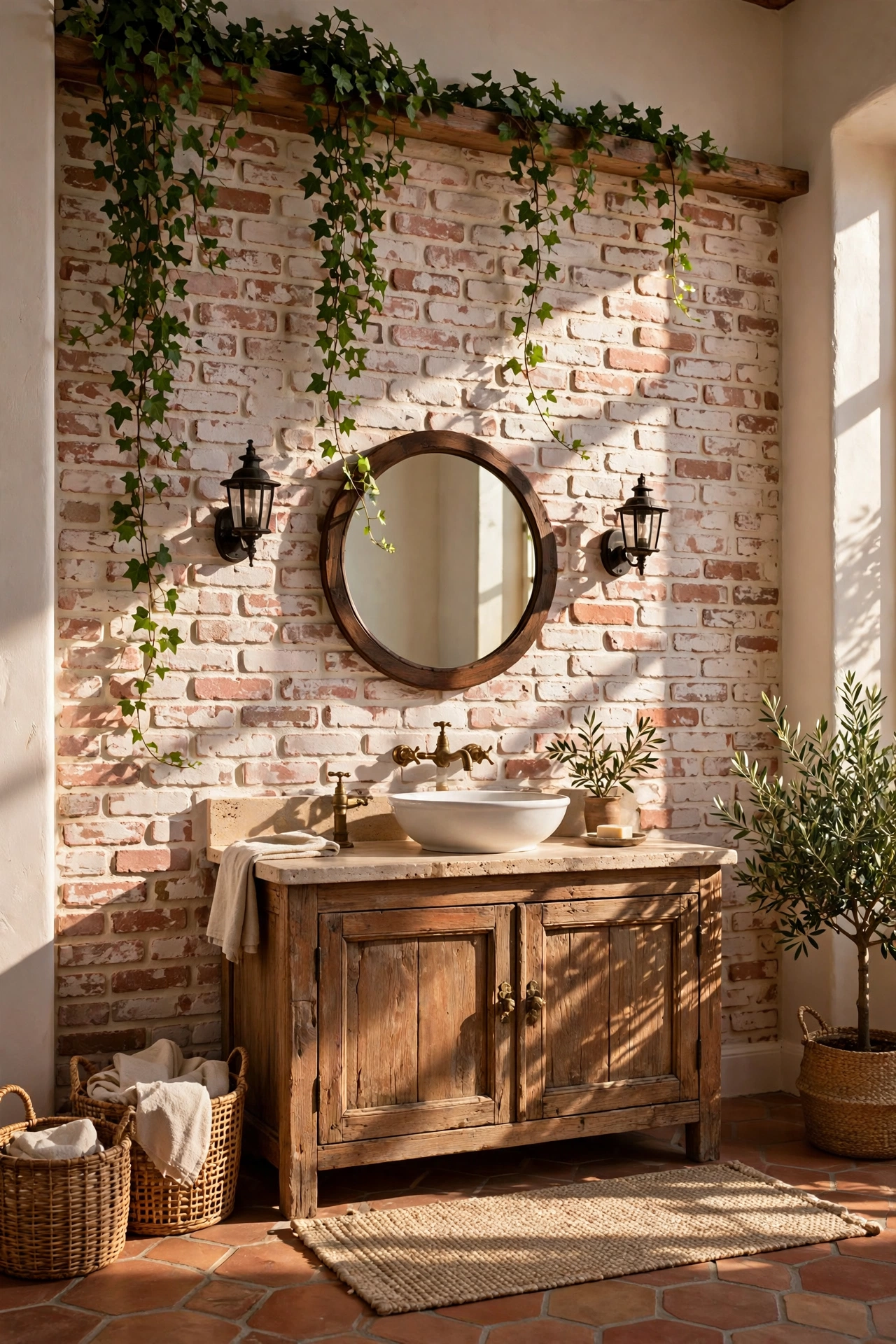
Real brick can be whitewashed with diluted paint or limewash, brushed on and wiped back to taste. Brick slips or brick-effect panels give the same look on a plain stud wall, and in a wet zone a clear matte sealer protects the finish.
One accent wall is enough — behind the vanity, behind a freestanding tub, or in the water closet. Pair it with smooth plaster on the other walls so the contrast reads clearly, and warm it up with wood, iron, and greenery.
Whitewashed brick loves imperfection: uneven coverage, visible mortar lines, a patch worn a little thinner. Do not aim for even; aim for aged. The wall should look like it has stories, not like it was decorated yesterday.
Test your whitewash mix on a hidden patch first and let it dry fully — wet wash looks far darker than the finished wall. Two thin coats beat one thick one for that soft, aged translucency.
26. Grecian Blue Woodwork
The vivid blue of Greek island shutters and doors — that famous cobalt against whitewash — makes a thrilling bathroom accent. A vanity, a door, or a window frame painted in Grecian blue electrifies an otherwise calm Mediterranean scheme.
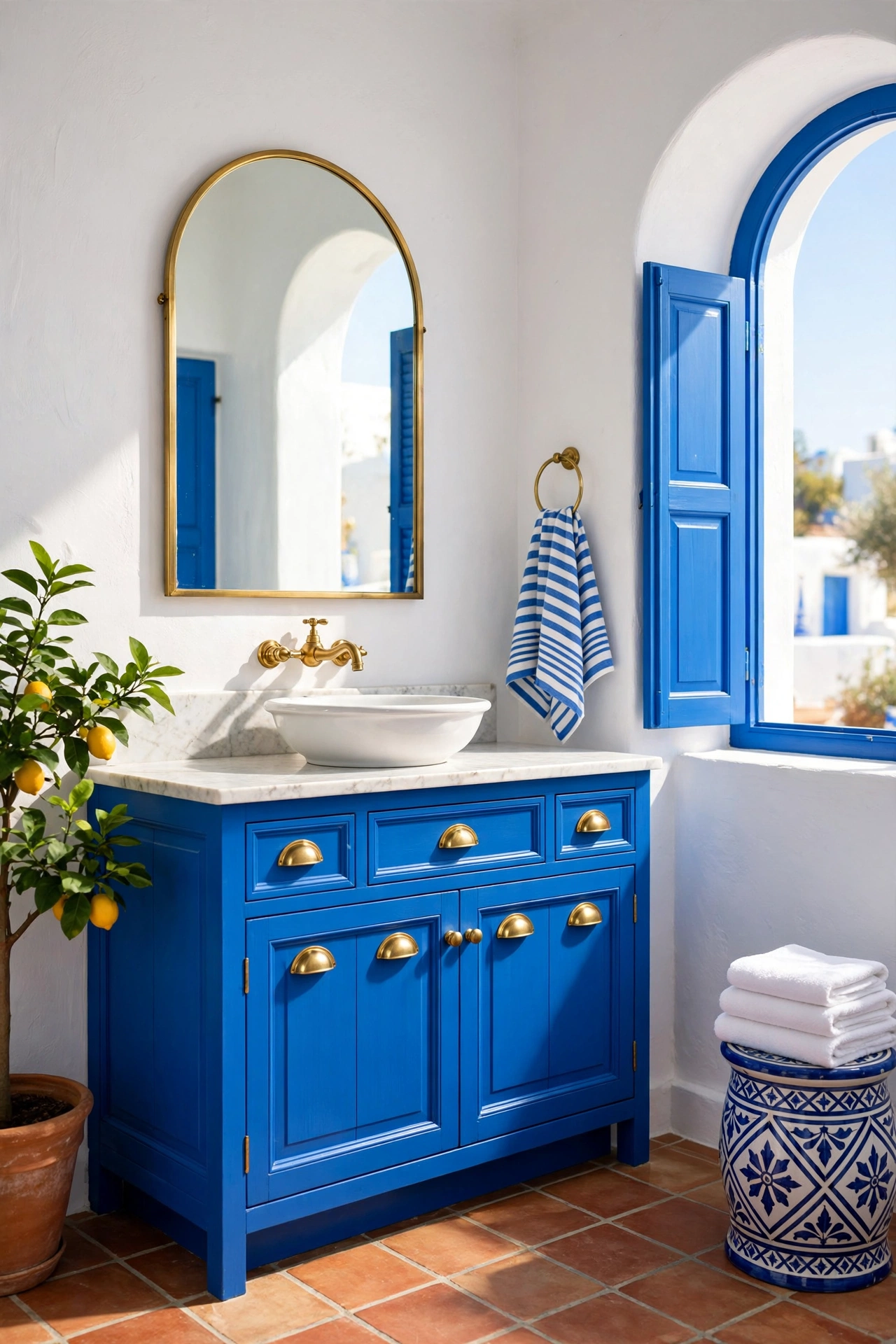
This blue works because it is unapologetic. Use it on one piece only — the vanity is the classic choice — and keep everything around it quiet: white walls, pale floors, simple brass. The blue becomes the room’s exclamation point.
Match the shade to the Greek ideal: a clear, saturated cobalt or Aegean blue, not navy and not turquoise. A satin finish made for humid rooms keeps it looking crisp, and brass or blackened-iron hardware completes the island look.
Echo the blue once, subtly, elsewhere — a striped towel, a patterned tile border, a small painted stool — so it feels intentional rather than random. One bold colour, used with discipline, is the whole Greek island trick.
Grecian blue shows every brush mark, so use a good synthetic brush and lay the paint off in long, even strokes. Two coats over a proper primer give the depth this saturated colour deserves.
27. Mosaic Tile Rug Inlay
A mosaic tile ‘rug’ — a patterned rectangle of mosaic inlaid into a plainer floor — is a jewel of Mediterranean flooring. Framed by a border, the inlaid panel reads like a fine carpet that never needs washing, usually in blues, terracotta, and cream.
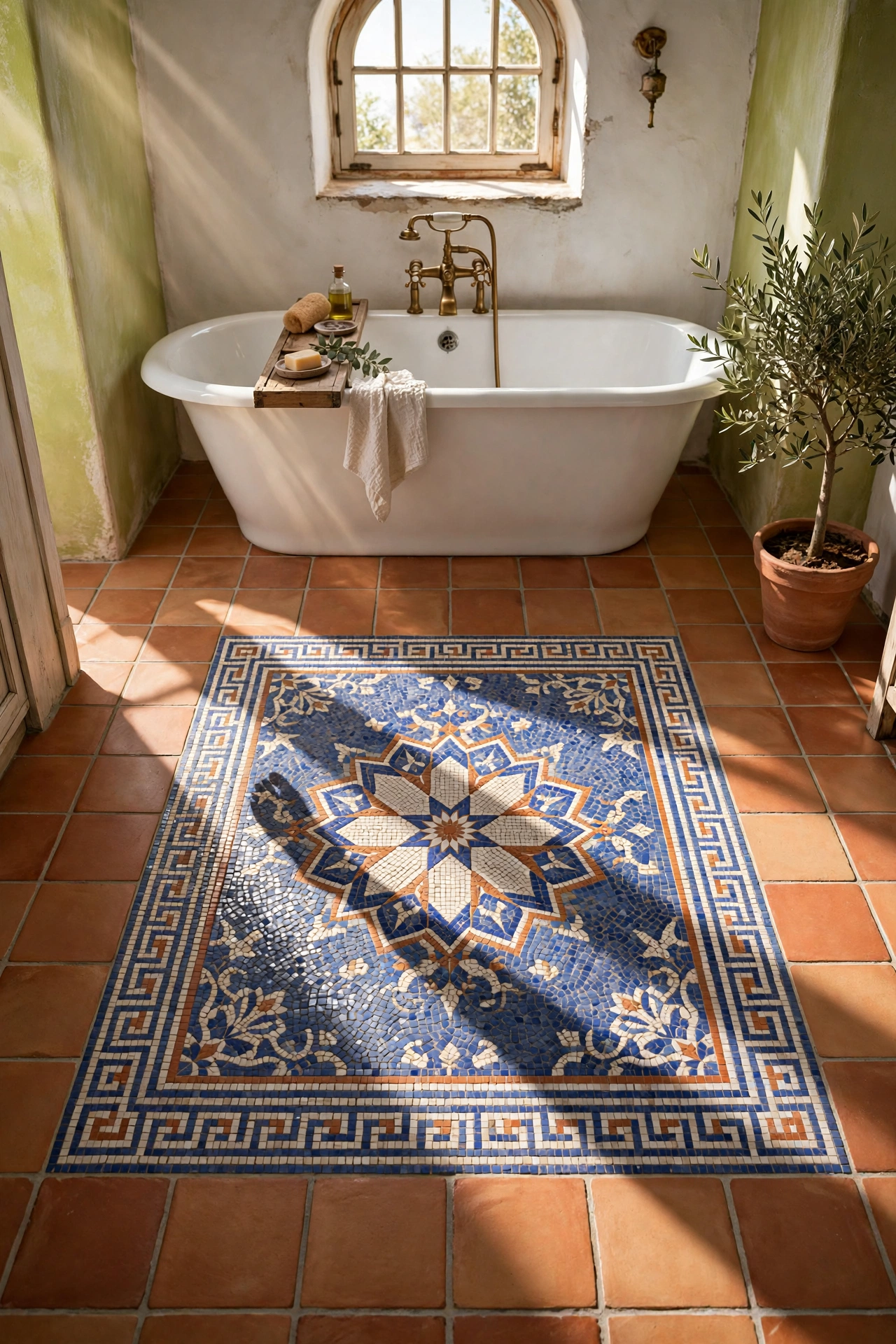
Place it where it will be seen and walked on: the centre of the room, before a freestanding tub, or running the length of a double vanity. The surrounding floor should be simple — large terracotta squares or plain stone — so the inlay shines.
Mosaic sheets make the technique accessible: lay the patterned panel first, then tile the field around it. A simple Greek key or Moorish star border frames the panel crisply and hides the transition between pattern and plain.
This is a forever floor — pattern that cannot fade, stain, or wear out. It is also a wonderful way to use beautiful patterned tile in a splash-prone room without committing every wall to pattern.
Photograph your mosaic inlay layout from above before fixing anything — patterns that look right at arm’s length can drift over a whole floor. Number the sheets on the back to keep the sequence straight.
28. Sunlit Skylight Tub
A bathtub placed beneath a skylight is the Mediterranean dream distilled: warm water, open sky, and sunlight tracking across the room through the day. It turns bathing into something close to bathing outdoors, wrapped in privacy.
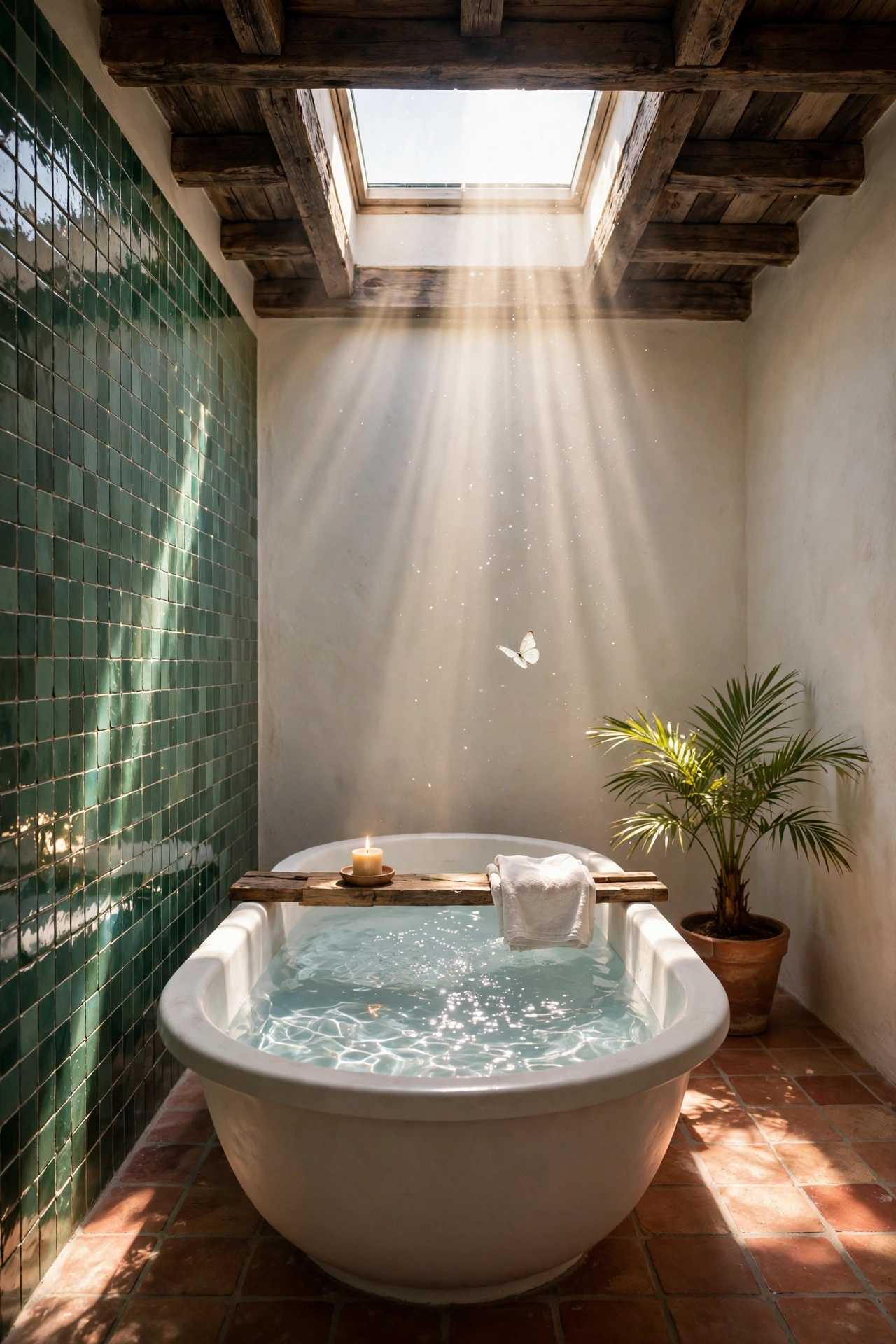
A roof skylight over the tub floods the room with daylight that flatters every material — zellige shimmers, terracotta glows, plaster breathes. At night, the same skylight frames the stars. If a true skylight is impossible, a large frosted window placed high on the wall gives much of the same magic.
Keep the tub area simple so the light is the luxury: a freestanding tub in white, a wooden bath caddy, a potted plant catching the sunbeam. Avoid clutter under the skylight — the moving patch of sun is decoration enough.
Consider a skylight blind for summer afternoons and privacy, and check ventilation: warm air rises, and a venting skylight doubles as the room’s best extractor. Light, air, water — the Mediterranean essentials, all in one spot.
A venting skylight above the tub is worth specifying even if it costs more — it clears steam faster than any wall fan and gives you fresh air exactly where the room needs it most.
29. Tuscan Fresco Accent
A fresco-style wall accent brings old Italian romance to the Mediterranean bathroom. A hand-painted or mural-effect panel — a landscape, a vine, a classical urn — behind the tub or on one wall turns the room into something from a Tuscan villa.
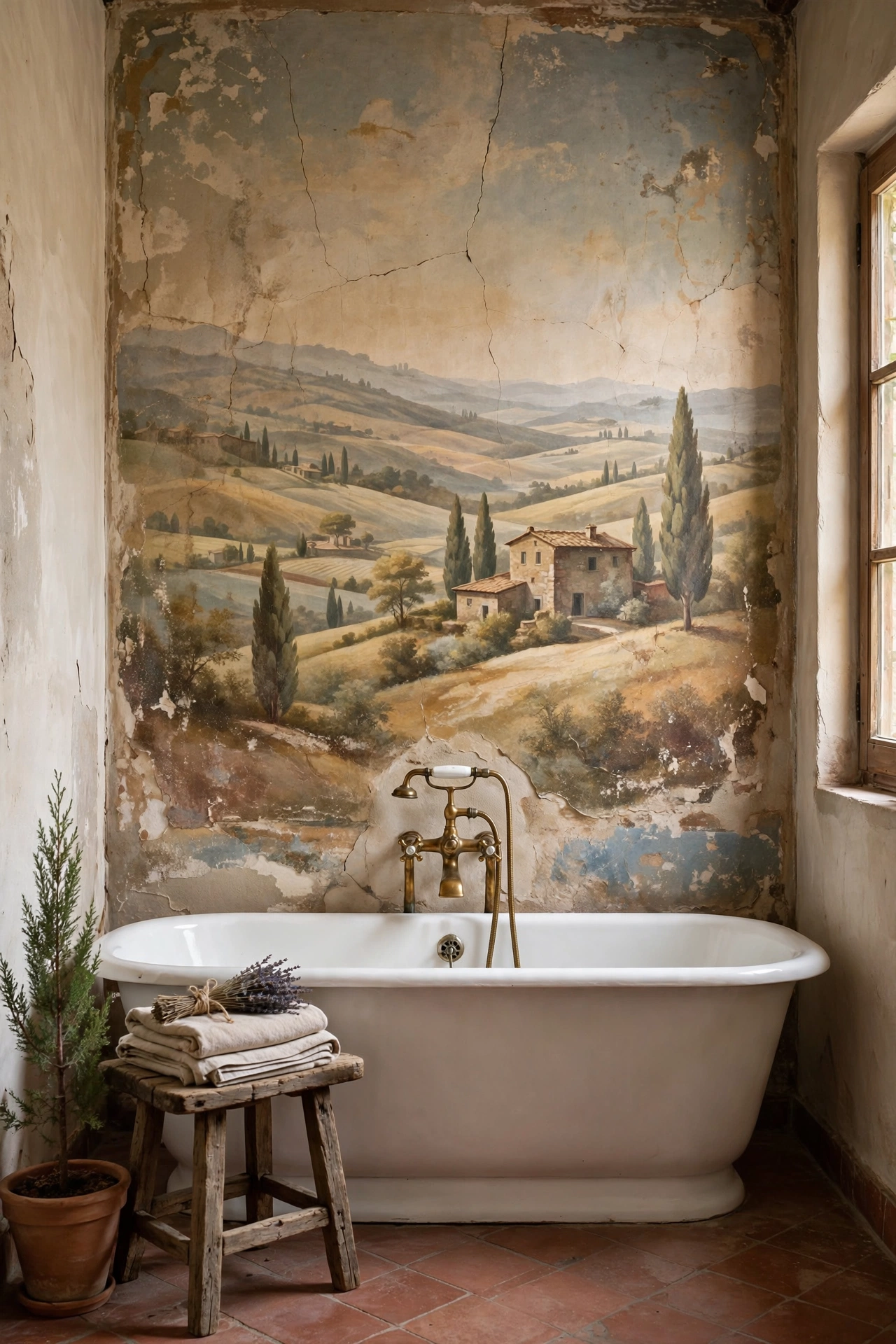
Full hand-painted frescoes are a specialist commission, but modern mural wallpapers and limewash-effect panels capture the aged-plaster look convincingly. Choose designs with soft, sun-faded colours and visible ‘ageing’ — cracks, patina, worn edges — for authenticity.
One wall or even one panel is plenty; fresco is a strong flavour. Keep the rest of the room in quiet plaster and natural materials so the painted wall reads as discovered heritage rather than theme-park decor.
Frame the fresco moment with simple styling: a wooden stool, a terracotta pot, a folded linen towel. The wall tells the story; everything else just quietly agrees with it.
If you use a mural wallpaper for the fresco effect, paste the wall rather than the paper for easier positioning, and book a full unhurried day. Rushing a mural shows in every seam.
30. Woven Seagrass Runner
A woven seagrass runner is the Mediterranean bathroom’s humble hero. Natural fibres underfoot, warm honey tones against cool tile, and a texture that says beach house without saying a word — it softens the hardest room in the house.
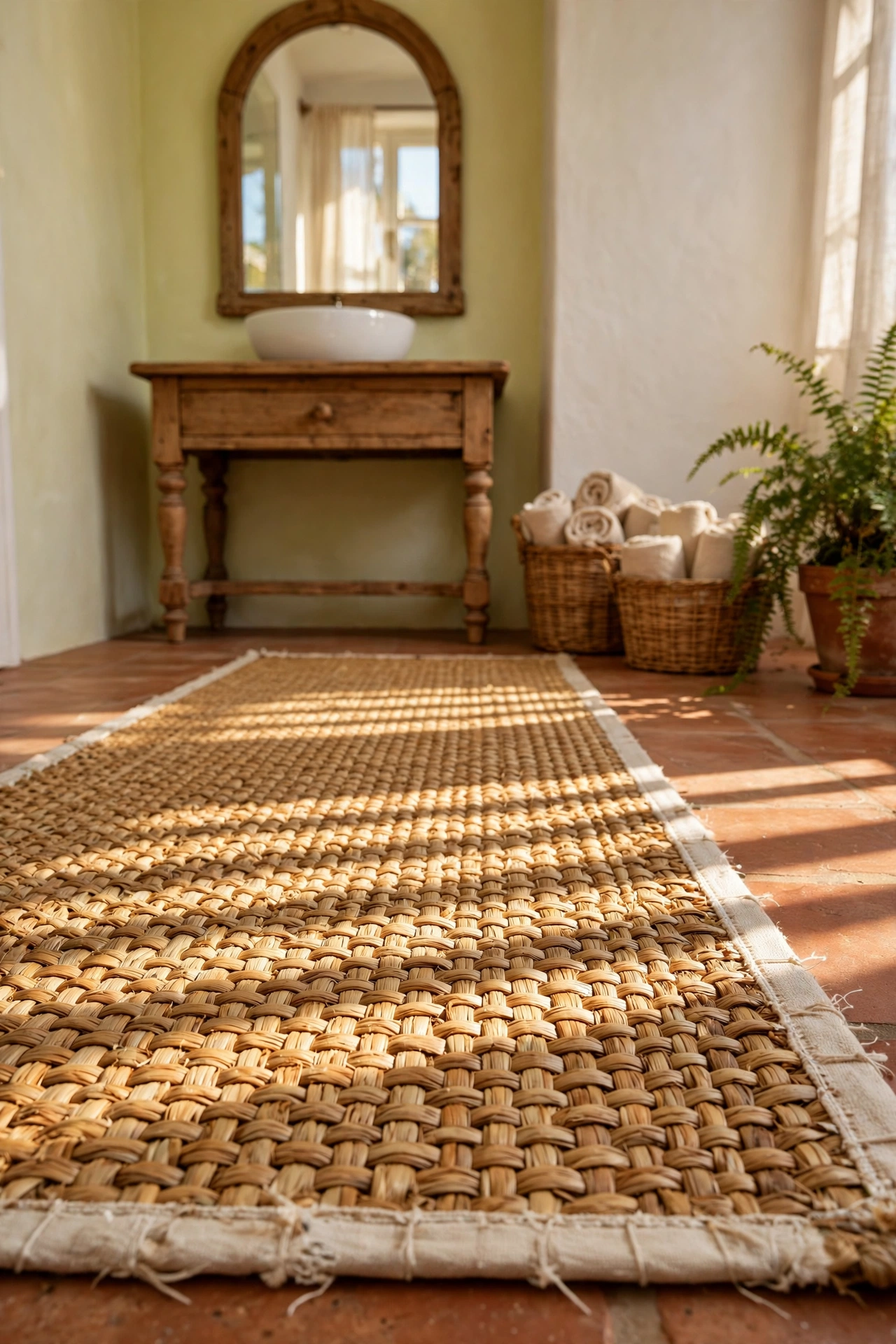
Seagrass is naturally hardwearing and suits bathrooms better than many natural fibres, but keep it out of direct splash zones: before the vanity, alongside the tub, or in the dressing area rather than inside the shower. A washable cotton rug is the practical alternative for wetter spots.
Choose a simple weave — basketweave or herringbone — with bound edges in cotton or leather for a finished look. Layer it over terracotta, stone, or patterned tile; the neutral fibre lets a beautiful floor show at the edges while warming the walking line.
Shake it out weekly and let it dry fully if it gets damp, and a good seagrass runner will serve for years. It is the finishing touch that makes a Mediterranean bathroom feel barefoot-welcoming.
In a busy family bathroom, choose a low-profile, washable runner for the wettest walkway and save the seagrass for drier dressing areas. The right fibre in the right spot lasts years longer.
Conclusion
A Mediterranean bathroom is never really finished — and that is its greatest charm. Each handmade tile, each sun-warmed texture, each small styling touch adds another layer to a room that grows more personal with time. The thirty ideas in this guide are starting points, not rules; the most memorable Mediterranean bathrooms are the ones that reflect the people who use them.
Start with one anchor that you love — a terracotta floor, a zellige feature wall, an arched mirror — and let the rest of the room gather around it. Mix honest natural materials, balance bold pattern with quiet plaster, and remember that patina is not a flaw but the whole point of this sun-aged style.
Whether you are planning a full renovation or simply swapping in a lemon-print towel and a terracotta pot this weekend, you are taking part in a design tradition shaped by centuries of coastal living. Here is to slow baths, warm stone, and bathrooms that feel like a holiday that never ends.
Key Takeaways
- Anchor the room with one hero feature — a terracotta floor, zellige wall, or arched detail — then build around it.
- Choose warm natural materials (clay, stone, wood, rattan) over cold synthetics for authentic Mediterranean warmth.
- Use handmade-look tile — zellige, hand-painted ceramic, mosaic — for shimmer and character that never dates.
- Balance bold pattern with quiet limewashed plaster so the room feels collected, not chaotic.
- Layer texture through linen, seagrass, wrought iron, and greenery for depth and coastal softness.
- Finish with living touches — olive branches, citrus trees, terracotta planters — that make the room feel alive.
- Always save the design as inspiration first: plan, budget, and verify in your own space before committing to a renovation.