30 Vintage Bathroom Ideas That Turn Any Space Into a Timeless Retreat

Introduction
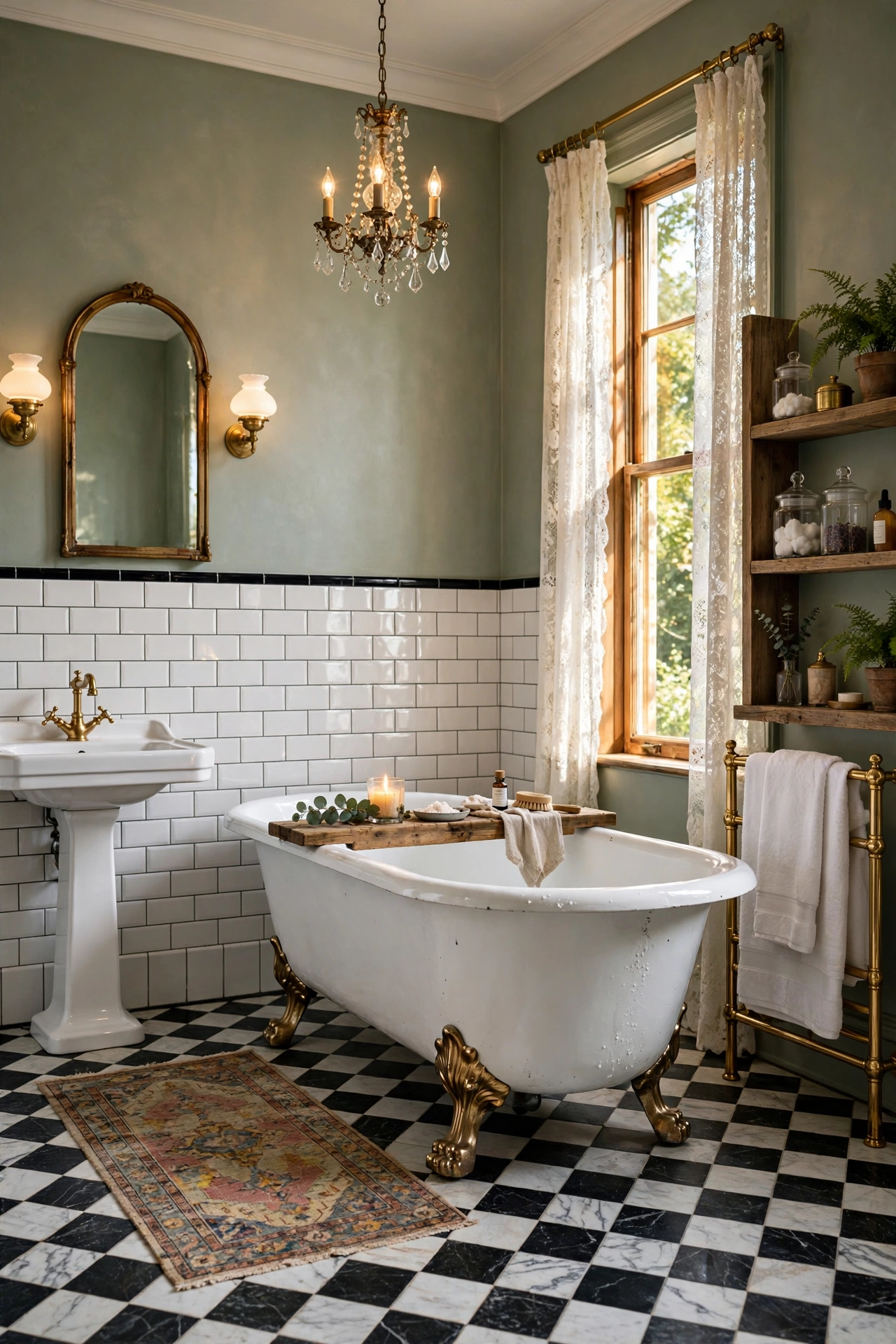
Step into a vintage bathroom and time seems to slow down. Clawfoot tubs with softly worn enamel, warm brass that glows under low light, and hand-laid tile that has held its pattern for a century — these are the details that turn an ordinary washroom into a place you actually want to linger.
The beauty of vintage style is that it never shouts. It whispers through small, thoughtful choices: a beaded board wall, a mirror with a gently foxed edge, a faucet whose curves were designed before straight lines took over. Each piece carries a story, and together they create a room that feels collected rather than decorated.
You do not need a century-old house to pull it off. Many of the most convincing vintage bathrooms are brand-new rooms built from reproduction fixtures, salvaged finds, and clever styling. What matters is the mix — pairing one or two true antiques with faithful reproductions so the room feels layered, not themed.
In this guide you will find thirty distinct ideas, from showstopping clawfoot tubs to the smallest porcelain details. Whether you are planning a full renovation or simply want to add a little old-world soul to the room you have, there is something here to inspire your next move.
1. Clawfoot Tub Statement
Nothing announces a vintage bathroom quite like a clawfoot tub. Its sculpted silhouette, raised on ornate feet, turns bathing into a ritual and the tub itself into the room’s undisputed centerpiece. Whether you choose a classic roll-top or a dramatic slipper shape, the tub sets the tone for everything around it.
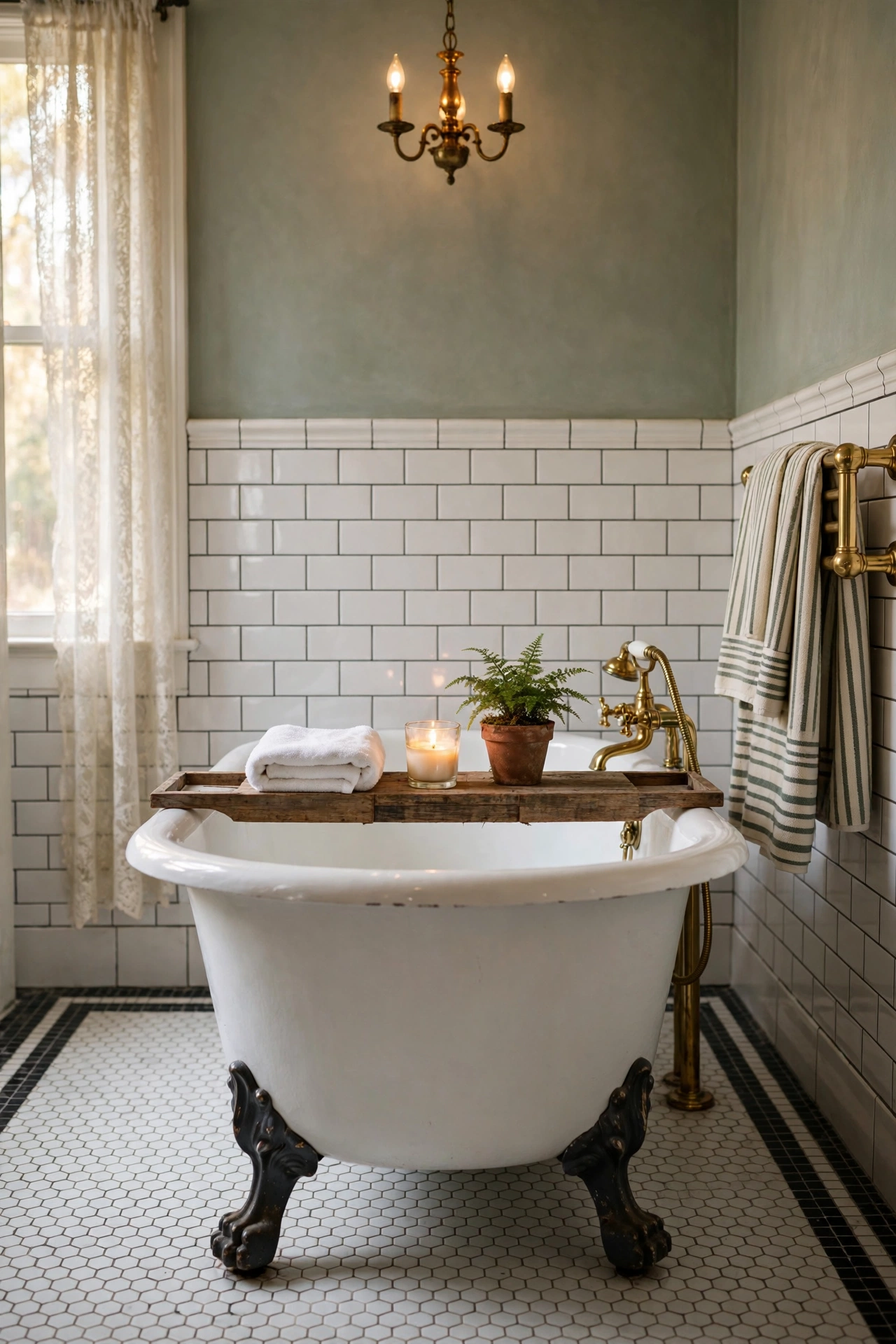
Original cast-iron tubs can be found at salvage yards and architectural reclaim shops, often at a fraction of the price of reproductions. Look for sound enamel and intact feet; minor chips can be professionally refinished, and a fresh coat of paint on the exterior — deep green, charcoal, or classic white — makes an old tub feel brand new.
If a salvage hunt is not your style, modern reproductions in acrylic or cast iron capture the look with lighter weight and better heat retention. Pair the tub with a floor-mounted or wall-mounted filler in polished brass or chrome to complete the period silhouette.
Finish the scene with a small wooden bath caddy, a folded stack of thick towels on a nearby stool, and perhaps a trailing plant on the windowsill. The clawfoot tub is not just a fixture — it is an invitation to slow down.
2. Pedestal Sink Elegance
The pedestal sink is the quiet hero of the vintage bathroom. Slim, sculptural, and wonderfully space-efficient, it suits small powder rooms and grand master baths alike. Its exposed column and graceful basin echo the sanitary ware of the early twentieth century, when bathrooms were first becoming rooms to show off.
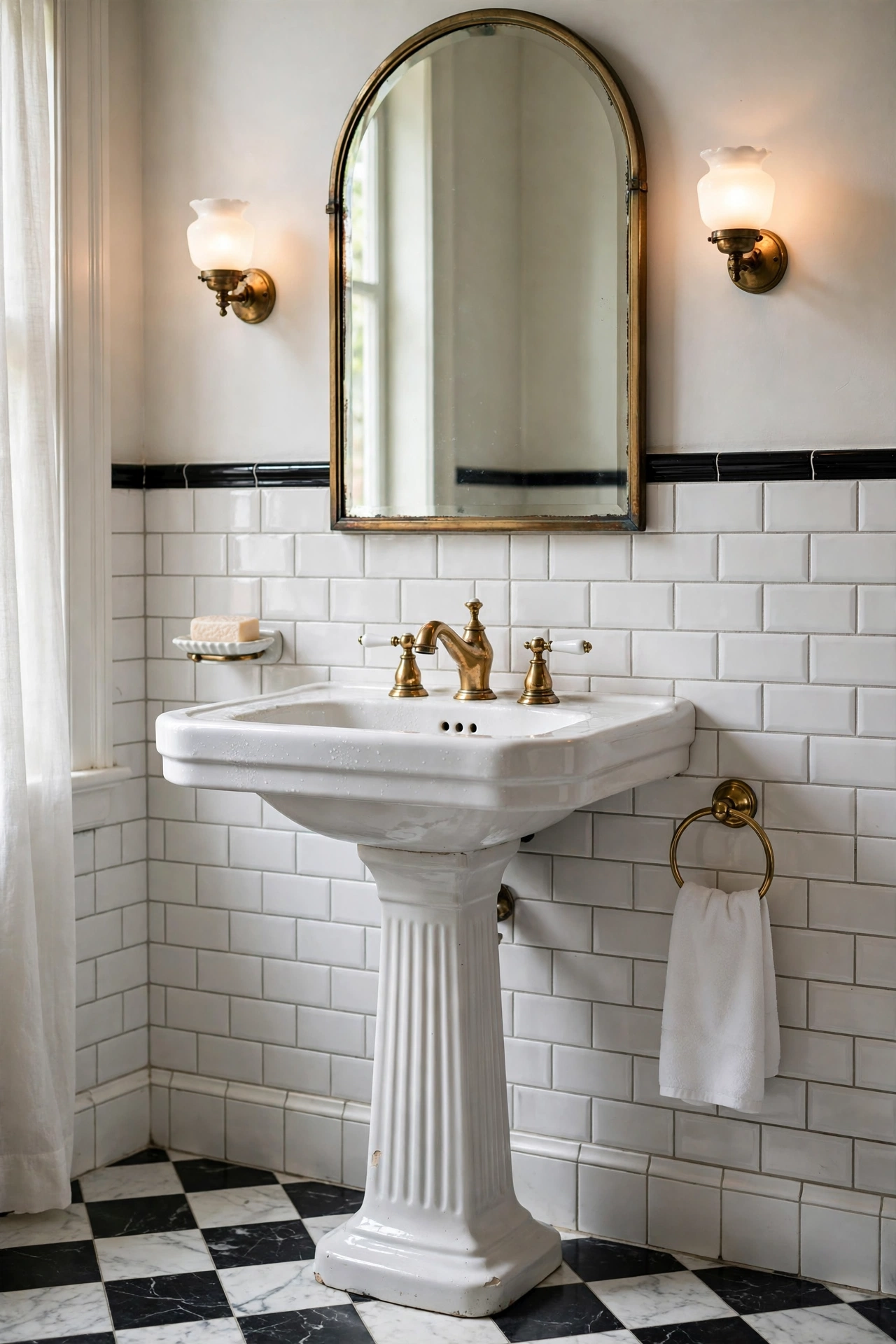
Vintage-look pedestals are widely available in vitreous china with crisp white glaze, and many pair beautifully with widespread faucets in crosshead or lever styles. For a truly authentic feel, hunt for an original sink with its maker’s stamp underneath — a little crazing in the glaze only adds character.


Because a pedestal offers no storage, plan for it. A mirrored medicine cabinet, a wall-mounted shelf, or a small étagère beside the sink keeps everyday items close without cluttering the basin’s clean lines.
Style the sink with a bar of milled soap in a porcelain dish, a folded hand towel on a nearby ring, and a small bud vase. Restrained and refined, the pedestal sink proves that in vintage design, less is very often more.
For a cohesive look, echo the sink’s curves elsewhere in the room — an oval mirror, a rounded soap dish, a softly arched window treatment. These repeated gentle shapes are what make a vintage bathroom feel harmonious rather than assembled from spare parts. Take your time choosing; a pedestal sink you love will serve you beautifully for decades.
3. Hex Tile Floor Pattern
Tiny hexagonal tiles are one of the most recognisable signatures of the vintage bathroom. Laid in classic white with a contrasting border — or scattered with dark hexes forming a simple flower motif — they bring instant period authenticity underfoot.
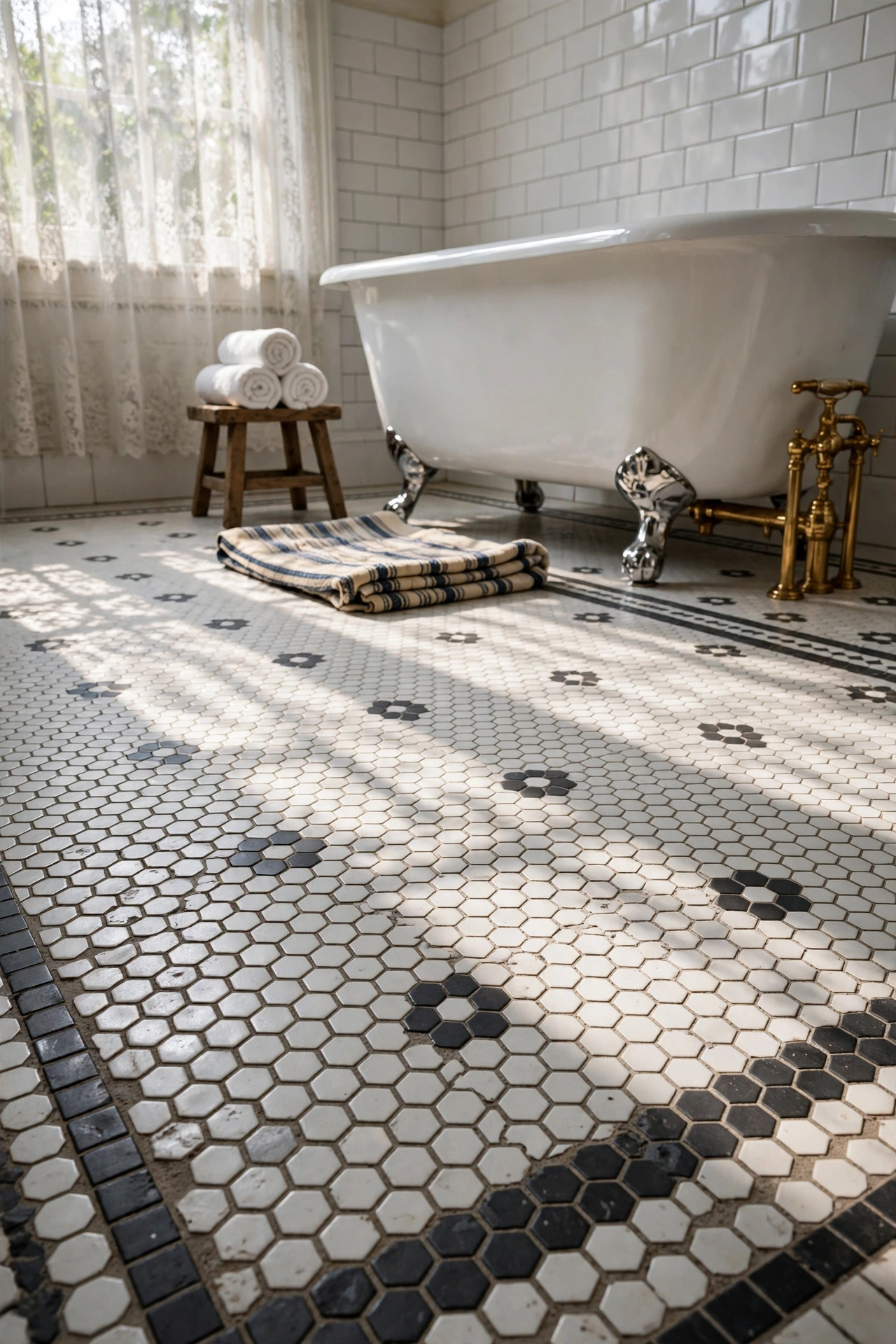
Traditional one-inch hex mosaics were the standard in bathrooms from the 1910s through the 1930s, chosen because their small size gripped well on slightly uneven floors and drained beautifully. That same practicality makes them a smart choice today, especially in shower areas.
Modern porcelain hex tiles mimic the look with easier maintenance and more colour options. Try an all-white field with a charcoal border for crisp contrast, or a soft grey blend for a gentler take. Keep grout lines tight and choose a grout colour close to the tile to let the pattern read clearly.
Underfoot, hex tile feels wonderfully tactile, and its small scale makes even a compact bathroom feel larger. It is a floor that has been fashionable for a hundred years — and shows no sign of leaving.
One practical tip: order ten percent more tile than your measurements suggest, and keep a box of spares after installation. Hex mosaics are easy to patch if a tile ever cracks, and having matching spares means a small repair stays invisible. It is the kind of forward thinking that keeps a vintage floor looking perfect for generations.
4. Brass Fixture Details
Warm, glowing brass is the jewellery of the vintage bathroom. Faucets, shower trims, towel rings, and cabinet knobs in unlacquered brass develop a rich living patina over time, deepening in colour wherever hands touch them most.
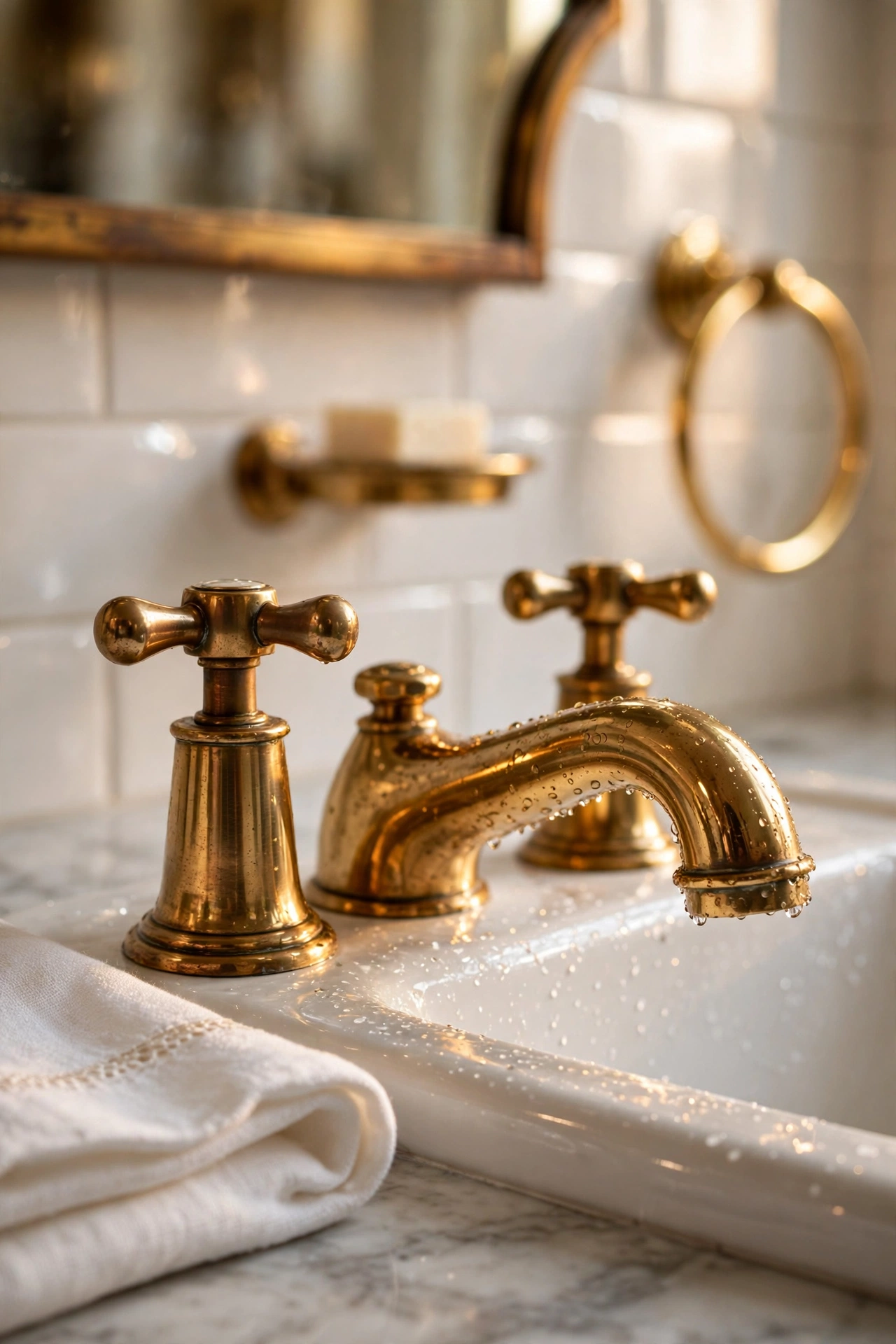
Mixing metals is perfectly acceptable in a vintage scheme, but brass should lead. A polished brass faucet against white porcelain and marble reads instantly classic, while aged or brushed brass brings a softer, more collected feel. Keep chrome to a minimum so the brass can shine — literally.
When buying, look for solid brass construction rather than plated zinc; the weight and finish are noticeably better, and solid brass can be polished back to life decades from now. Reproduction crosshead taps in brass are widely available and pair with both pedestal sinks and dresser-style vanities.
Maintain the finish with a gentle polish a few times a year, or let it mellow untouched for an authentically aged look. Either way, brass rewards you with warmth that no other metal quite matches.
To keep brass looking its best in a humid bathroom, wipe fixtures dry after heavy use and avoid abrasive cleaners that scratch the surface. A thin coat of clear wax once a year slows tarnishing on polished pieces. With minimal care, solid brass fixtures will outlive every other finish in the room.
5. Classic Subway Tile
Few materials say vintage bathroom like glossy white subway tile. Originally used in early-twentieth-century transit stations and hospitals for its cleanability, the humble 3-by-6 tile migrated into home bathrooms and never left.
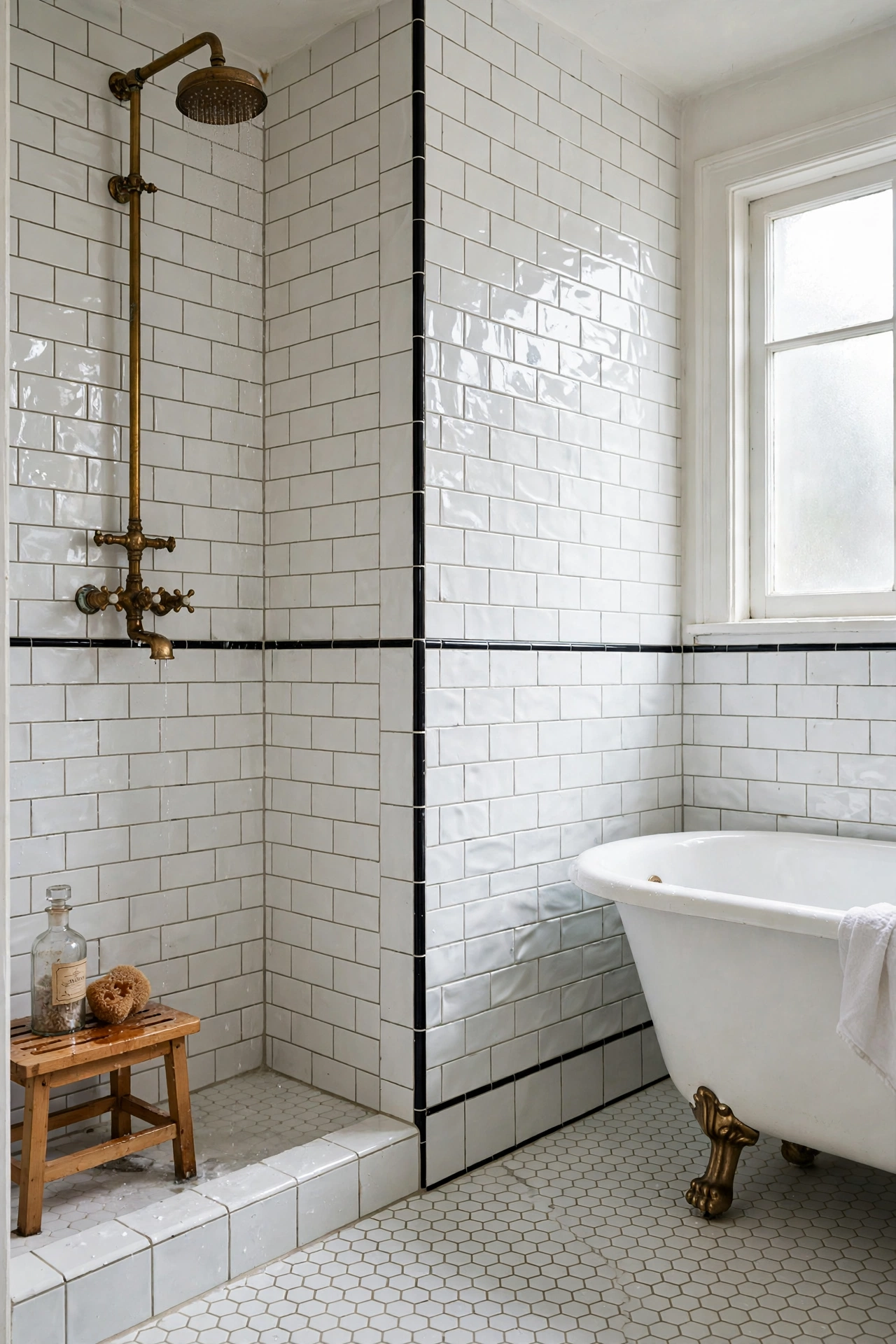
The classic installation is a running bond — offset by half a tile — with narrow grout joints. Take it to the ceiling in a shower for a crisp, waterproof envelope, or stop at picture-rail height with a chair rail cap for a more traditional wainscot effect.
Small variations keep it interesting: handmade-look tiles with undulating glaze catch the light beautifully, while a contrasting grout colour (soft grey is a favourite) emphasises the grid. For a bolder vintage gesture, run a single row of black pencil liner or a decorative border at the top.
Subway tile is also one of the most budget-friendly ways to get an authentic vintage look. It is timeless, easy to clean, and pairs with everything from clawfoot tubs to pedestal sinks without ever feeling dated.
If you are tiling yourself, invest in a good tile levelling system and take time with the first row — everything follows from it. Renting a wet saw for a weekend makes cutting around pipes and outlets far less stressful. A patient DIY installation can look every bit as good as a professional one.
6. Arched Mirror Focal Point
An arched mirror brings softness and architecture to the vintage bathroom in one move. The gentle curve breaks up the room’s rectangles — the tile grid, the vanity lines, the door frame — and draws the eye upward, making ceilings feel a little taller.
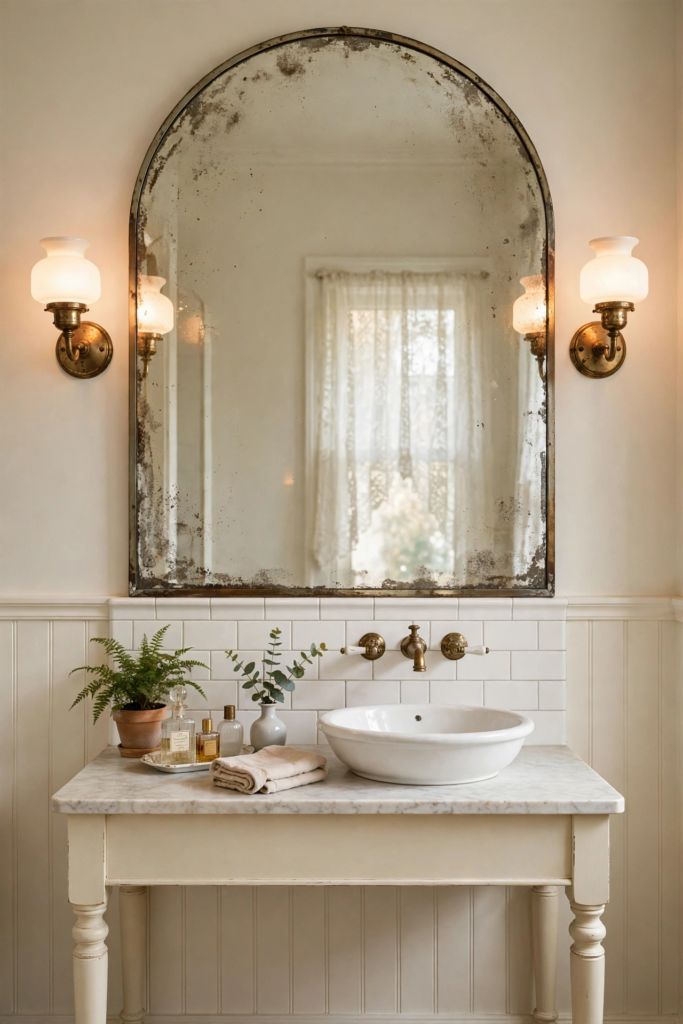
Look for mirrors with slim brass or aged-wood frames for the most period-appropriate feel. A slightly foxed or antiqued mirror glass adds wonderful authenticity, scattering light in a way that flat modern glass never quite manages.
Scale matters: the mirror should be roughly two-thirds the width of the vanity below it, hung so its centre sits at eye level. In a double vanity, a pair of arched mirrors is pure vintage elegance.
Above a pedestal sink, a single arched mirror becomes the room’s jewellery. Flank it with simple sconces and you have a vignette that feels straight out of a 1920s townhouse — no renovation required.
When shopping vintage, bring measurements and a small torch: check the back of the mirror for the maker’s label and inspect the frame joints for solidity. A little wobble can be fixed, but a warped frame cannot. The hunt is half the pleasure, and the right mirror is worth waiting for.
7. Beadboard Wall Charm
Beadboard panelling is cottage-vintage at its most charming. Those narrow vertical grooves add texture and rhythm to bathroom walls, protecting plaster from splashes while giving the room a handcrafted, lived-in warmth.
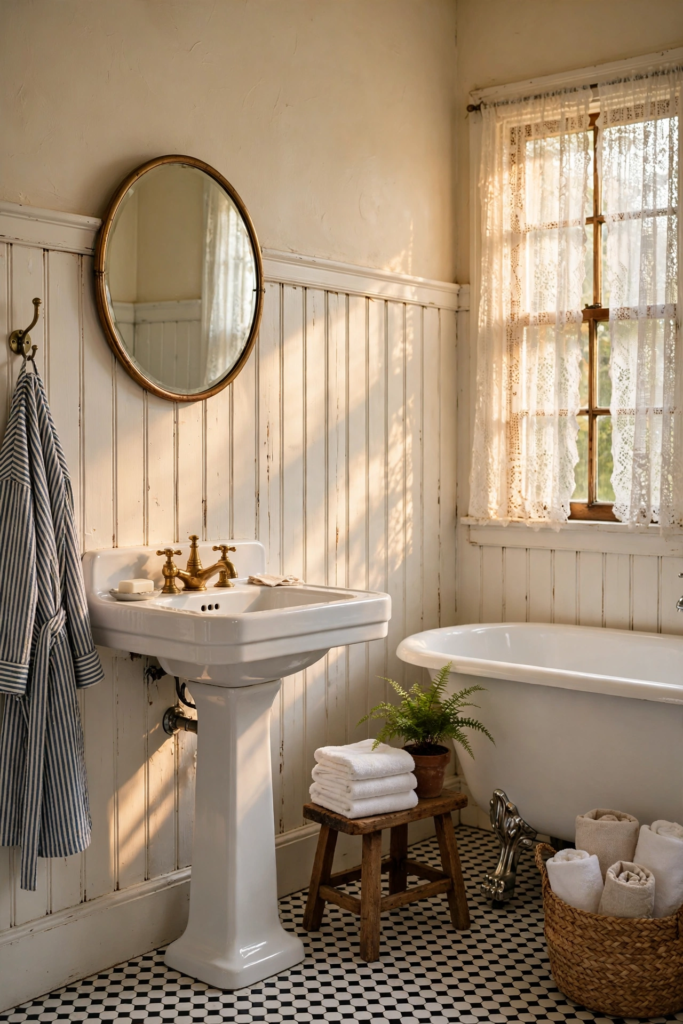
Traditionally made from tongue-and-groove boards, beadboard is now available in moisture-resistant MDF and PVC panels that handle bathroom humidity beautifully. Paint it in a soft white, warm cream, or a dusty heritage colour like sage or powder blue.
Install beadboard to chair-rail height with a simple cap moulding for the classic look, or run it floor to ceiling behind a vanity for extra drama. In a small bathroom, vertical lines visually stretch the walls, making the room feel taller.
Pair beadboard with a pedestal sink and a simple framed mirror for a sweet, unfussy vintage scheme. It is an affordable weekend project that delivers an outsized dose of character.
For extra authenticity, consider a plate rail or picture ledge along the top of the beadboard to display small framed prints or miniature potted herbs. This layered, collected styling is what separates a true vintage bathroom from a merely renovated one. Small touches, thoughtfully placed, do the heaviest lifting.
8. Freestanding Vanity with Marble Top
A freestanding vanity with a marble top borrows its silhouette from antique washstands and commodes. Turned legs, a lower shelf, and a cool veined stone surface combine furniture-like elegance with everyday practicality.
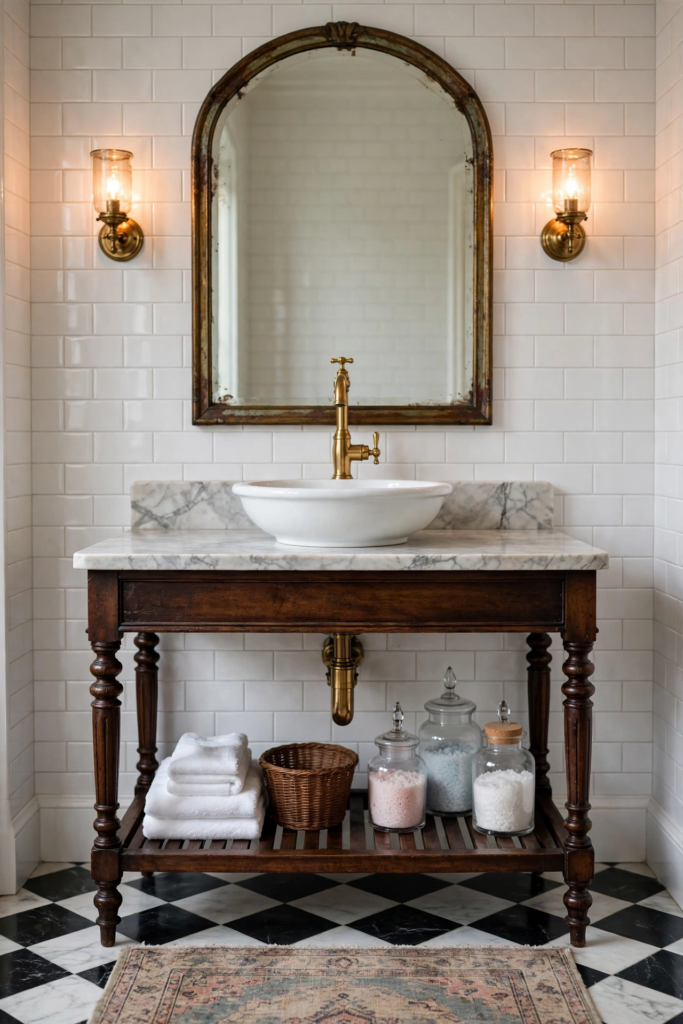
Carrara or Calacatta marble is the classic choice, its grey veining echoing the stone used in grand European bathrooms. Seal it well and wipe up promptly, and it will age gracefully — a little patina on marble is part of the vintage charm.
Undermount or vessel sinks both work beautifully. A vessel bowl in white porcelain sitting on the marble reads as a modern nod to the old washbasin-and-pitcher ritual, while an undermount keeps the lines clean and traditional.
Style the lower shelf with folded towels, woven baskets, or a stack of apothecary jars. With its furniture stance and stone top, this vanity anchors the whole room in quiet, old-world luxury.
When sourcing the vanity base, check that the legs are level and the frame is square — antique furniture sometimes needs a little shimming. A stone fabricator can template the top precisely, and your plumber will appreciate knowing the exact basin and tap positions before the top is cut.
9. Vintage Wall-Mounted Faucet
Wall-mounted faucets free the sink deck and deliver one of the most authentic vintage gestures you can make. Spout and handles emerging directly from the tile read as pure early-twentieth-century plumbing, before deck-mounted mixers took over.
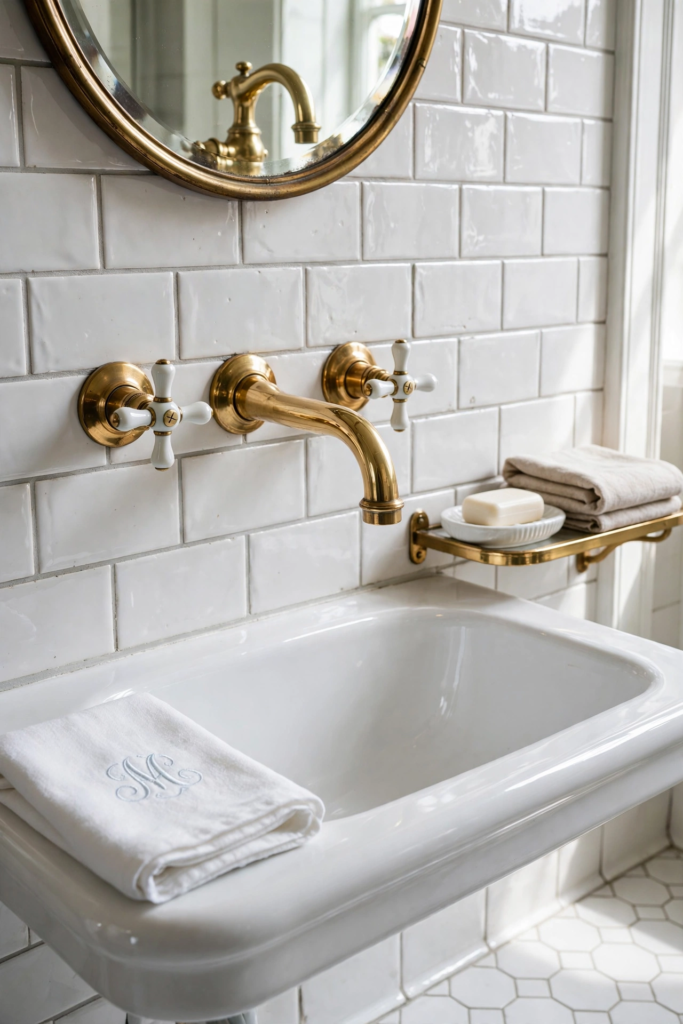
They pair naturally with vessel sinks and wall-hung basins, where there is no deck to drill. Choose crosshead handles in polished brass or porcelain-lever handles for the full period effect, and make sure the spout reach suits your basin depth.
Installation needs a little planning: supply lines run inside the wall, so this is a rough-in decision best made during a renovation. A good plumber will set the valves at the right height and depth for clean, drip-free lines.
The payoff is a sink area that feels open, architectural, and unmistakably vintage. With the deck clear, even a small basin gains a sense of ceremony.
If a full wall-mounted installation is too invasive, consider a deck-mounted bridge faucet with the same crosshead styling as a compromise. You still get the vintage silhouette with a far simpler installation. Either way, the crosshead handle is the detail that signals period intent most clearly.
10. Patterned Encaustic Floor Tile
Encaustic-look floor tiles bring artistry underfoot. Their intricate patterns — stars, florals, geometrics — recall the tiled halls and bathrooms of Victorian and Edwardian homes, where the floor was treated as a canvas.
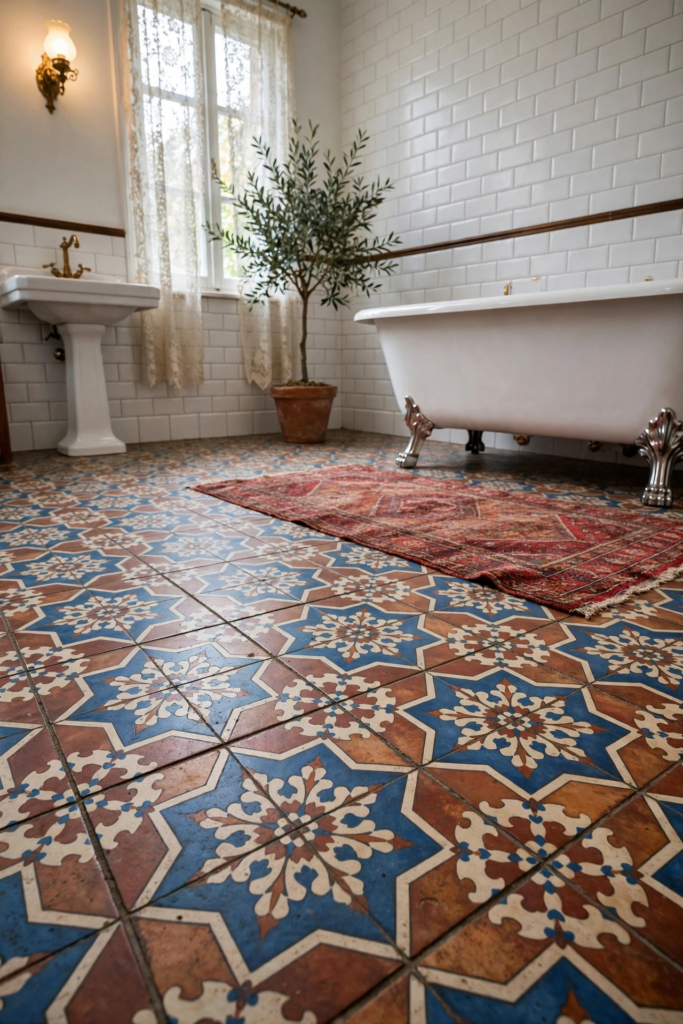
True encaustic tiles are made from coloured clays pressed into pattern; modern porcelain versions reproduce the designs with far less maintenance. Either way, the effect is a floor that feels collected and storied rather than simply new.
Because the pattern is busy, keep the rest of the room calm: white sanitary ware, simple wall tile, and quiet paint colours let the floor take centre stage. A single bold floor with restrained surroundings is the vintage formula that always works.
Use patterned tile across the whole floor for maximum impact, or as a bordered rug-like inset within a plain field. Whichever you choose, this is a floor guests will remember.
When laying patterned tile, dry-lay the design first and photograph it from above to check the pattern flows correctly before any adhesive is spread. Starting from the room’s centre keeps cut tiles symmetrical at the edges. Careful planning turns a bold floor from risky to remarkable.
11. Wainscoting Wall Treatment
Wainscoting — panelled woodwork on the lower portion of walls — lends the vintage bathroom a tailored, architectural polish. Flat panels, raised panels, or simple shaker-style frames all sit comfortably in a period-inspired scheme.
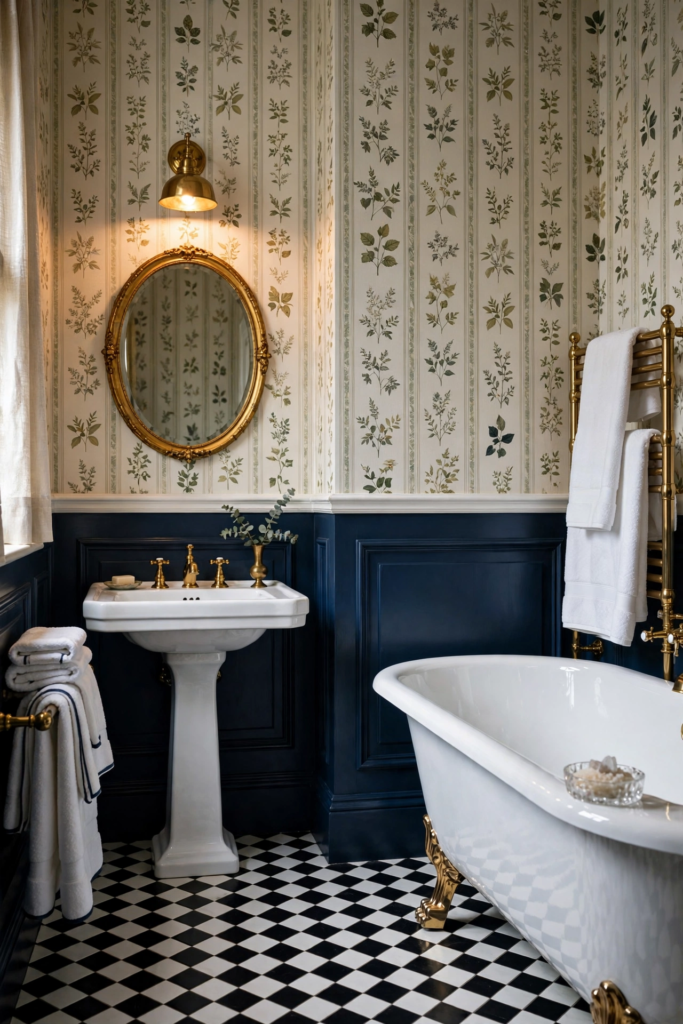
In a bathroom, choose moisture-resistant materials and a quality paint finish. A satin or semi-gloss paint in white, cream, or a deep heritage hue like ink navy or forest green stands up to steam while looking appropriately formal.
Top the wainscot with a chair rail, then paint or paper the wall above. A subtle striped or botanical wallpaper above crisp white wainscoting is a combination straight out of a Victorian townhouse.
Wainscoting also hides a multitude of sins — uneven plaster, old tile edges, patched walls — making it as practical as it is pretty. It is millwork that makes the whole room feel finished and intentional.
For a less formal take, try beadboard-style vertical panelling instead of raised panels — it reads more cottage, less manor. Painted in a dusty blue or warm putty, it softens the architecture beautifully. The principle is the same: divided walls, thoughtful colour, and crisp joinery.
12. Antique Chandelier Lighting
A chandelier in the bathroom feels deliciously indulgent — and it is entirely period-appropriate. Grand houses of the past lit their bathrooms with the same care as their drawing rooms, and a sparkling fixture overhead transforms the everyday into the ceremonial.
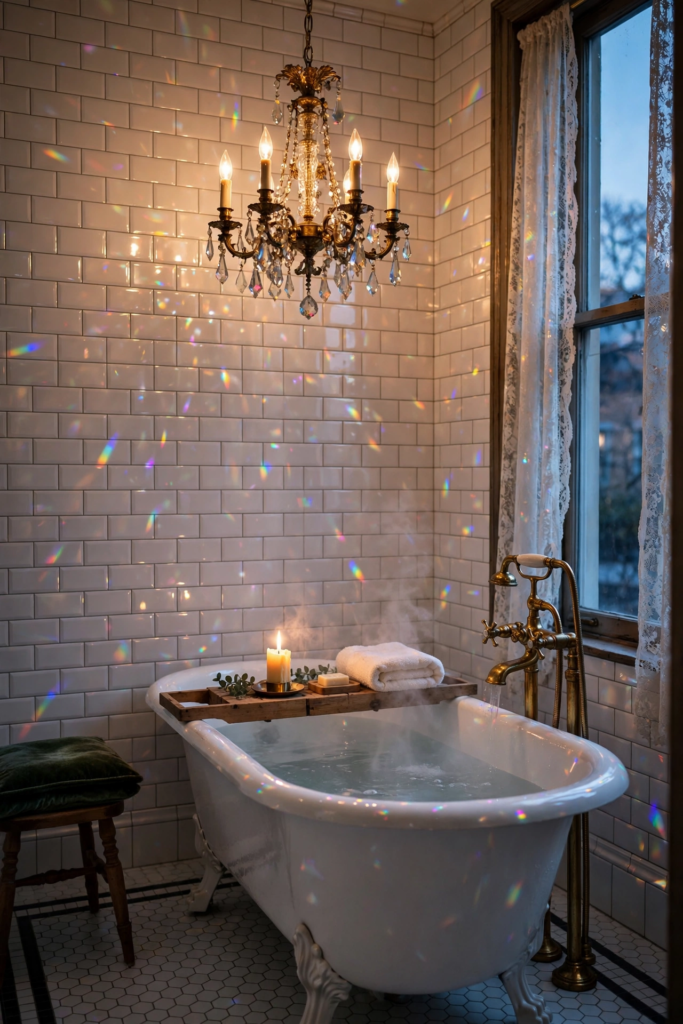
Choose a fixture rated for damp locations, and hang it where it cannot be touched from the tub or shower. Small crystal or brass chandeliers with candle-style bulbs cast the flattering, warm light that vintage bathrooms do best.
Scale the chandelier to the room: a petite four-arm fixture suits a powder room, while a larger piece can crown a spacious master bath. Hang it on a dimmer so you can shift from bright task light to soft evening glow.
Paired with a clawfoot tub below, a chandelier completes the fantasy of the vintage bathroom as a private spa. It is the single fastest way to make the room feel special.
If your ceiling cannot take a chandelier’s weight, a semi-flush milk glass fixture gives a similar vintage glow with a simpler mount. Always confirm the fitting is rated for bathroom zones, and put every light on a dimmer. Vintage bathrooms are about atmosphere, and dimmers are the cheapest atmosphere money can buy.
13. Apothecary Storage Jars
Glass apothecary jars turn everyday necessities into a beautiful display. Cotton balls, bath salts, and soap bars look infinitely more appealing decanted into clear vessels with ground-glass stoppers than left in their packaging.
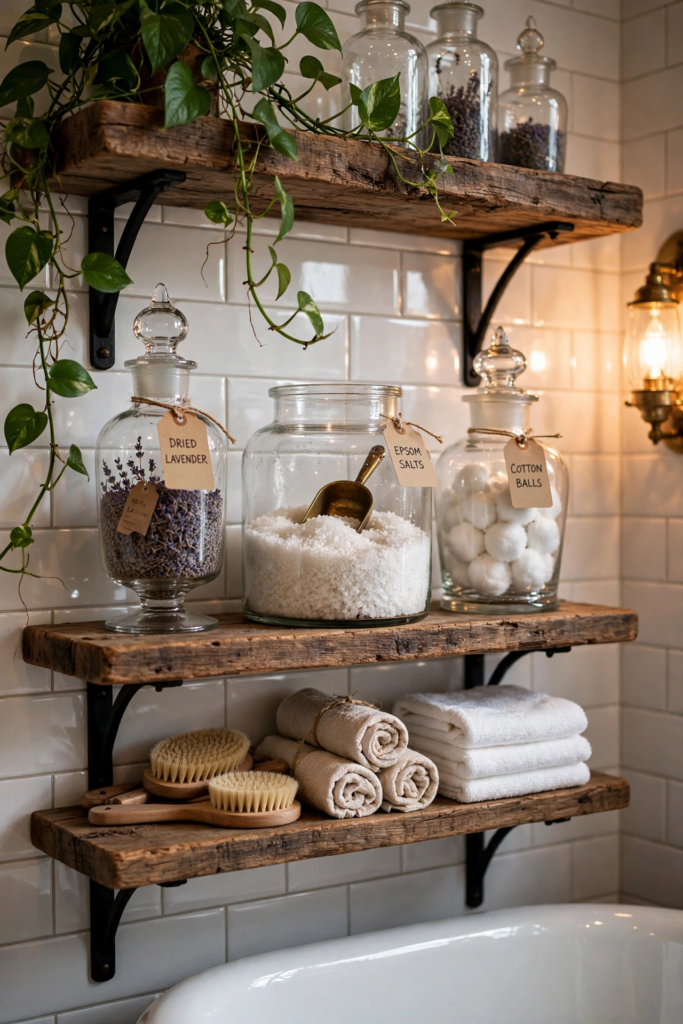
Hunt for true vintage jars at flea markets and antique shops — old pharmacy and laboratory glass has a weight and clarity modern copies rarely match. Group jars in odd numbers and varying heights for the most pleasing arrangement.
Place a cluster on open shelving, on the vanity back, or on a small tray beside the tub. Fill them with things you actually use: Epsom salts, cotton pads, wooden bath brushes. Beauty and function in perfect balance.
Label the jars with simple paper tags tied in twine for an extra apothecary touch. It is a small styling move that makes the whole bathroom feel curated and intentional.
Beyond the bathroom, the same jars work beautifully for cotton pads, hair ties, and spare toiletries, keeping every surface calm. Once you start decanting, it is hard to stop — and your bathroom will look all the better for it. Order, it turns out, is one of the prettiest vintage accessories.
14. High-Tank Pull-Chain Toilet
The high-tank pull-chain toilet is the ultimate vintage bathroom conversation piece. With its cistern mounted high on the wall and a long chain pull, it recreates the drama of Victorian plumbing — and it genuinely works beautifully.
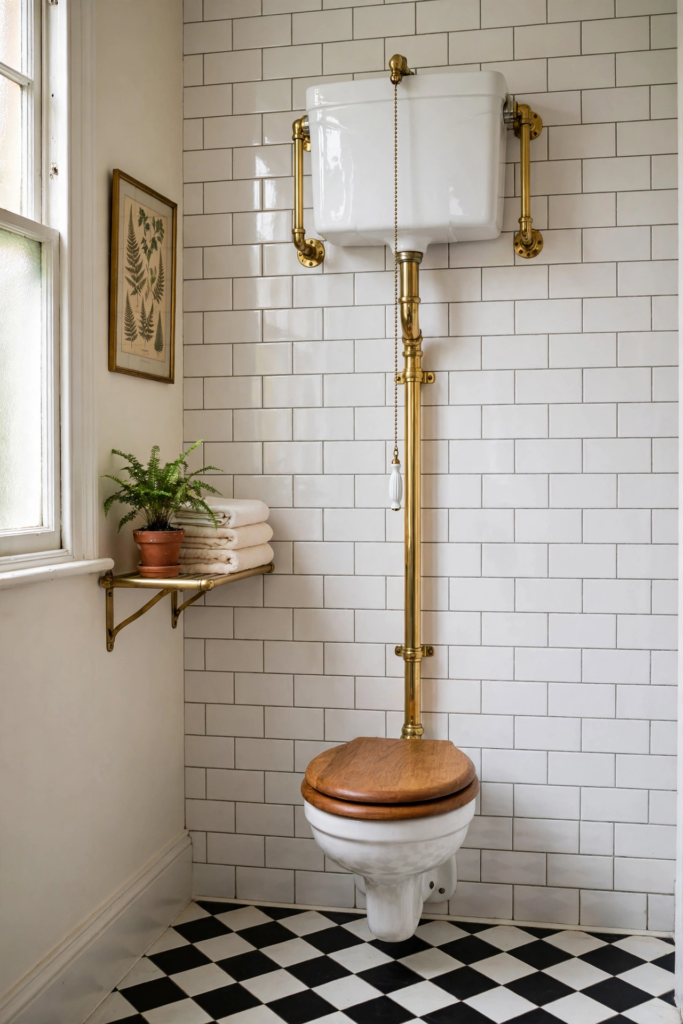
The elevated tank gives the flush extra gravity-fed power, and the exposed pipework is honest, mechanical, and full of character. Reproduction sets in white vitreous china with brass or chrome fittings are available from specialist suppliers.
This is a statement for a larger bathroom or a dedicated water closet; the vertical pipework needs wall space and becomes a visual feature in its own right. Pair it with a wooden seat for warmth and authenticity.
Few fixtures telegraph vintage intent as clearly as a pull-chain toilet. Guests will smile, and you will enjoy one of the most satisfying flushes in domestic plumbing.
Because the cistern sits high, check your water pressure is adequate and the wall fixings are rock solid — a full cistern is heavy. A specialist plumber experienced with heritage fittings will set the flush pipe run perfectly vertical, which is essential for both looks and performance.
15. Antique Brass Towel Rail
A brass towel rail — wall-mounted, freestanding, or ladder-style — keeps towels within reach while adding another layer of warm metal to the room. In the vintage bathroom, even the most functional fittings deserve to be beautiful.
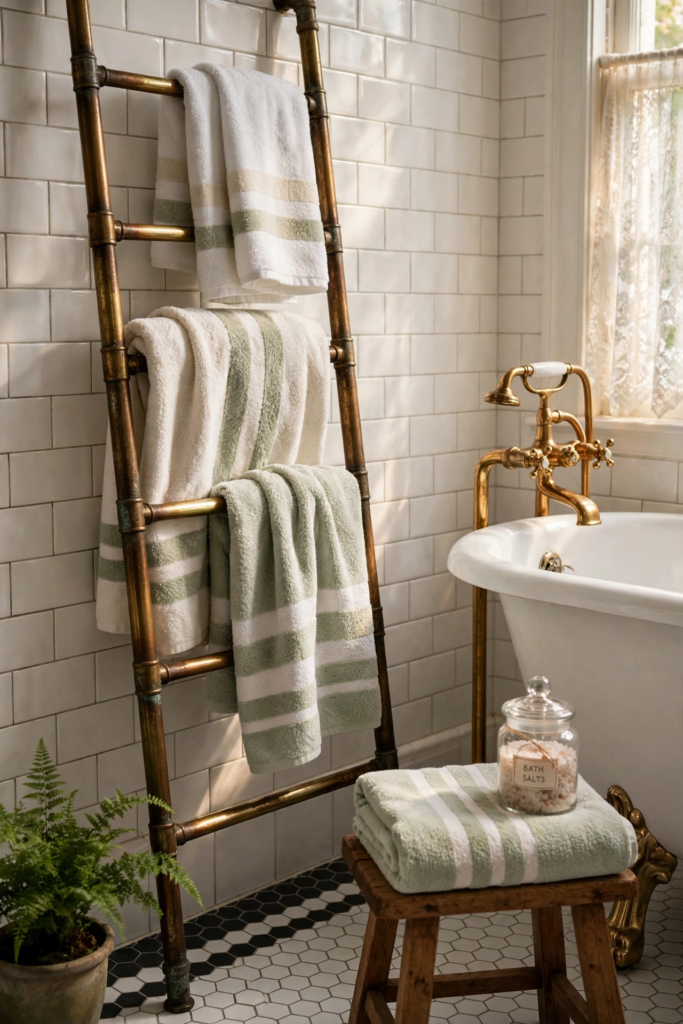
Wall-mounted rails beside the tub or vanity save floor space and suit smaller rooms. A freestanding ladder rail leans casually against the wall and can hold several towels, making it ideal for a family bathroom or a generous master.
Choose solid brass with a polished or aged finish to match your faucets and lighting. The consistency of metal finishes across fixtures is one of the quiet details that makes a vintage scheme feel considered rather than assembled.
Drape thick, thirsty towels in white or natural linen over the rail and let them be part of the decor. A well-styled towel rail is proof that in a vintage bathroom, utility and beauty are the same thing.
In a busy family bathroom, add a second rail or a set of individual hooks so everyone has a spot. Matching the hooks’ finish to the rail keeps the scheme coherent. Thoughtful towel storage is one of those invisible luxuries that makes a bathroom feel genuinely well designed.
Vintage Bathroom Feature Budget & Style Guide
| Feature | Budget Range | Notes |
|---|---|---|
| Clawfoot tub (salvaged / reproduction) | $400–$1,200 / $1,500–$4,000 | Centrepiece; allow extra floor space |
| Pedestal sink + brass faucet | $250–$800 | Ideal for small bathrooms |
| Hex or subway tile (materials + install) | $8–$25 per sq ft | Timeless; DIY-friendly in small areas |
| Brass fixtures set (faucet, shower, accessories) | $300–$1,200 | Solid brass outlasts plated finishes |
| Arched or brass-framed mirror | $80–$400 | Instant vintage focal point |
| Beadboard / wainscoting | $3–$10 per sq ft | Big character for modest cost |
| Chandelier or milk glass lighting | $100–$600 | Must be damp-rated for bathrooms |
| Antique dresser vanity conversion | $200–$900 + plumbing | One-of-a-kind; seal wood well |
| Checkerboard / encaustic floor tile | $10–$30 per sq ft | Bold floors pair with calm walls |
| Styling (jars, prints, linens, rug) | $100–$400 | The layer that makes it feel collected |
16. Weathered Wood Medicine Cabinet
A medicine cabinet in weathered or reclaimed wood brings rustic vintage warmth to the bathroom wall. Behind its charmingly aged doors hides thoroughly modern storage — the best of both worlds.
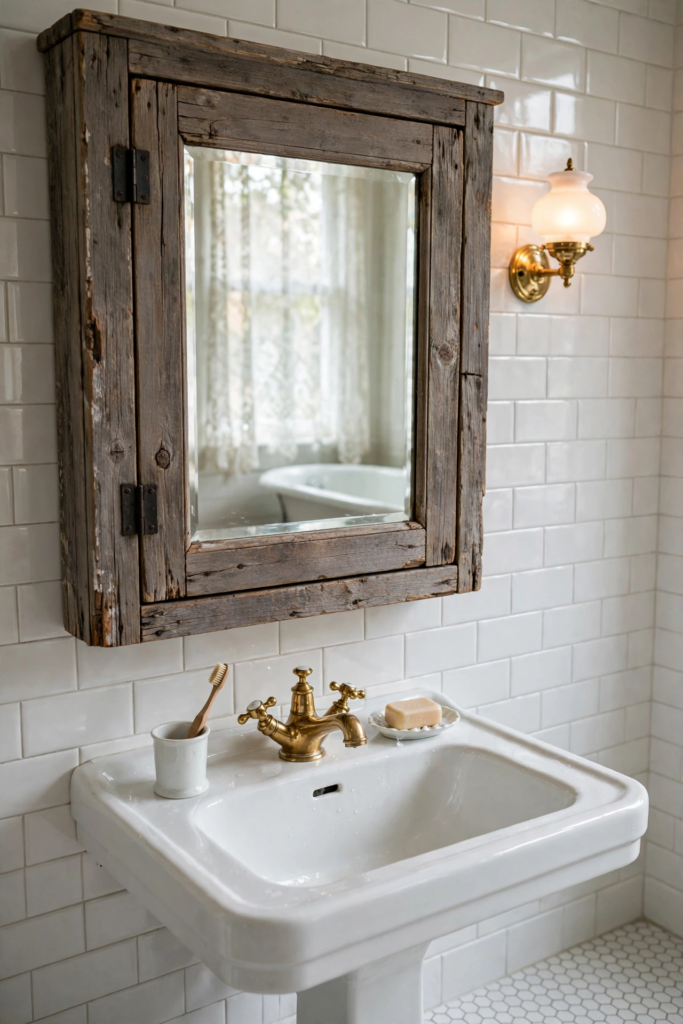
Look for cabinets with a softly distressed finish, simple hardware, and a mirror on the front for double duty. The contrast of rough wood against smooth tile and porcelain is exactly the kind of texture play that makes vintage rooms feel alive.
Mount it above the sink at a comfortable height, and keep the interior organised with small trays or jars so the beautiful exterior is matched by calm functionality inside.
If you cannot find a true antique, a new cabinet in reclaimed-look timber works just as well. A light sanding and a coat of wax will give even a new piece a gently timeworn glow.
To protect the wood in steamy conditions, ensure the bathroom has good extraction and leave the cabinet doors ajar after hot showers. A yearly rub of furniture wax keeps the finish nourished. Treated with a little respect, a wooden cabinet will age as gracefully as the antiques it imitates.
17. Lace Curtain Window Treatment
Lace curtains filter bathroom daylight into something magical. Their open weave preserves privacy while letting soft, dappled light pour in — the kind of light that flatters both people and porcelain.
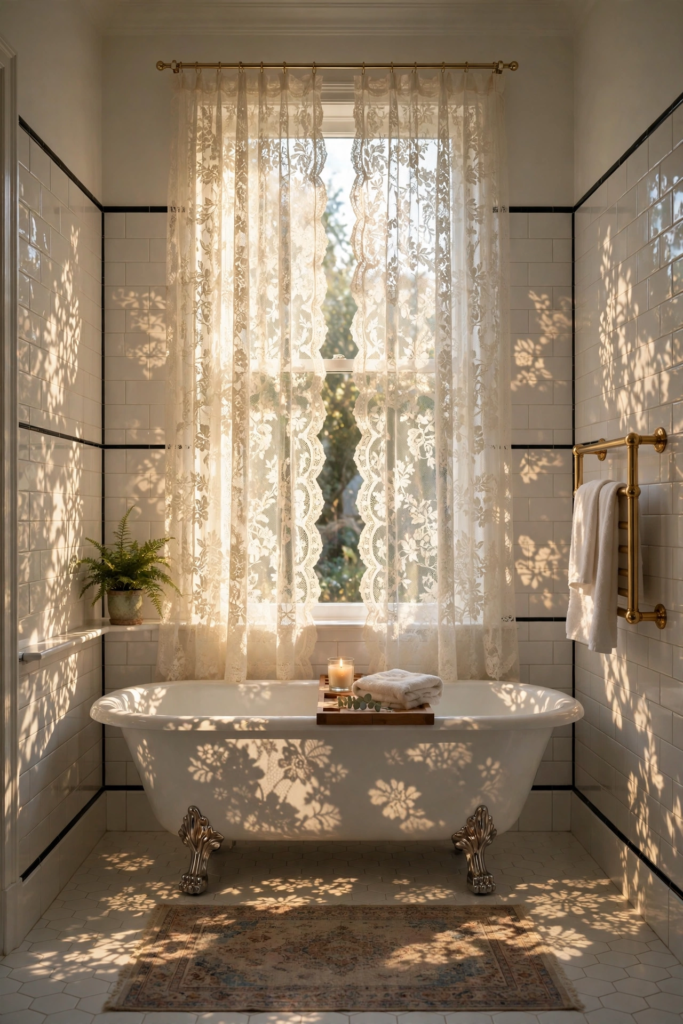
Traditional Nottingham or Battenberg lace panels suit the vintage bathroom perfectly. Hang them on a slim brass tension rod inside the window frame for a neat, unfussy look, or on a decorative rod with simple finials for more presence.
Keep the lace white or ivory and wash it occasionally to prevent yellowing from steam. A single panel per window is usually enough; the goal is glow, not gloom.
Paired with a clawfoot tub beneath the window, lace curtains complete one of the most romantic vignettes in the vintage bathroom repertoire. Simple, inexpensive, and utterly transformative.
For windows that need more privacy at night, layer a simple roller blind behind the lace — down after dark, up by day. The lace remains the star while the blind does the practical work unseen. It is a combination that preserves both the romance and the modesty of the room. Choose a washable cotton lace if your bathroom runs steamy, and the curtains will stay fresh and bright for years.
18. Antique Brass Vanity Mirror
A vanity mirror in an antique brass frame does more than reflect — it gilds the whole room. Whether round, oval, or rectangular with softly rounded corners, a brass-framed mirror catches light and adds a jewellery-box gleam above the sink.
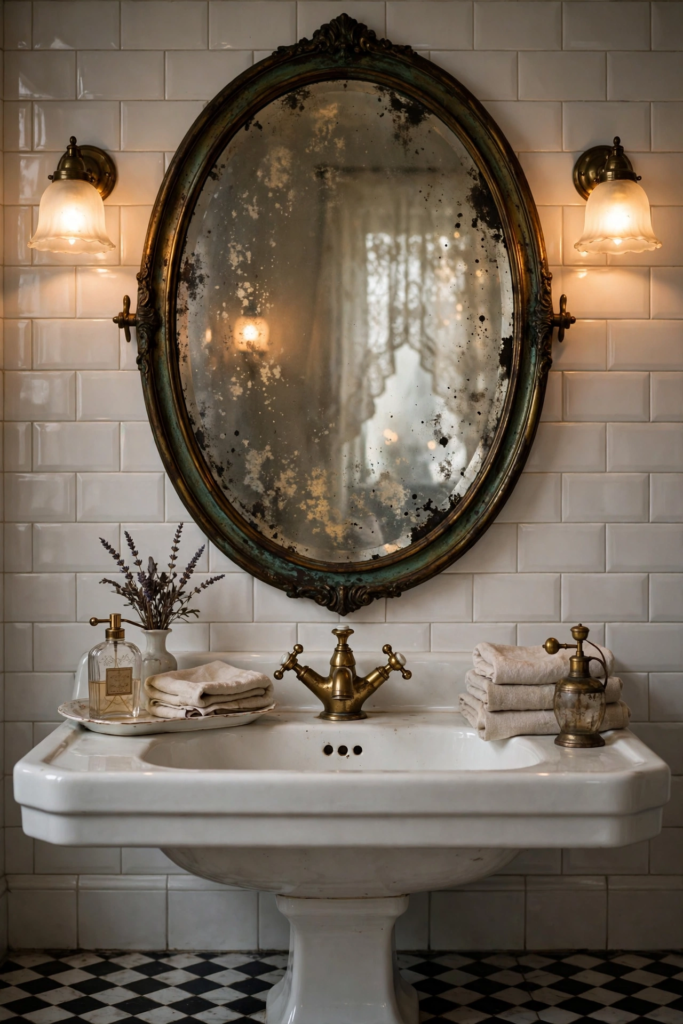
Flea markets and antique shops are full of brass-framed mirrors waiting for a second life. Check the silvering for foxing — those dark, mottled spots are prized by vintage lovers, as they prove the mirror’s age and scatter light beautifully.
Hang the mirror so its centre sits at eye level, and consider flanking it with a pair of small brass sconces. The trio of brass frame plus twin lights is a classic composition that never fails.
If the brass is dull, a gentle polish revives it; if you love the dark, aged patina, leave it exactly as found. Either finish tells a story, and that is precisely the point.
If you fall for a mirror whose frame you love but whose glass is too far gone, a glass specialist can re-silver it while keeping the original frame. The result is the best of both worlds: crisp reflection wrapped in genuine antique character. Ask to see examples of their foxing work first.
19. Marble Hexagon Shower Tile
Marble hexagon tiles bring a touch of quiet luxury to the vintage shower. The small-scale pattern nods to early-twentieth-century mosaic floors, while the natural stone veining adds depth that ceramic can only imitate.
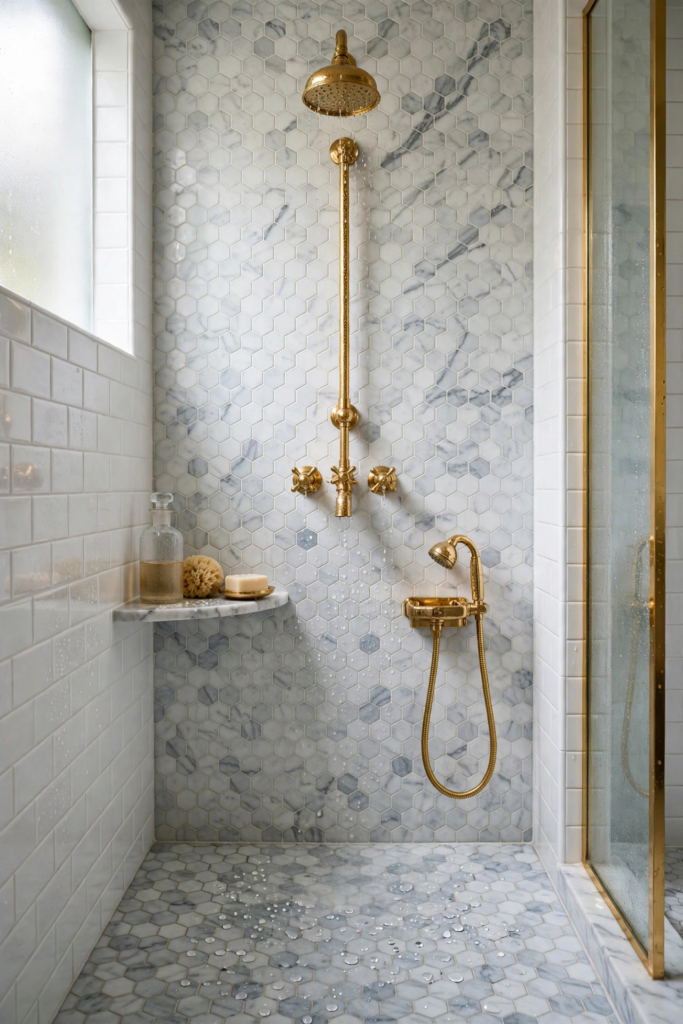
Use honed marble hexes on the shower floor for sure footing and timeless looks, and consider running them up one accent wall. Keep the remaining walls in simple white subway tile so the marble reads as a precious detail rather than an overwhelming one.
Seal marble thoroughly and reseal annually — natural stone is more maintenance than porcelain, but its patina and variation are unmatched. Choose a grout colour close to the stone’s base tone for a seamless, high-end finish.
Paired with brass shower fittings and a frameless or brass-trimmed screen, a marble hex shower becomes the jewel of the vintage bathroom. It is an investment that pays back every single morning.
To stretch the budget, use marble hex only on the shower floor and a beautiful porcelain lookalike on the walls. Nobody will know, and the floor — where your feet actually meet the stone — delivers the authentic luxury. Smart splurging is the secret of every convincing vintage renovation.
20. Vintage Rug Runner
A vintage rug runner softens the bathroom’s hard surfaces and adds pattern, colour, and warmth underfoot. Persian and Turkish designs in faded reds, blues, and creams sit beautifully against white tile and porcelain.
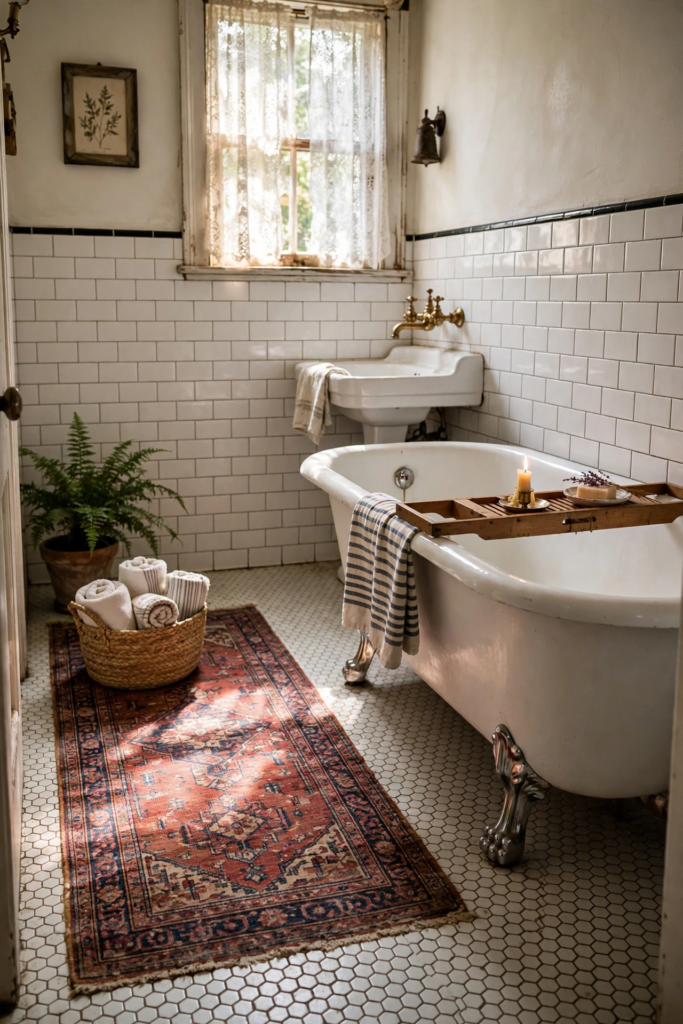
Choose a low-pile, flatweave rug that dries quickly and lies flat — antique kilims and distressed wool runners are ideal. Add a non-slip pad underneath for safety on wet tile floors.
Place the runner alongside the tub, in front of a double vanity, or down the centre of a long, narrow bathroom. The textile instantly makes the room feel more like a living space and less like a washroom.
Rotate and air the rug regularly, and keep a spare so one can always be drying. With a little care, a good vintage rug will outlast almost everything else in the room.
If you love the look but worry about damp, keep the rug outside the splash zone and choose machine-washable vintage-style rugs for high-traffic family bathrooms. Modern reproductions in traditional patterns give you the aesthetic with zero anxiety. Beauty should never come with a maintenance headache. Shake the rug outside weekly and it will reward you with decades of soft, pattern-rich service.
21. Cast Iron Radiator Accent
A cast iron column radiator is equal parts heater and sculpture. Its ribbed Victorian profile brings industrial-vintage character to the bathroom while keeping towels and toes gloriously warm.
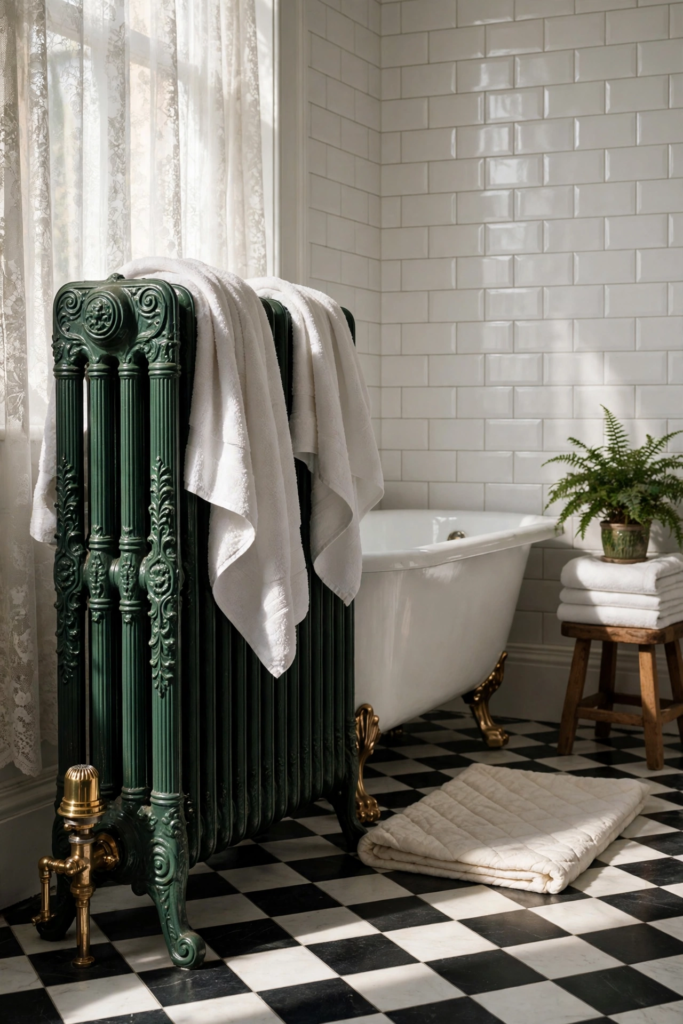
Original radiators can be salvaged, shot-blasted, and repainted in any colour — classic white, dramatic black, or a heritage shade that picks up the room’s palette. Specialist companies will even convert them for modern central heating systems.
Position the radiator where it doubles as a towel warmer: beside the tub or near the shower. Drape it with thick towels and it becomes one of the hardest-working decorative elements in the house.
Even in a mild climate, a slim column radiator adds architectural presence that a flat modern panel never could. It is heating you will actually want to look at.
Bleed the radiator at the start of each heating season to keep it running silently and efficiently. A tiny key and two minutes of your time prevent cold spots and gurgling. Even a decorative radiator deserves to work as beautifully as it looks. Pair it with a matching heated towel rail in the same finish for the ultimate cold-morning luxury.
22. Reclaimed Wood Open Shelving
Open shelving in reclaimed wood displays your prettiest bathroom essentials while adding organic warmth. Thick scaffold boards or salvaged planks, simply bracketed to the wall, create storage that feels crafted rather than installed.
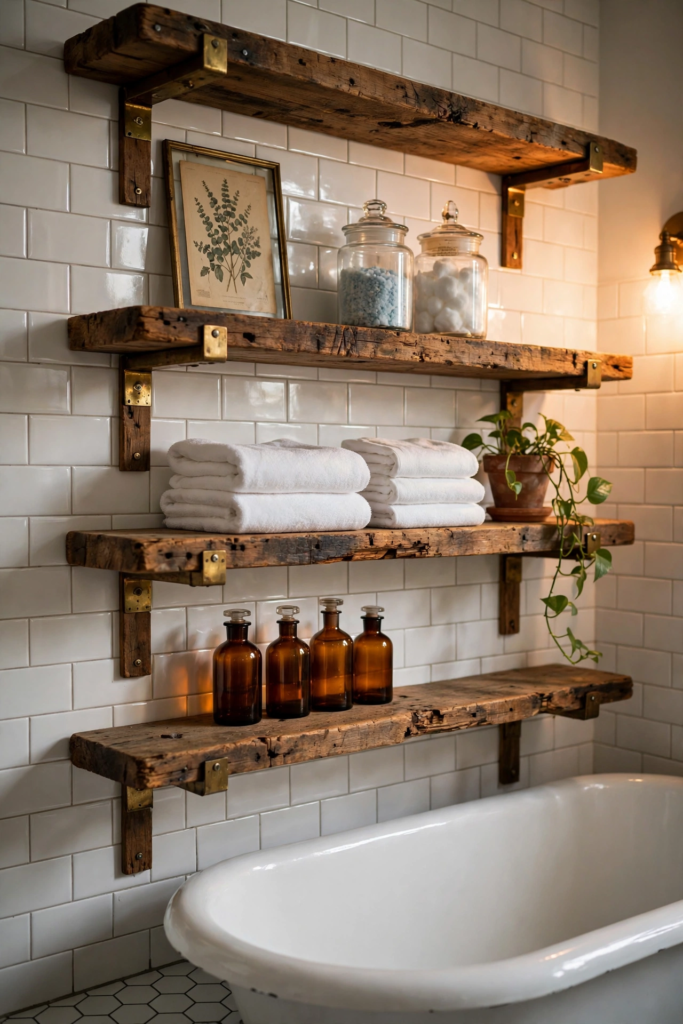
Style the shelves with restraint: folded towels, apothecary jars, a small plant, a stack of beautiful soap. Leave breathing room between objects so each one can be appreciated — clutter is the enemy of the vintage look.
Seal the wood with a matte water-resistant finish to protect against steam, and choose solid brass or black iron brackets to suit your fixture finishes.
Above a toilet, beside a mirror, or filling an awkward alcove, reclaimed wood shelving turns dead wall space into one of the room’s most characterful features.
Anchor the brackets into studs or solid masonry — shelves loaded with jars and towels are heavier than they look. A dab of museum putty under lightweight objects stops them rattling when doors slam. Solid fixing is the unglamorous foundation of every beautiful shelf. Keep heavier items low and lighter objects high so the whole arrangement feels balanced and secure.
23. Milk Glass Light Fixtures
Milk glass shades glow with a soft, diffused light that flatters everything in the vintage bathroom. Their opaque white glass — popular from the 1920s through the 1950s — hides the bulb and spreads light evenly, banishing harsh shadows.
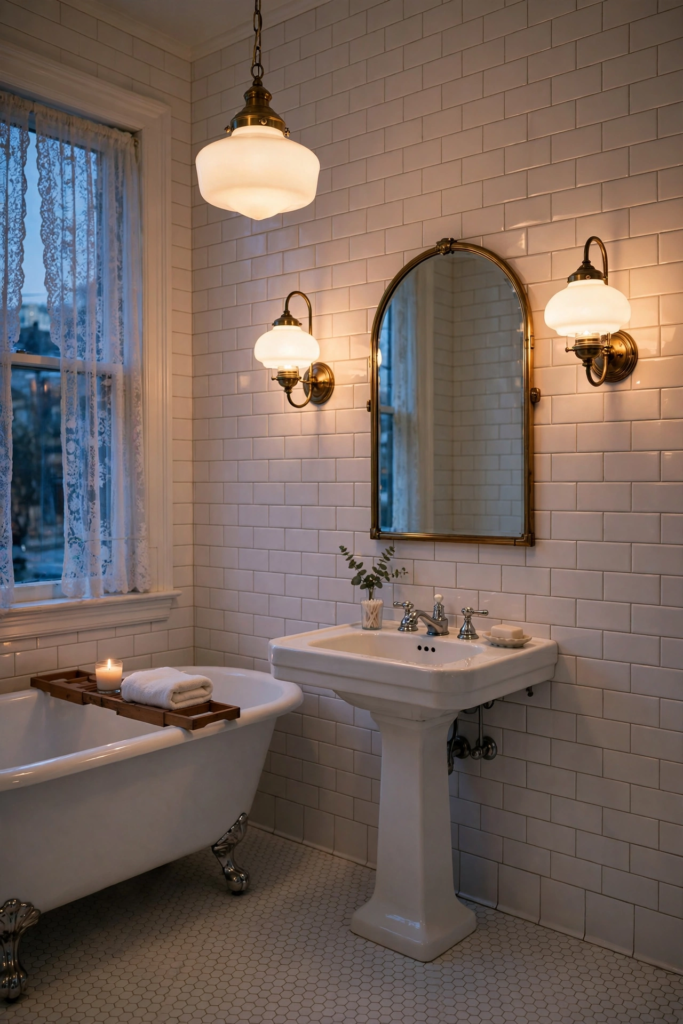
Look for schoolhouse pendants, flush-mount ceiling fixtures, and wall sconces with classic milk glass shades. Originals surface regularly at antique shops; faithful reproductions are widely available for a fully matched set.
Hang a pair of milk glass sconces flanking the mirror for ideal face-flattering light, and add a schoolhouse pendant to the ceiling for ambient glow. Use warm-white bulbs to keep the light golden rather than clinical.
Timeless, affordable, and endlessly versatile, milk glass lighting is one of the easiest ways to give any bathroom an instant vintage soul.
Dust the shades regularly with a soft dry cloth, and wash them in warm soapy water once or twice a year to keep the glass glowing. Milk glass yellows gracefully with age, but a gentle clean restores its luminous best. Little maintenance rituals keep vintage lighting looking loved. Choose LED filament bulbs for the vintage look of carbon filaments with thoroughly modern efficiency.
24. Antique Dresser Vanity
Converting an antique dresser into a vanity is the ultimate vintage bathroom statement. A Victorian chest of drawers or an Art Deco sideboard, topped with stone and fitted with a basin, becomes a one-of-a-kind piece no showroom can replicate.
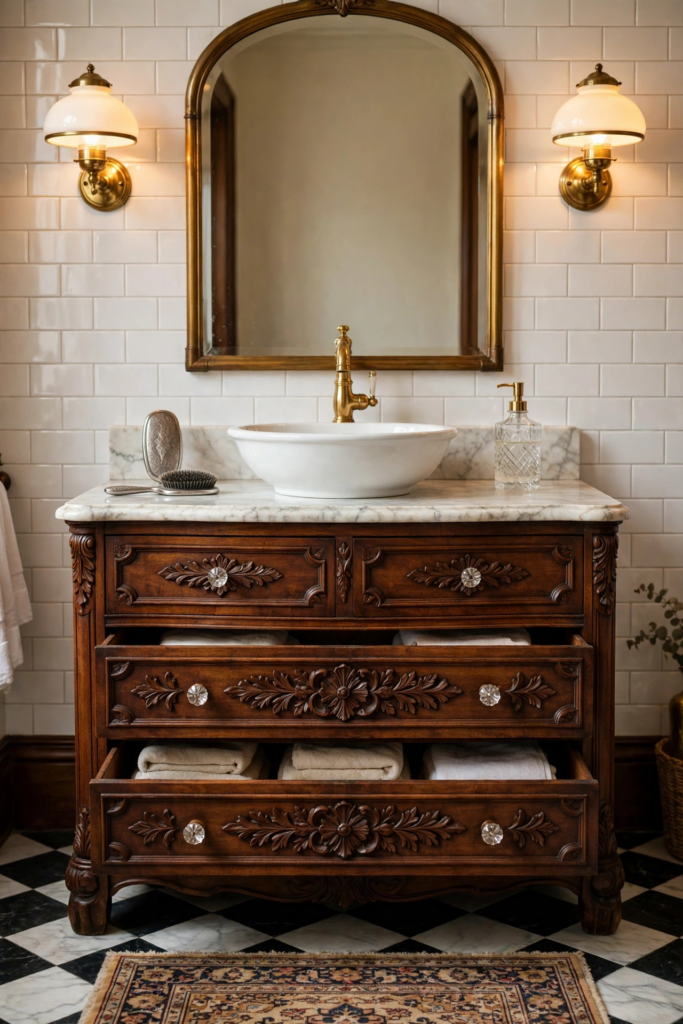
Choose a dresser of comfortable height with drawers that can be adapted around plumbing — the top drawers are usually cut or converted to false fronts. A marble or quartz top protects the wood and completes the furniture look.
Vessel sinks sit beautifully on dresser tops, while an undermount keeps the profile lower. Pair with wall-mounted or tall vessel faucets, and add crystal or brass knobs to the original drawers.
Seal all wood surfaces against moisture and ensure good ventilation in the room. Done well, a dresser vanity is the piece guests ask about — and the heart of the whole bathroom.
Before committing, live with the dresser in place for a few days to confirm the height and projection feel right. Bathroom vanities sit slightly lower than ideal for some, and a dresser cannot be adjusted. A test run now prevents an expensive regret later.
25. Porcelain Soap Dish & Accessories
Small porcelain accessories — soap dishes, tumblers, lotion dispensers — are the finishing brushstrokes of the vintage bathroom. In white vitreous china with simple, classic shapes, they bring a crisp, clean counterpoint to brass and wood.
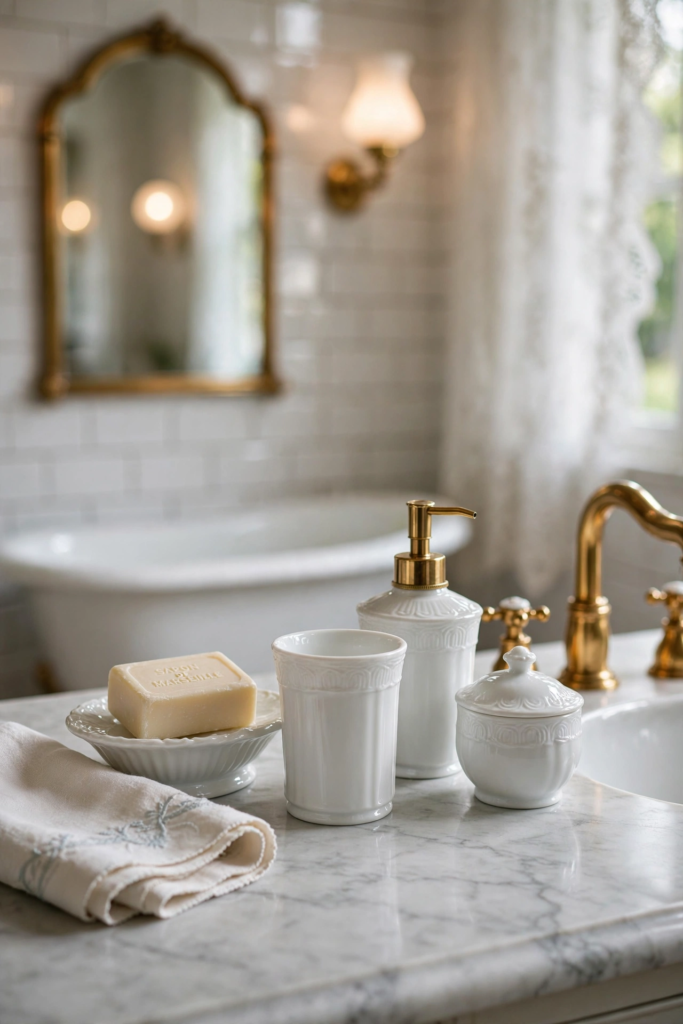
Look for pieces with subtle period details: fluted edges, embossed rims, or a maker’s mark on the base. Matching sets create a sense of order, while a collected mix of complementary pieces feels more authentically vintage.
Decant hand soap and lotion into porcelain dispensers rather than leaving branded bottles on show. It is a tiny change that instantly elevates the vanity from functional to styled.
These small pieces are also the most affordable entry point into vintage styling. A beautiful soap dish costs little but signals, unmistakably, that every detail in the room has been considered.
Wash porcelain accessories by hand with mild soap rather than harsh chemicals to preserve their glaze for decades. Group them on a single tray and the whole arrangement can be lifted for easy counter cleaning. Beautiful things that are also easy to live with — that is the vintage ideal. A matching porcelain tray keeps the whole collection together and makes cleaning the counter effortless.
26. Checkerboard Floor Tile
The black-and-white checkerboard floor is vintage drama at its boldest. This high-contrast classic has graced bathrooms, bistros, and grand hallways for over a century, and it still stops people in their tracks.
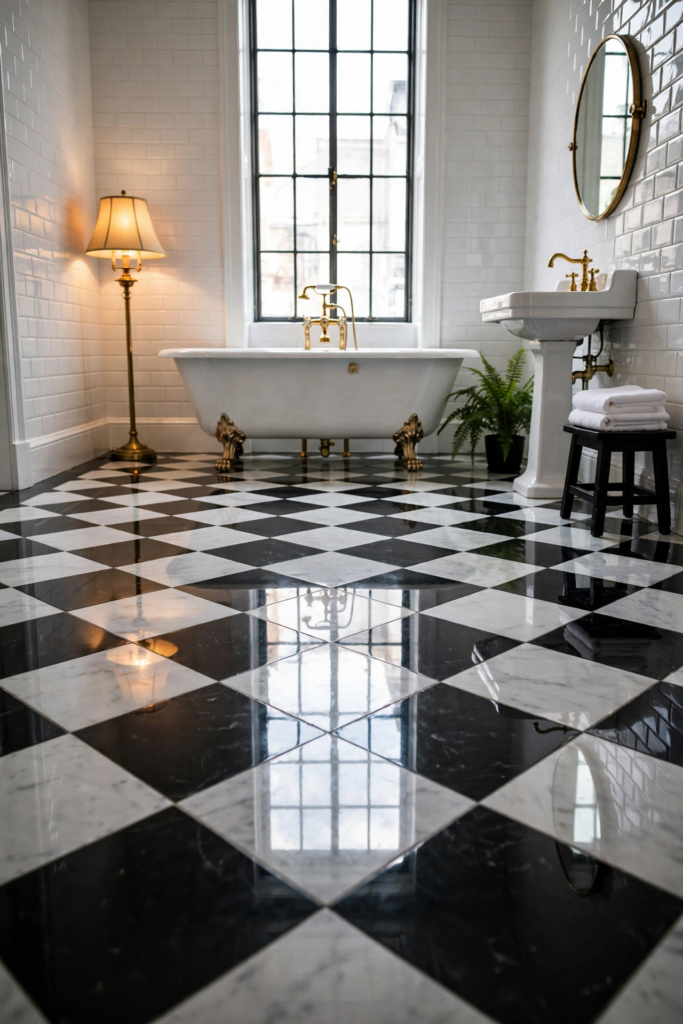
Large-format squares in marble or porcelain create the most authentic look; smaller squares feel busier and more cottage-like. Lay the pattern on the diagonal to make the room feel larger, or square to the walls for a calmer, more formal effect.
Balance the bold floor with quiet surroundings: white sanitary ware, simple wall tile, and minimal colour elsewhere. The checkerboard is the star — everything else plays a supporting role.
It is a floor that hides dirt well, cleans easily, and never goes out of style. For maximum vintage impact with minimum fuss, few choices beat the checkerboard.
For the grout, choose a dark charcoal rather than pure black — it hides discolouration and looks softer against the white squares. Seal the grout after installation and reseal yearly. A checkerboard floor is a long-term relationship, and it rewards consistent care. In a small bathroom, the bold pattern tricks the eye into reading the space as larger than it is.
27. Brass Showerhead & Exposed Pipe
An exposed-pipe shower with a generous brass showerhead is industrial-vintage at its most romantic. Riser pipes, visible valves, and a wide rain-style head recreate the grand hotel bathrooms of a century ago.
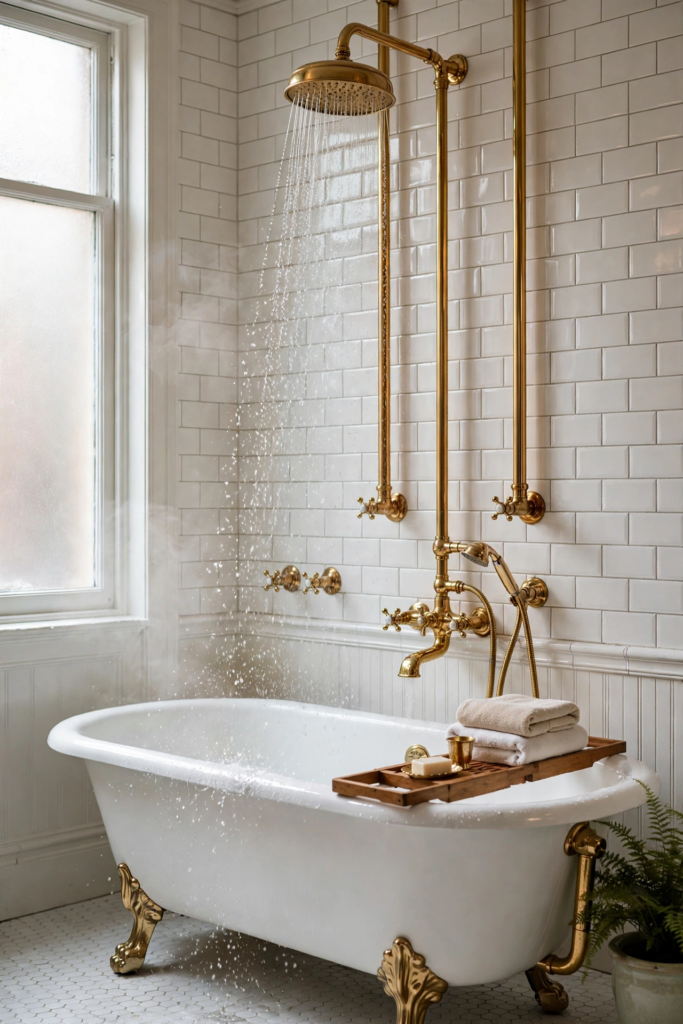
Exposed shower sets in solid brass — with crosshead controls and a hand-shower on a cradle — are available as complete kits. They mount to the wall over the tub or in a walk-in shower, turning the plumbing itself into decoration.
Pair with a simple white tub or a tiled shower enclosure in subway or hex tile. The contrast of gleaming brass pipework against crisp tile is one of the great visual pleasures of the vintage bathroom.
Beyond looks, a large brass head delivers a wonderfully generous shower. This is vintage style you feel on your skin every morning.
After installation, run the shower for a few minutes and check every joint for weeps before the tiler seals the wall. Exposed pipework is easy to access, which is part of its charm — any future maintenance is a simple spanner job rather than a tile-smashing expedition. A thermostatic valve keeps the temperature perfectly steady, blending period looks with modern safety.
28. Vintage Botanical Prints
Framed botanical prints bring gentle colour and natural history charm to bathroom walls. Nineteenth-century style illustrations of ferns, herbs, and flowers suit the vintage bathroom’s palette perfectly.
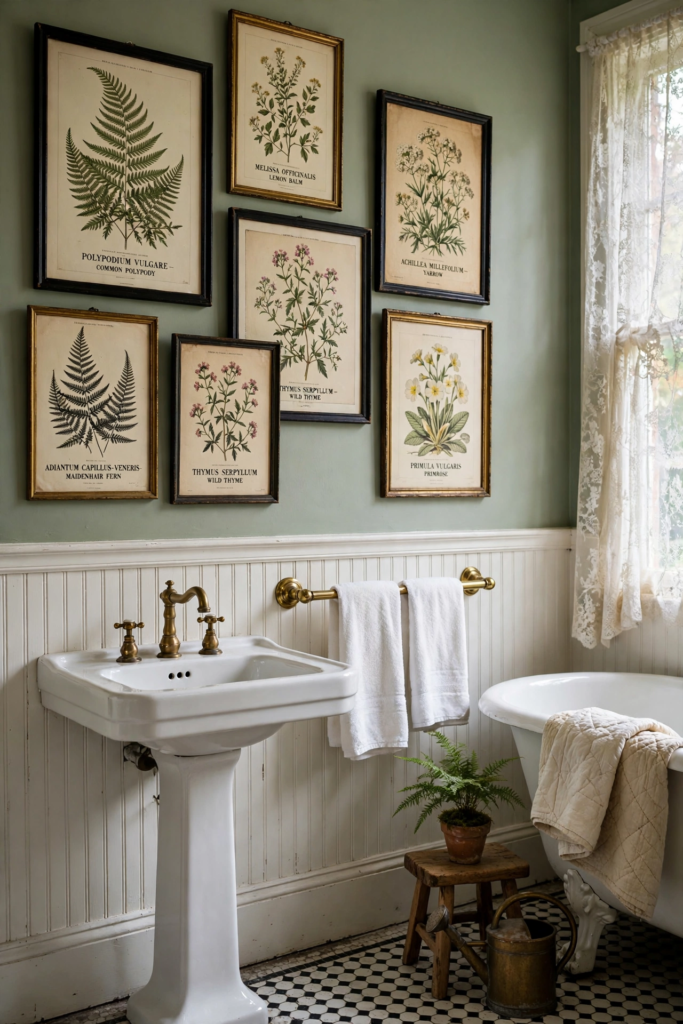
Choose prints with aged-paper backgrounds and simple black or gilt frames. A single large print makes a quiet statement; a small salon-style grouping fills an empty wall with layered interest.
Hang prints away from direct splashes — above the toilet, on the wall opposite the mirror, or in a water closet. In steamy bathrooms, choose frames with sealed backs or opt for high-quality reproductions you will not mind replacing in a decade.
Botanical art softens the room’s hard surfaces and connects it to the garden beyond. It is wall decor that feels collected over time, which is exactly the vintage ideal.
Rotate your prints with the seasons — ferns for spring, seed heads for autumn — to keep the wall feeling fresh. Store the off-duty prints flat between sheets of acid-free tissue. A small rotating gallery means the bathroom never feels static or stale. Choose frames with UV-protective glazing if the wall catches direct sun, and the colours will stay true for years.
29. Fluted Glass Cabinet Doors
Fluted or reeded glass on cabinet doors adds texture and vintage mystery. The vertical ribs obscure the cabinet’s contents into soft shapes while letting light through — practical privacy with period style.
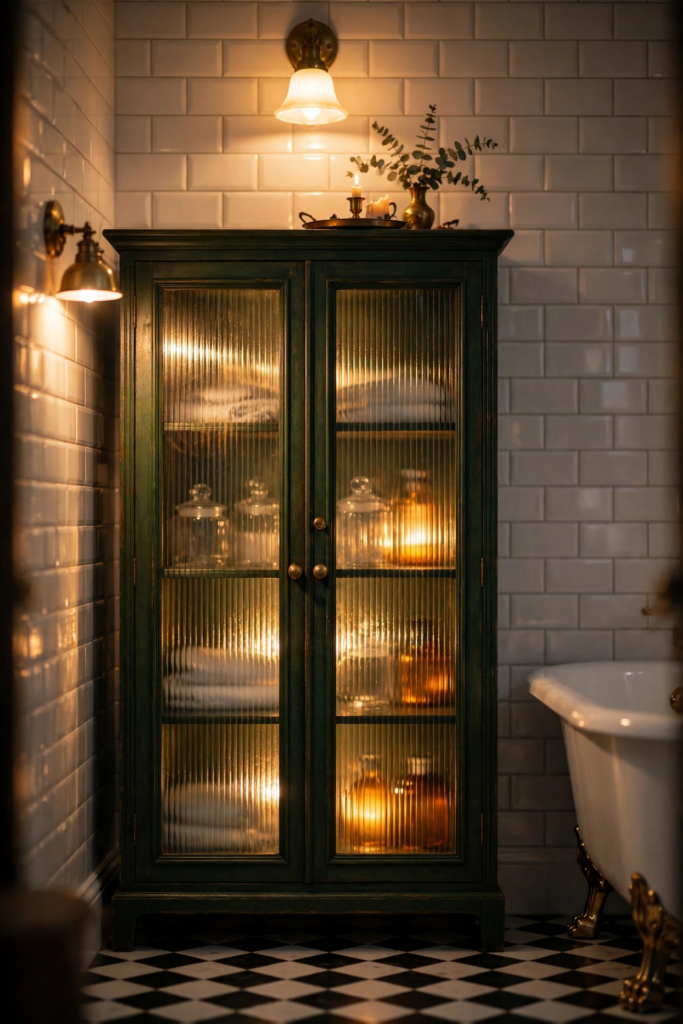
Use fluted glass on a vanity, a linen cabinet, or a wall-hung cupboard. Framed in painted wood or brass trim, it recalls the glazed cabinets of early-twentieth-century kitchens and bathrooms.
Behind the glass, keep contents tidy and tonal — folded white towels, glass jars, and simple bottles look beautiful through the fluting, while clutter turns to visual noise.
It is a small material choice with outsized effect: light, texture, and vintage character in a single detail. Fluted glass proves that even storage can be beautiful.
Clean fluted glass with a soft brush to reach into the grooves, followed by a microfibre cloth and a little vinegar solution. Avoid abrasive pads that could dull the ribbed texture. Kept clean, fluted glass catches light like nothing else in the room. Line the shelves with linen shelf paper for a soft finish that also protects the wood from damp jars.
30. Aged Copper Accent Pieces
Aged copper accents — a planter, a waste bin, a pair of wall planters, a vintage-style mirror frame — introduce a warm, rosy metal that complements brass without competing with it. Copper’s living finish deepens beautifully with age.
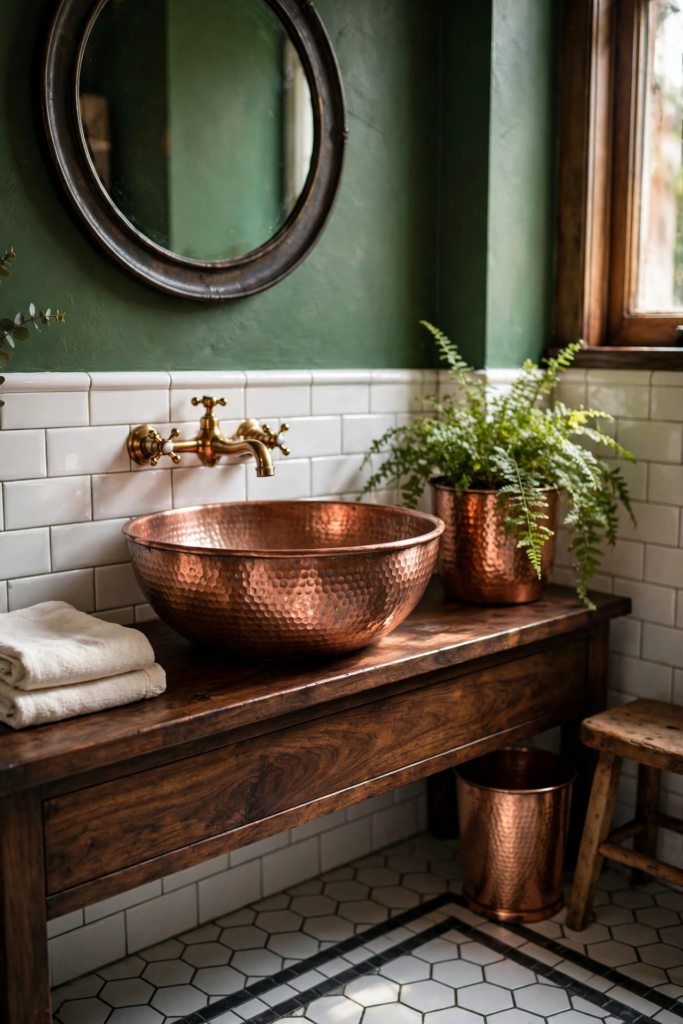
Use copper sparingly as an accent rather than a primary finish: one or two pieces are enough to warm the room. A hammered copper vessel sink is a bolder move, and a genuinely stunning one in the right setting.
Pair copper with deep greens, warm whites, and natural wood for a rich, autumnal vintage palette. The metal’s warmth is especially flattering in north-facing bathrooms that need all the glow they can get.
Maintain with an occasional gentle polish, or let it darken naturally for a more rustic feel. Either way, copper brings a handcrafted, artisanal note that rounds out the vintage bathroom perfectly.
When mixing copper with brass, keep one metal clearly dominant and the other as the accent — roughly a seventy-thirty split works beautifully. This keeps the scheme intentional rather than accidental. Restraint, as ever, is what makes vintage metalwork sing. A copper planter or two is often all it takes — let this warm metal be the exclamation point, not the paragraph.
Conclusion
A vintage bathroom is never really finished — and that is its greatest charm. Each flea-market find, each carefully chosen reproduction, each small styling tweak adds another layer to a room that grows more personal with time. The thirty ideas in this guide are starting points, not rules; the most memorable vintage bathrooms are the ones that reflect the people who use them.
Start with one anchor piece that you love — a clawfoot tub, a brass faucet set, a patterned floor — and let the rest of the room gather around it. Mix true antiques with faithful reproductions, balance bold features with quiet ones, and remember that patina is not a flaw but the whole point.
Whether you are planning a full renovation or simply swapping in a new mirror and some apothecary jars this weekend, you are taking part in a design tradition that has been beautiful for a hundred years. Here is to slow baths, warm brass, and bathrooms with stories to tell.
Key Takeaways
- Anchor the room with one hero piece — a clawfoot tub, dresser vanity, or patterned floor — then build around it.
- Choose warm metals (brass, copper) over cool chrome for instant vintage warmth and a living patina.
- Classic tile patterns — hex, subway, checkerboard, encaustic — deliver period authenticity that never dates.
- Mix genuine antiques with quality reproductions so the room feels collected, not themed.
- Layer texture through beadboard, wainscoting, lace, rugs, and fluted glass for depth and softness.
- Finish with small details — porcelain accessories, apothecary jars, botanical prints — that make the room feel considered.
- Always save the design as inspiration first: plan, budget, and verify in your own space before committing to a renovation.